ON THIS DAY ·
Russian apartment bombings
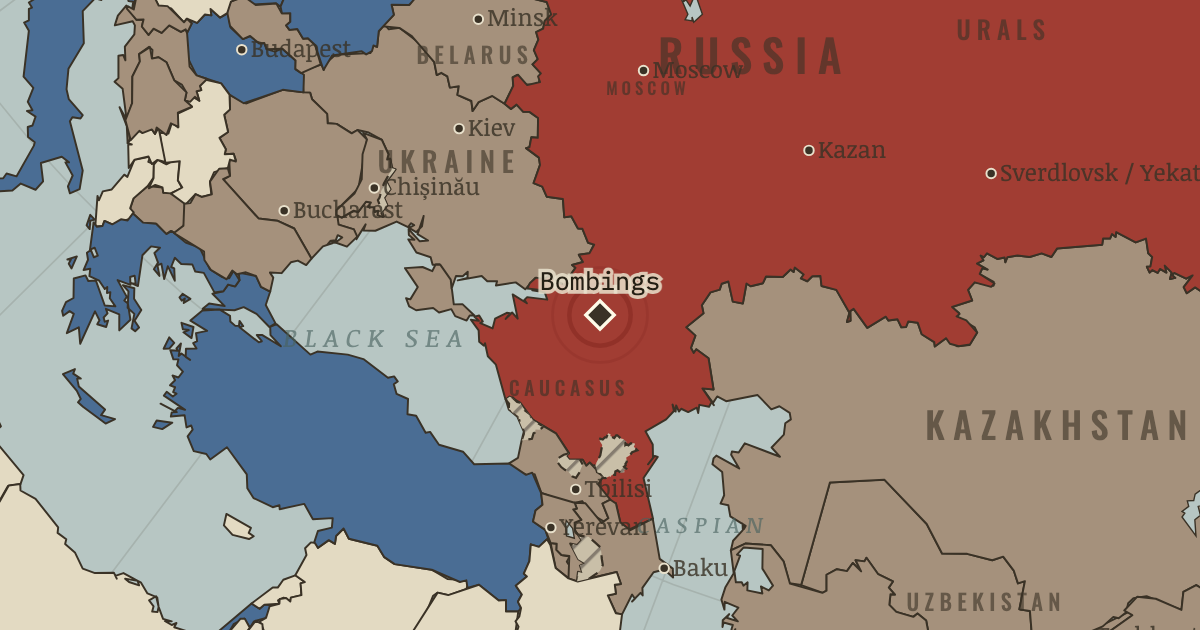
4–16 Sep 1999 — Bombs destroy apartment blocks in Buynaksk, twice in Moscow and finally here in Volgodonsk, killing about 300 people in all. The government blamed Chechen militants and launched a second war. A disputed incident in Ryazan, where security officers planted what they called a training device, has kept questions about responsibility alive.
WW2 is free — every chapter. Try chapters 1–2 of any 2 other atlases (3 with a free account). Opening a new atlas uses one of them. Membership opens all 21 — Join.
Free printable Meiji Japan and post-Soviet Russia study guide, sent by email ↓
The moment in context
War made Putin, and the way it began still divides historians. Yeltsin appointed Putin, head since 1998 of the FSB, the KGB’s successor as Russia’s security service, on 9 August 1999, two days after fighters led by Shamil Basayev entered Dagestan, the arrows crossing from Chechnya on the map. Between 4 and 16 September bombs destroyed apartment blocks in Buynaksk, Moscow and Volgodonsk, killing about 300 people. The government blamed Chechen militants, yet when residents found explosives in an apartment basement in Ryazan on 22 September and the men who planted them proved to be FSB officers, the FSB called it a training exercise; no independent inquiry has settled the questions this raised. On 1 October Russian forces entered Chechnya, and after weeks of bombardment took Grozny, which the United Nations later called the most destroyed city on earth. Putin’s promises of victory made him Russia’s most popular politician, and the war delivered him the presidency.
From Meiji and post-Soviet Russia compared, chapter 12 of Remaking the State: Meiji Japan 1600–1912 and Post-Soviet Russia 1964–2000 (2000).
The place: Russian apartment bombings — map and full story →
Teach this in 5 minutes
- Why it happened — Chechnya’s interwar chaos and the Dagestan raid. After the Khasavyurt accord, Chechnya’s elected president Aslan Maskhadov could not control field commanders such as Shamil Basayev, and kidnapping…
- The turn — Yeltsin resigns, 31 December 1999. Yeltsin’s resignation is the hinge of the epilogue because it turned a decade of open, chaotic politics into a managed succession. By resigning six…
- What it changed — The centre reclaimed the regions. Putin’s federal districts, super-regions each supervised by a presidential envoy, his control over the upper house of parliament and his demand that…
Then ask the room: To what extent did the Meiji transition succeed where the post-Soviet transition failed? The argued answer is on the chapter page →
The atlas that shows it
THE FREE PRINTABLE STUDY GUIDE
Join the Dispatch — a short welcome series, then a letter when a new atlas opens — and the printable study guide for Remaking the State is yours now, free.
NO TRACKING · YOUR ADDRESS IS USED FOR THE DISPATCH AND NOTHING ELSE · UNSUBSCRIBE ANYTIME