Meiji Japan and post-Soviet Russia · EPILOGUE ·
Meiji and post-Soviet Russia compared
Chapter 12 of Remaking the State: Meiji Japan 1600–1912 and Post-Soviet Russia 1964–2000: “Two Transitions Compared”
Russia’s decade of transition ended with a return to strong central power. Vladimir Putin, made prime minister in August 1999, led a second war in Chechnya, became acting president when Yeltsin resigned on 31 December 1999 and won the March 2000 election with 52.9%, setting up a comparison with Meiji Japan.
Chapter 12 is part of membership. WW2 is free — every chapter. Try chapters 1–2 of any 2 other atlases (3 with a free account). Opening a new atlas uses one of them. Membership opens all 21 — Join.
Free printable Meiji Japan and post-Soviet Russia study guide, sent by email ↓
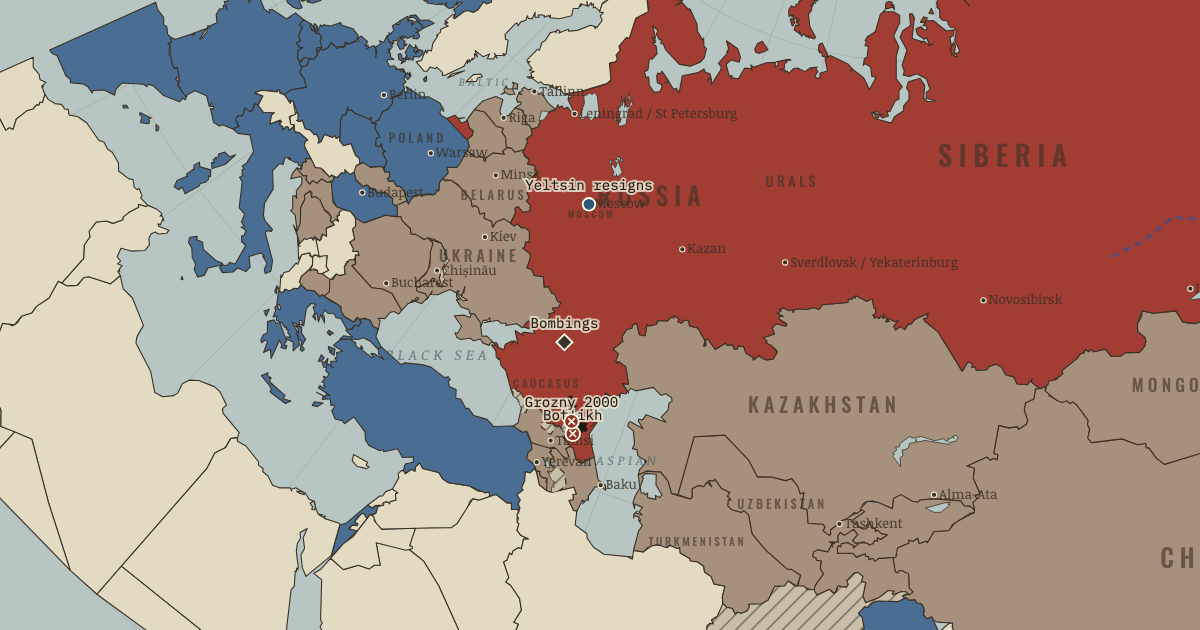
The map above is the world of Russia and the former Soviet Union, February 2000 — Grozny falls; Putin takes power.
Part of IB History: Meiji Japan and post-Soviet Russia →
BRIEF EXPLANATION — THE ESSENTIAL ARGUMENT
Russia’s decade of transition ended with a return to strong central power, and the way it happened brings this atlas back to its central question. In August 1999 Islamist fighters from Chechnya crossed into Dagestan, and two days later Yeltsin appointed a little-known former officer of the KGB, the Soviet secret police, Vladimir Putin, as prime minister. In September bombs destroyed apartment blocks in Buynaksk, Moscow and Volgodonsk, killing about 300 people, and because Putin answered with a second war in Chechnya that took Grozny by February 2000, he became the country’s most popular politician. Yeltsin resigned on 31 December 1999, which made Putin acting president and brought the election forward, and in March 2000 he won with 52.9%. Rising oil prices then refilled the budget, which paid for rebuilding what Putin called the “vertical of power”, a chain of command running from the Kremlin through governors, courts and television, much as a company might place every branch under head-office control. A war, an engineered succession and an oil windfall rebuilt the state that the 1990s had weakened.
Set side by side, the two transitions answer this atlas’s central question in three ways. Leadership mattered, because a united group can carry reform through a generation: Japan was remade by a small circle of leaders from Satsuma and Chōshū who governed together for forty years, while Russia’s change was driven by two men, Gorbachev and Yeltsin, with short horizons and a divided elite. Sequencing mattered even more, because a state that cannot tax, judge or command cannot govern a market: Japan built central authority first, then revenue, an army and industry, and granted a limited constitution last, while Russia opened politics and markets before it had such a state. The costs fell differently: Japan pushed much of its cost onto farmers without votes and then onto Taiwan and Korea, while Russia turned its costs inward, onto savers, pensioners, the sick and the borderlands. Both transitions ended with power concentrated at the top and a limited democracy. A transition is judged by what it builds and by who carries its costs, and the two answers rarely match.
The full story
War made Putin, and the way it began still divides historians. Yeltsin appointed Putin, head since 1998 of the FSB, the KGB’s successor as Russia’s security service, on 9 August 1999, two days after fighters led by Shamil Basayev entered Dagestan, the arrows crossing from Chechnya on the map. Between 4 and 16 September bombs destroyed apartment blocks in Buynaksk, Moscow and Volgodonsk, killing about 300 people. The government blamed Chechen militants, yet when residents found explosives in an apartment basement in Ryazan on 22 September and the men who planted them proved to be FSB officers, the FSB called it a training exercise; no independent inquiry has settled the questions this raised. On 1 October Russian forces entered Chechnya, and after weeks of bombardment took Grozny, which the United Nations later called the most destroyed city on earth. Putin’s promises of victory made him Russia’s most popular politician, and the war delivered him the presidency.
Putin used that mandate to restore the central state that Yeltsin had weakened. Putin’s first decree as acting president gave Yeltsin immunity from prosecution, and the early election helped Putin win in March 2000 with 52.9%. Within months he divided Russia into seven federal districts, super-regions each supervised by a presidential envoy, ordered regional laws brought into line with federal ones, so the special treaties that Tatarstan and other regions had won in the 1990s were wound down. State prosecutors pursued the independent television channel NTV, and the oligarchs, tycoons who had turned wealth into political power, were told to stay out of politics in exchange for keeping their fortunes. The map of 2000 also shows NATO, the Western military alliance led by the United States, taking in its first members from the former Soviet bloc: Poland, Hungary and the Czech Republic in blue, a move Moscow resented. The Russian state was rebuilt largely by narrowing the democracy of the 1990s.
Comparing the two cases shows why transitions succeed or fail and who pays. Both began as revolutions from above, led by members of the old elite: in Japan samurai of Satsuma and Chōshū, hereditary warrior-officials, and in the Soviet Union party reformers. Japan’s leaders faced a foreign threat that united them, so they could abolish the domains, the lords’ semi-independent territories, within three years and spend two decades building revenue, an army, industry and schools before granting a constitution that limited participation. Soviet reformers opened politics first, and because the republics gained elected parliaments before Moscow could offer them a working economy, the centre lost control of them; Russia then freed prices and sold state property before courts, taxes or regulators could govern a market, so the gains flowed to insiders. Japan’s costs fell on peasants, mill girls, the Ainu of Hokkaido and the people of annexed Ryukyu, and then on Taiwanese and Koreans; Russia’s fell on its own citizens’ savings, wages and lives, and on Chechnya and the borderlands. Japan built a strong state and exported much of its cost; Russia lost an empire, built a market and then rebuilt a strong state at the expense of its new freedoms.
DEEP EXPLANATION — EVIDENCE & INTERPRETATION
Sequencing compared: authority, revenue, participation
Political scientists have long argued about the order in which states should build institutions. Samuel Huntington’s Political Order in Changing Societies (1968) argued that states need strong institutions before they open politics to mass participation, and Japan’s sequence fits his argument: abolition of the domains in 1871, conscription and the land tax in 1873, financial stabilisation in the 1880s and a limited constitution in 1889. Russia’s sequence ran the other way, from openness and elections in 1986–89 to the collapse of the Union in 1991, price liberalisation in 1992, a constitution imposed after violence in 1993 and the reconstruction of central power in 2000. Critics such as Thomas Carothers warn that the “sequencing” argument has often been used to excuse authoritarian rulers who never get round to democracy, and Meiji Japan’s own path led to military rule in the 1930s. The comparison suggests a balanced conclusion. Japan’s order produced state capacity at the expense of democracy, while Russia’s produced freedom at the expense of capacity, then rebuilt capacity by surrendering much of that freedom.
Leaders and elites: oligarchs of two kinds
Both transitions were made by oligarchies, small groups holding power, and the difference between them is instructive. The Meiji genrō shared the formative experience of the 1860s, came mostly from two domains, rotated the premiership among themselves and checked one another, as Itō Hirobumi’s preference for parliamentary compromise checked Yamagata Aritomo’s military authoritarianism, for forty years. Ellen Kay Trimberger’s Revolution from Above argued that their independence from landowners and merchants allowed them to remake society without defending any class’s property. Russia’s transition was led by two presidents with rapidly changing teams; Yeltsin went through six heads of government in eight years. Its oligarchs were businessmen whose wealth came from the state’s weakness, and research by Olga Kryshtanovskaya and Stephen White showed how many of the new elite had been Soviet officials who converted their positions into property. Japan’s leaders sought power to build a state; many of Russia’s new elite used a weak state to build fortunes. The same word, oligarchy, describes two very different relationships between power and wealth.
Who paid: exporting and importing the costs
The COST chart compares deaths in the wars of each transition, and its pattern is striking: Japan’s internal wars of 1868–77 were small compared with the wars it fought abroad, while Russia’s heaviest military losses came inside its own borders and on its edges. The chart leaves out two larger tolls. Afghanistan, where between about half a million and 2 million Afghans died in 1979–89, belongs to the Soviet old order described in chapter 7. Russia’s mortality crisis of the 1990s, meanwhile, killed far more people than any of the transition’s wars: demographers’ estimates for the 1990s run from under 2 million to more than 3 million excess deaths, mostly among working-age men, depending on the baseline and the years counted, and longer-period estimates are higher still. Its causes are still debated by demographers. Elizabeth Brainerd and David Cutler stress alcohol and stress; David Stuckler, Lawrence King and Martin McKee linked rapid mass privatisation to rising male mortality in a 2009 study, a link other economists dispute. Japan’s costs were heavy too, from the farmers ruined in the 1880s to the colonised Koreans and Taiwanese. In both cases those who paid most were those with the least say in the decisions.
Key places on the map
On this day
Why it happened
Chechnya’s interwar chaos and the Dagestan raid. After the Khasavyurt accord, Chechnya’s elected president Aslan Maskhadov could not control field commanders such as Shamil Basayev, and kidnapping for ransom became an industry. In August 1999 Basayev and Khattab led an armed incursion into Dagestan to support a local Islamist rising. The raid gave Moscow a reason for a new war, and it allowed Russia’s leaders to present the conflict as a defence of the country against terrorism.
Yeltsin needed a successor who would protect him. By 1999 Yeltsin was ill, deeply unpopular and threatened by corruption investigations involving his family and associates. His circle searched for a successor who could win an election and guarantee the outgoing president’s safety. Putin, loyal, disciplined and unknown to the public, fitted that need, and his first decree as acting president granted Yeltsin immunity.
The 1998 crisis discredited the reformers and the oligarchs. The default destroyed savings for the second time in a decade and ended the credibility of the governments that had promised a quick transition to Western prosperity. Many Russians associated democracy and markets with chaos, theft and humiliation. That mood created demand for a leader who promised order, and it made the curbing of the oligarchs and the independent media popular with much of the public.
Oil prices rose again. World oil prices, which had fallen to around ten dollars a barrel in late 1998, roughly tripled by 2000. Revenue flowed back into the budget, wages and pensions were paid on time, and growth returned. As in the 1970s, oil gave Moscow resources that did not depend on reform, and this time the windfall helped finance the reconstruction of central power.
THE TURNING POINT
Yeltsin resigns, 31 December 1999. Yeltsin’s resignation is the hinge of the epilogue because it turned a decade of open, chaotic politics into a managed succession. By resigning six months early he made Putin acting president and moved the election forward, so that Putin could campaign as an incumbent while the war in Chechnya was popular. The transfer happened within the ruling circle, approved afterwards by voters, and it reversed the trend of the 1990s by placing the restoration of state power ahead of political competition. Russia’s transition ended, as Japan’s had begun, with authority concentrated at the centre.
What it changed
The centre reclaimed the regions. Putin’s federal districts, super-regions each supervised by a presidential envoy, his control over the upper house of parliament and his demand that regional laws match federal ones ended the bargaining federalism of the 1990s, in which each region negotiated its own deal with Moscow, and from 2005 governors were appointed instead of elected. The change echoed, in a softer form, Japan’s abolition of its domains in 1871. In both cases a weak centre became strong by taking power from the regions, though the Kremlin was reclaiming powers lost in 1990–91 while Japan’s new government seized powers no Japanese centre had ever held.
The war in Chechnya became a long insurgency. After Grozny fell, fighting continued in the mountains for years, accompanied by terrorist attacks inside Russia, and Moscow governed Chechnya through a loyal Chechen leadership under Akhmad Kadyrov and later his son Ramzan. The counter-terrorist operation was officially ended only in 2009. Human rights groups documented disappearances and killings on a large scale throughout.
Two transitions, two strong states. Meiji Japan’s emperor-centred constitution and powerful military later allowed the army to escape civilian control, and Japan’s empire expanded into China in the 1930s. Russia’s restored “vertical of power” narrowed elections, media and courts in the decades after 2000. Both transitions created states strong enough to survive, and both left limits on democracy that later leaders could exploit.
DISCUSSION QUESTION — To what extent did the Meiji transition succeed where the post-Soviet transition failed?
By the measures its leaders chose, Meiji Japan succeeded more clearly: within forty years it ended the unequal treaties, built industry, schools and a constitution, and defeated two great powers. Russia in 2000 had lost an empire, seen output fall by about 40% and suffered millions of excess deaths. Yet the comparison needs to be made with care. Russia did create a market economy, private property and a decade of competitive elections, and it grew quickly after 1999, while Japan’s success rested on authoritarian institutions, cheap labour and colonial conquest, and its state slid into militarism. Criteria matter: success for a state differs from success for its people, its minorities or its neighbours. Historians such as Carol Gluck and Stephen Kotkin warn against judging transitions only by their end points. A strong answer compares leadership, sequencing, the international setting and the distribution of costs, and reaches a judgement that names its criteria. The transferable insight is that a transition’s success depends on who is asked, and the answer of those who paid deserves equal weight.
An interesting fact
Vladimir Putin’s rise was among the fastest of any modern head of state. In June 1996 he lost his job as deputy mayor of St Petersburg when his patron, the reformist mayor Anatoly Sobchak, was defeated for re-election. He moved to a post managing Kremlin property, the department that ran the presidency’s buildings and resorts, became head of the FSB security service in July 1998, prime minister in August 1999 and acting president on 31 December 1999. Less than four years separated unemployment from the presidency, and he had never stood in an election before March 2000.
Related
THE FREE PRINTABLE STUDY GUIDE
Join the Dispatch — a short welcome series, then a letter when a new atlas opens — and the printable study guide for Remaking the State is yours now, free.
NO TRACKING · YOUR ADDRESS IS USED FOR THE DISPATCH AND NOTHING ELSE · UNSUBSCRIBE ANYTIME