ON THIS DAY ·
Assassination of Chief Waruhiu
7 Oct 1952 — The government’s leading Kikuyu chief is shot dead in his car on the Kiambu road. Thirteen days later the governor declares a State of Emergency.
WW2 is free — every chapter. Try chapters 1–2 of any 2 other atlases (3 with a free account). Opening a new atlas uses one of them. Membership opens all 21 — Join.
Free printable Haiti and Kenya independence study guide, sent by email ↓
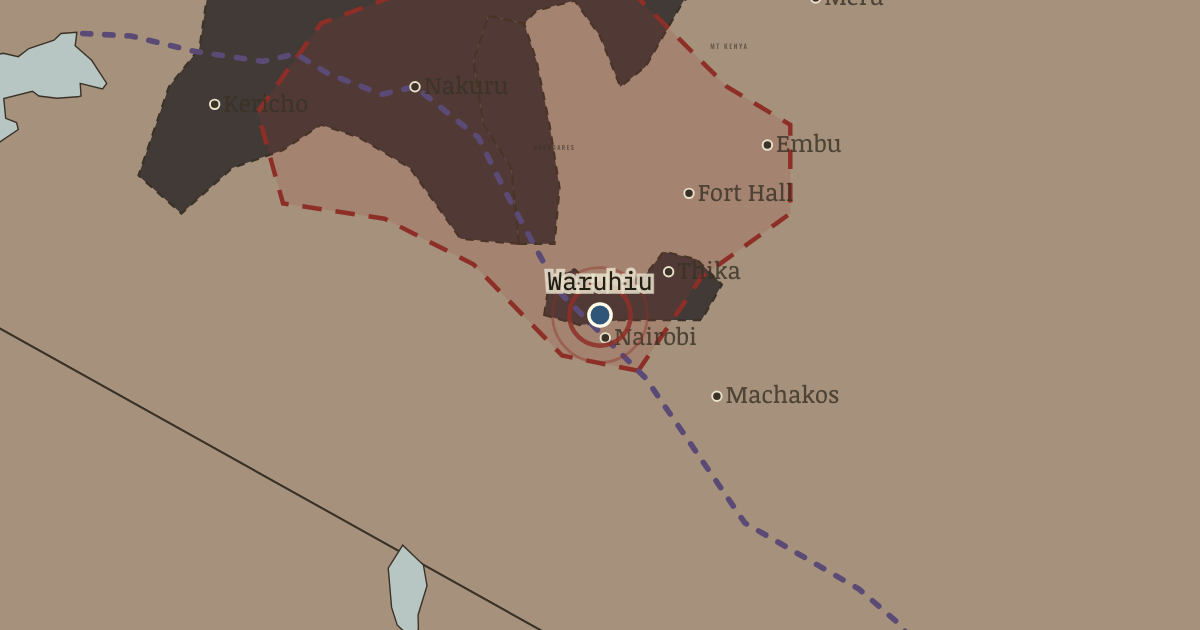
The moment in context
The Second World War widened Kenyan horizons faster than the colonial state could absorb the change. About 98,000 Kenyan Africans enlisted, most in the King’s African Rifles, the British army’s East African regiment, and the 11th (East Africa) Division fought into Burma in 1944–45. On the map, the arrow leaving Mombasa, Kenya’s main port, traces its voyage. Veterans such as Waruhiu Itote, later the forest commander “General China”, had fought beside British soldiers and seen that the colonisers were neither invincible nor uniquely brave. The Kikuyu, Kenya’s largest people and the highland farmers who had lost the most land to settlers, had lost their political voice when the government banned the Kikuyu Central Association in 1940. Veterans came home to the same pass laws, which made every African man carry the kipande, an identity document much like an internal passport, and the gap between their service and their treatment became a political force.
From Origins of the Mau Mau uprising, chapter 8 of Two Roads to Independence: Haiti 1789–1838 and Kenya 1895–1978 (1950).
The place: Assassination of Chief Waruhiu — map and full story →
Teach this in 5 minutes
- Why it happened — Petitions that won nothing. Moderate politics failed to deliver anything a landless family could see. KAU asked for elected African seats and the return of alienated land, the…
- The turn — The Kiambu road, 7 October 1952. The killing of Senior Chief Waruhiu is the hinge because it drove both sides to violence. Waruhiu was the government’s most prominent Kikuyu ally,…
- What it changed — The Emergency begins. The State of Emergency declared on 20 October 1952 gave the government powers to detain without trial, ban meetings and later to shoot on sight in…
Then ask the room: Why did constitutional nationalism fail to contain the oath between 1946 and 1952? The argued answer is on the chapter page →
The atlas that shows it
THE FREE PRINTABLE STUDY GUIDE
Join the Dispatch — a short welcome series, then a letter when a new atlas opens — and the printable study guide for Two Roads to Independence is yours now, free.
NO TRACKING · YOUR ADDRESS IS USED FOR THE DISPATCH AND NOTHING ELSE · UNSUBSCRIBE ANYTIME