ON THIS DAY ·
China’s first nuclear test
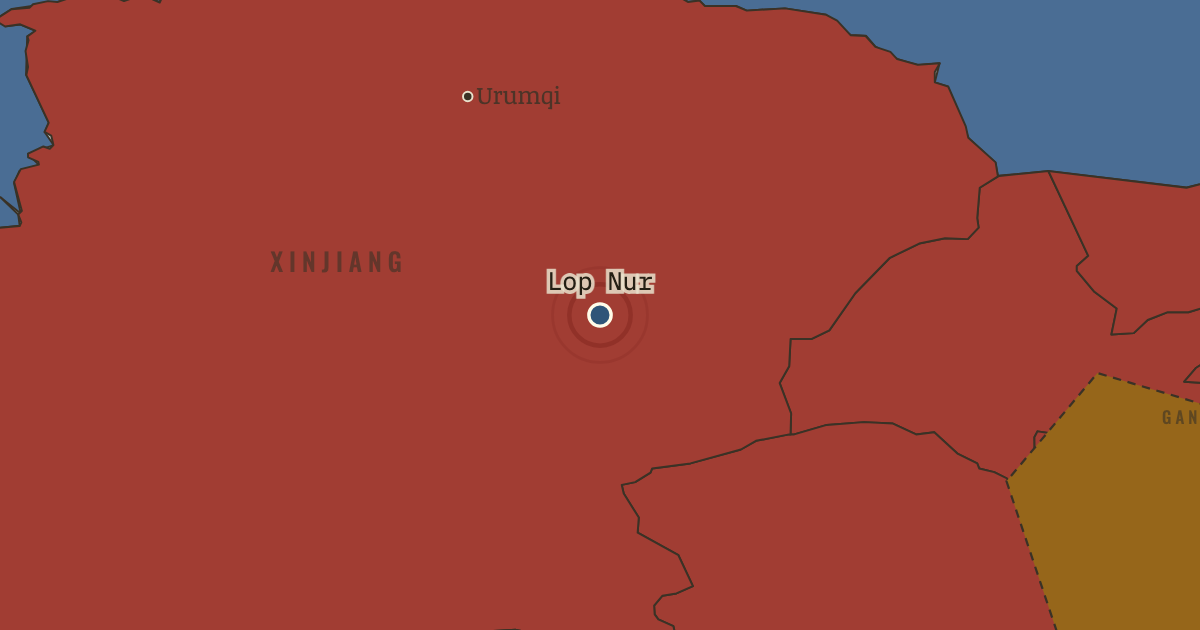
16 Oct 1964 — China explodes its first atomic bomb in the Xinjiang desert. The device was codenamed 596, after June 1959, the month Moscow reneged on its promise to supply a sample bomb. It came two days after Khrushchev’s fall, and it made China the fifth nuclear power, largely without the help it had been promised.
WW2 is free — every chapter. Try chapters 1–2 of any 2 other atlases (3 with a free account). Opening a new atlas uses one of them. Membership opens all 21 — Join.
The moment in context
The retreat from the Great Leap Forward, Mao’s failed drive of 1958 that ended in famine, worked because leaders finally saw the countryside for themselves. In the spring of 1961 Liu Shaoqi, head of state and second only to Mao in the Communist Party that ran every level of government, spent 44 days in rural Hunan and found empty granaries and peasants who blamed the disaster on officials and their orders. The mess halls closed, farming units shrank to the production team of a few dozen households, and peasants could again raise pigs, tend private plots and sell at markets. In Anhui its leader Zeng Xisheng allowed “responsibility fields”, in which a household contracted to farm a plot and kept what it produced above a quota, much like a tenant who pays a fixed rent and keeps the rest. Deng Xiaoping, the Party’s general secretary, defended such methods in July 1962 with a Sichuan proverb: it does not matter whether a cat is yellow or black, as long as it catches mice. Food production recovered quickly because peasants again had a reason to work hard.
From Recovery after the Great Leap, chapter 8 of The People’s Republic under Mao, 1949–1976 (1964).
The place: China’s first nuclear test — map and full story →
Teach this in 5 minutes
- Why it happened — The famine could no longer be denied. The evidence of mass death from places such as Xinyang had reached Beijing by 1960–61 through the Party’s own investigators, and grain had to be…
- The turn — The Seven Thousand Cadres Conference, January 1962. The conference was the hinge because the frankness that made the recovery possible also convinced Mao that his colleagues might one day repudiate…
- What it changed — Mao turns on the Party. The Socialist Education Movement and the Twenty-three Articles of January 1965 pointed Mao’s suspicion at “power-holders” inside the Party. In 1966…
Then ask the room: Why did the recovery of 1961–65 lead to the Cultural Revolution instead of to lasting reform? The argued answer is on the chapter page →
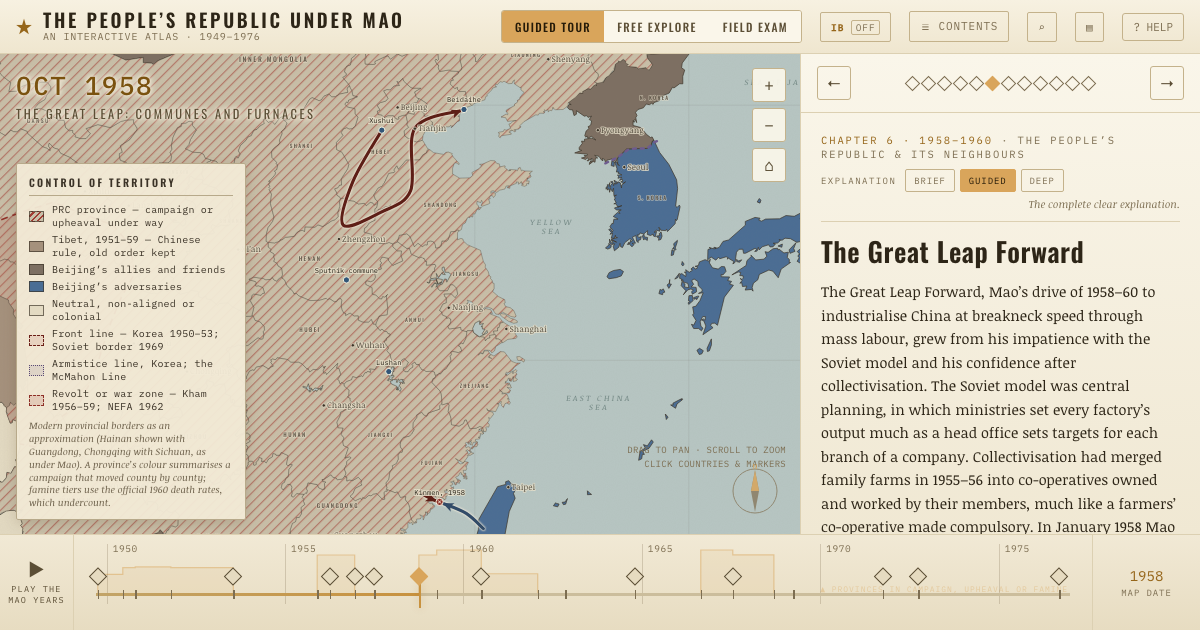
The atlas that shows it
THE FREE PRINTABLE STUDY GUIDE
Join the Dispatch — a short welcome series, then a letter when a new atlas opens — and the printable study guide for The People’s Republic under Mao is yours now, free.
NO TRACKING · YOUR ADDRESS IS USED FOR THE DISPATCH AND NOTHING ELSE · UNSUBSCRIBE ANYTIME