ON THIS DAY ·
Opening of the Suez Canal
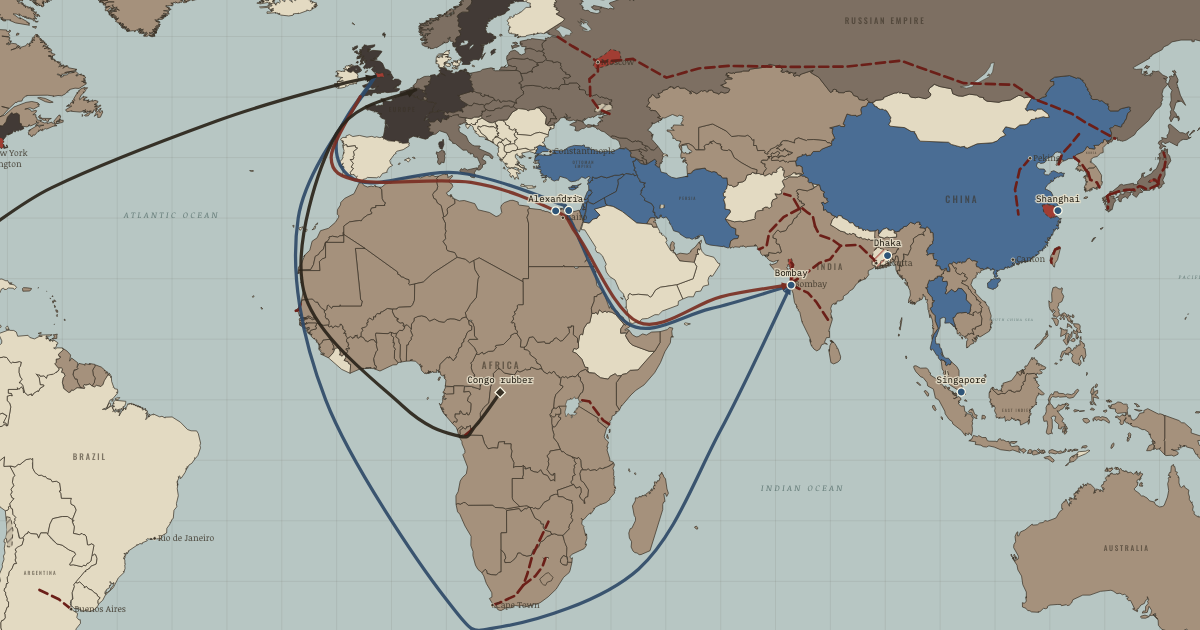
The Suez Canal opens, cutting the sea route from London to Bombay by about 40 per cent and making the passage to Asia a steamship route.
WW2 is free — every chapter. Try chapters 1–2 of any 2 other atlases (3 with a free account). Opening a new atlas uses one of them. Membership opens all 21 — Join.
Free printable Industrial Revolution study guide, sent by email ↓
The moment in context
Three technologies shrank the world after 1850, and the arrows on the map trace them. Iron steamships with compound engines, which used their steam twice to save coal, made long ocean voyages reliable and cheap from the 1860s, and coaling stations such as Singapore refuelled them. The Suez Canal, opened on 17 November 1869, cut the distance from London to Bombay from about 10,700 to 6,300 nautical miles. The telegraph carried information faster than any ship: a cable across the Atlantic worked from 1866, and in 1870 a line from Porthcurno in Cornwall to Bombay carried in minutes messages that had taken weeks by mail. London investors could now manage mines and railways on other continents. Because the prices of grain, cotton and cloth now converged across oceans, a producer’s real competitors could for the first time be on the far side of the world.
From Great Divergence and global trade, chapter 11 of The Industrial Revolution, 1750–1914 (1913).
Teach this in 5 minutes
- Why it happened — Steam and cable shrank distance. Steamships and undersea cables cut the cost of moving goods and messages so far that distance stopped protecting local markets. Compound engines,…
- The turn — The Suez Canal, 17 November 1869. The opening of the Suez Canal is the hinge because it fused the steamship, the empire and the world market into a single system. It cut the voyage…
- What it changed — Nationalism grows from economic grievance. Economic grievance gave Indian nationalism its sharpest argument. The Indian nationalist Dadabhai Naoroji argued that British rule drained India’s…
Then ask the room: Was the impoverishment of regions such as India the result of industrial competition or of imperial rule? The argued answer is on the chapter page →
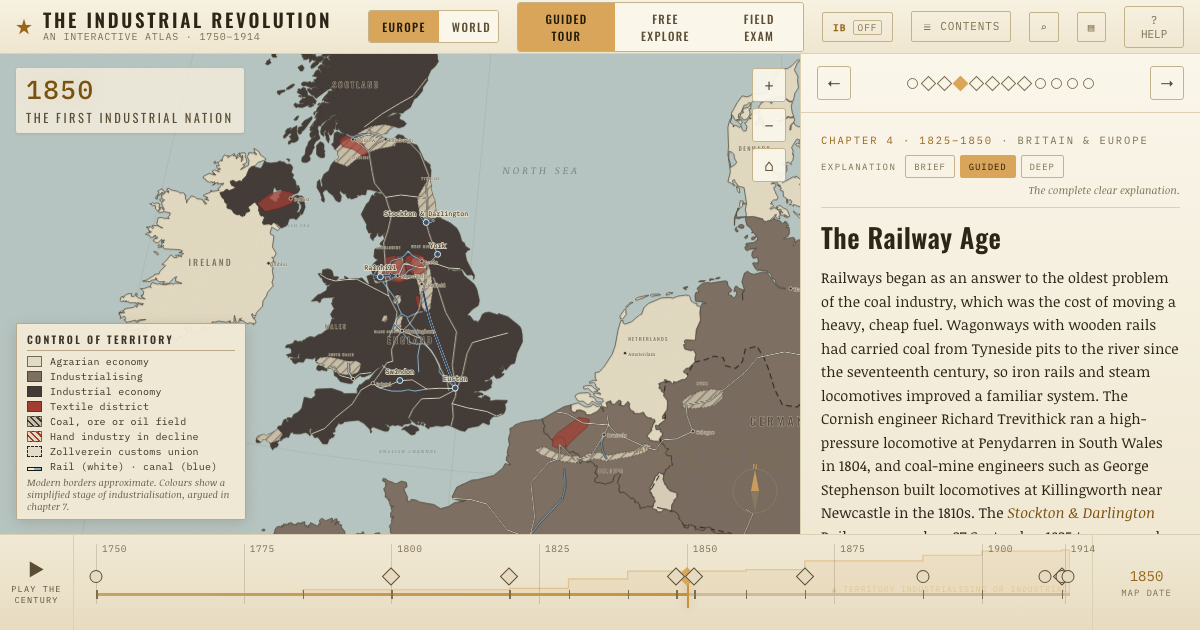
The atlas that shows it
THE FREE PRINTABLE STUDY GUIDE
Join the Dispatch — a short welcome series, then a letter when a new atlas opens — and the printable study guide for The Industrial Revolution is yours now, free.
NO TRACKING · YOUR ADDRESS IS USED FOR THE DISPATCH AND NOTHING ELSE · UNSUBSCRIBE ANYTIME