Industrial Revolution · CHAPTER 11 ·
Great Divergence and global trade
Chapter 11 of The Industrial Revolution, 1750–1914: “A Global Transformation”
After 1850 steamships, the telegraph and the Suez Canal, opened in 1869, joined the world into one economy organised around the industrial countries. Britain opened markets through what historians call the imperialism of free trade, while most of Asia and Africa became colonies or were bound by unequal treaties.
Chapter 11 is part of membership. WW2 is free — every chapter. Try chapters 1–2 of any 2 other atlases (3 with a free account). Opening a new atlas uses one of them. Membership opens all 21 — Join.
Free printable Industrial Revolution study guide, sent by email ↓
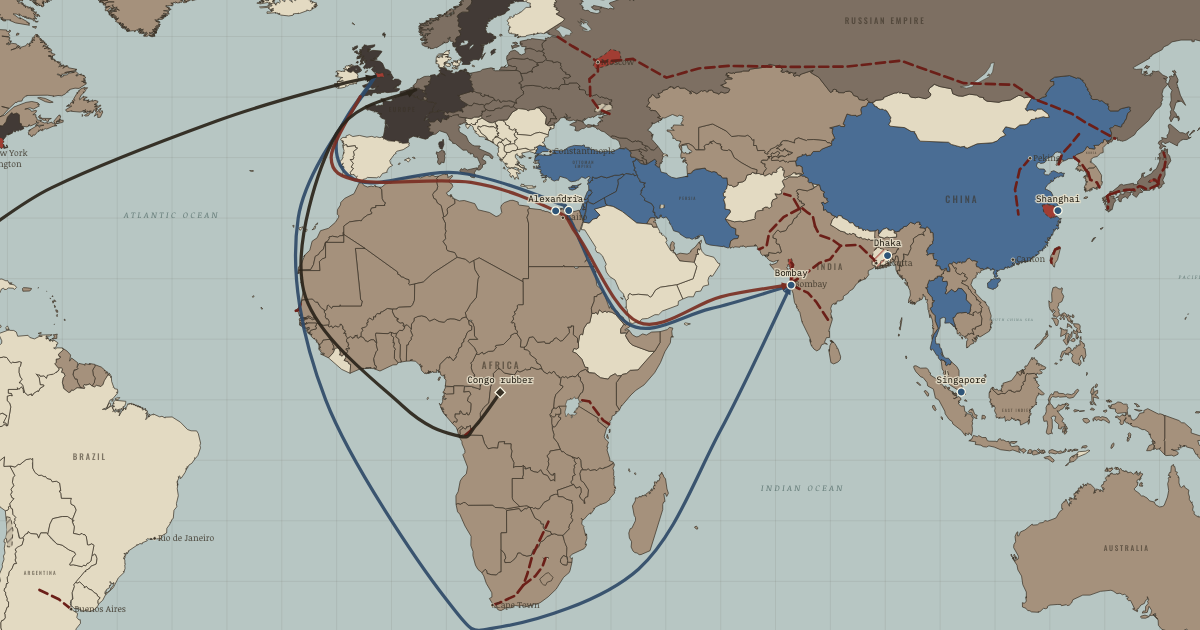
The map above is the world of The industrial world, 1913 — The first global economy.
Part of IB History: The Industrial Revolution →
BRIEF EXPLANATION — THE ESSENTIAL ARGUMENT
Steam, the telegraph and new canals joined the world into a single economy in the decades after 1850, and that economy was organised around the needs of the industrial countries. Steamships carried goods and people across the oceans on timetables, and the Suez Canal, opened in 1869, cut the sea route from Britain to India by about 40 per cent. From 1870 undersea telegraph cables carried messages from London to Bombay in minutes, so a merchant could order cotton, and a government could order troops, almost at once. The industrial powers sold manufactures and bought raw materials, while most of Asia and Africa became colonies, painted tan on the map, or were opened by unequal treaties, painted blue. Unequal treaties were agreements forced on weaker states that fixed low taxes on imports and gave foreigners legal privileges, much like a contract signed under threat. Historians call the result the first globalisation, like the integration of world markets since the 1990s, though this one was enforced by gunboats and empire.
Integration created winners and losers, and the map shows both. India’s handloom weavers, who wove by hand, especially around Dhaka, lost their export markets to machine-made cloth. Historians call this deindustrialisation, the loss of a region’s industry, much as the American Rust Belt lost its steel towns after the 1970s, although Indian merchants built their own mills at Bombay from 1854. In the Congo Free State, a colony owned personally by King Leopold II of Belgium, agents forced Congolese villagers to gather rubber for tyres and cables through hostage-taking and violence; estimates of the population loss run from about one to ten million, and the map marks it as a memorial. By 1900 Europe and the United States made about 85 per cent of the world’s manufactured goods. Historians call this widening gap between the industrial West and the rest of the world the Great Divergence, and it turned the modest difference of 1750 into a chasm.
The full story
Three technologies shrank the world after 1850, and the arrows on the map trace them. Iron steamships with compound engines, which used their steam twice to save coal, made long ocean voyages reliable and cheap from the 1860s, and coaling stations such as Singapore refuelled them. The Suez Canal, opened on 17 November 1869, cut the distance from London to Bombay from about 10,700 to 6,300 nautical miles. The telegraph carried information faster than any ship: a cable across the Atlantic worked from 1866, and in 1870 a line from Porthcurno in Cornwall to Bombay carried in minutes messages that had taken weeks by mail. London investors could now manage mines and railways on other continents. Because the prices of grain, cotton and cloth now converged across oceans, a producer’s real competitors could for the first time be on the far side of the world.
The world economy that resulted divided the industrial exporters of manufactures and capital from the suppliers of raw materials and food. Britain enforced the division through what the historians John Gallagher and Ronald Robinson called the imperialism of free trade: opening markets through treaties and gunboats where possible, and by conquest only where necessary, much as powerful states today steer weaker ones with sanctions and loans. The Opium War, fought by Britain after China tried to stop British merchants selling Indian opium, forced China to open its ports in 1842, and the treaty port of Shanghai, where foreigners traded and lived under their own laws, became its first industrial city. Treaties of 1838–41 forced the Ottoman Empire and Egypt to lower tariffs, their taxes on imports, ending the attempt by Muhammad Ali, Egypt’s ruler from 1805 to 1848, to build state cotton mills. The cotton famine of 1861–65, when the American Civil War cut off Southern cotton, showed the system’s reach: Lancashire’s mills fell idle, while growers in India and Egypt, shipping through Bombay and Alexandria, enjoyed a boom that collapsed when the war ended. A war in America could now ruin spinners in Lancashire and enrich farmers in Gujarat and the Nile delta.
The costs of integration fell unevenly, and the map marks the sharpest of them. In India, Lancashire’s machine-made cloth destroyed the export trade of Bengal’s weavers: Dhaka, which may have held 150,000 people or more around 1800, had shrunk to about 50,000 by 1840. Yet Indian entrepreneurs, many of them Parsis, descendants of religious refugees from Persia, built cotton mills at Bombay from 1854, and India had about 260 to 270 by 1914. In Africa, the demand for rubber after the invention of the air-filled tyre led the Congo Free State, a colony owned personally by King Leopold II of Belgium, to force villagers to gather wild rubber through hostage-taking, mutilation and killing; the population losses are disputed, from about one million to perhaps ten million people. By 1900 Europe and the United States made about 85 per cent of the world’s manufactured goods, against about 23 per cent in 1750. That widening gap, which historians call the Great Divergence, was the period’s largest economic legacy.
DEEP EXPLANATION — EVIDENCE & INTERPRETATION
Did Britain deindustrialise India?
Whether British rule destroyed Indian industry has been argued for more than a century, and Indian nationalists made the charge first. The nationalist Dadabhai Naoroji’s Poverty and Un-British Rule in India (1901) and R. C. Dutt’s economic histories argued that British rule drained India’s wealth and destroyed its industries. The economist Amiya Kumar Bagchi supported them with evidence from Bihar in the Ganges valley, where the share of the population dependent on industry fell from about 18.6 per cent in the surveys of 1809–13 to about 8.5 per cent in 1901, with spinners and weavers making up most of the loss. The historians Morris D. Morris and later Tirthankar Roy questioned the scale of the collapse: Roy shows that weaving by hand survived by moving into coarse cloth and specialised fabrics that machines could not easily copy, so decline meant adaptation as well as ruin. The economists David Clingingsmith and Jeffrey Williamson (2008) offered a two-stage explanation. The break-up of the Mughal empire, which had ruled most of India since the 1500s, and droughts in the eighteenth century raised food prices and wages, making Indian textiles less competitive even before Lancashire’s machines arrived, and British factory productivity then finished the job. Colonial policy shaped the result, since Britain kept India’s import taxes low and in 1896 taxed Indian mill cloth to match the duty on British imports. The debate has moved from whether decline happened to how it was distributed.
Measuring the Great Divergence
The Great Divergence is usually measured with two kinds of reconstruction, and both have wide margins of error. The economic historian Paul Bairoch estimated shares of world manufacturing output: China about 33 per cent and the Indian subcontinent about 25 per cent in 1750, falling to about 6 and under 2 per cent by 1900, while Britain rose from about 2 to a peak of about 23 per cent in 1880. The economist Angus Maddison estimated income per person, and his figures suggest that western Europe was already richer than China and India by 1820 and several times richer by 1913. The two series answer different questions, since a country can make a large share of the world’s goods because it has many people while remaining poor per person. Scholars of the so-called California school, named for the universities where several of them taught, among them Kenneth Pomeranz, Roy Bin Wong and Jack Goldstone, place the divergence late, after 1750 or even 1800, and stress coal and colonies. Others, including the economic historians David Landes and Stephen Broadberry, find a gap in wages and productivity well before 1750 and stress institutions, such as laws and property rights, and culture. The dates matter, because a late divergence points to advantages of luck and circumstance, while an early one points to deeper differences between societies.
Free trade, gunboats and informal empire
Britain’s power in this period reached far beyond the lands it formally ruled, and historians still argue about what drove it. The historians John Gallagher and Ronald Robinson argued in 1953 that British expansion was continuous, preferring trade with informal control where possible and imposing rule only where necessary. Informal empire, meaning influence over independent states through treaties, debt and gunboats, covered much of Latin America, China and the Ottoman world, and this atlas paints it blue as opened by force or treaty. China’s maritime customs, the service that taxed its foreign trade, were run by a Briton, Robert Hart, from 1863, and from 1881 European lenders controlled part of Ottoman revenue through the Ottoman Public Debt Administration. Egypt’s debts, about £91 million by 1876, led first to Anglo-French financial control and then to British occupation in 1882. Critics have tested the thesis against the evidence. The historian D. C. M. Platt argued that the British government rarely intervened for traders in Latin America, and the historians P. J. Cain and A. G. Hopkins’ British Imperialism (1993) argued that the main driving force was finance and services centred on the City of London, the capital’s financial district, a view they called gentlemanly capitalism. The debate turns on whether industry needed empire, or whether empire served bankers and investors whose interests differed from the mills’.
Key places on the map
On this day
Why it happened
Steam and cable shrank distance. Steamships and undersea cables cut the cost of moving goods and messages so far that distance stopped protecting local markets. Compound engines, which used their steam twice, cut the coal a steamship burned, iron and later steel hulls made ships larger, and coaling stations from Gibraltar to Singapore refuelled them. Undersea cables, insulated with gutta-percha, a latex from Malayan trees, carried telegraph messages beneath the oceans. Bulky goods such as grain and cotton could now be traded profitably across the world, the global version of what railways had done for Britain.
Industry demanded raw materials. Factories in Europe and the United States consumed cotton, jute, wool, rubber, copper, tin, palm oil and grain on a scale no local supply could meet. Lubricants and soap for industrial Europe came from West African palm oil, sacks for the world’s grain from Bengal jute, tyres from Congo and Amazon rubber. The search for these materials pulled distant regions into the industrial economy as suppliers, on terms they rarely set.
Free trade backed by force. Britain preached free trade, commerce with few barriers, and, where rulers refused it, imposed it. The Opium War, fought after China tried to stop British opium sales, opened China in 1842, treaties forced low import taxes on the Ottoman Empire, Egypt, Persia, Siam (now Thailand) and Japan, and the colonial government kept India’s import taxes low on British goods. The historians Gallagher and Robinson called this the imperialism of free trade, meaning control through trade and treaties where possible and conquest where necessary. Open markets for industrial goods were often the first demand a gunboat made.
Capital from London. London’s capital shaped what the rest of the world built: British investors held about £4 billion of overseas assets by 1914, much of it in railways, ports, mines and government bonds, or loans to governments. In India the colonial government guaranteed railway companies a return of about five per cent, paid from Indian taxes, so British investors bore little risk. Capital went where profits and political security lay, so it built the railways and ports that carried raw materials out, and few of the factories that might have competed with Britain’s.
THE TURNING POINT
The Suez Canal, 17 November 1869. The opening of the Suez Canal is the hinge because it fused the steamship, the empire and the world market into a single system. It cut the voyage between Britain and India by about 40 per cent and made the route to Asia a steamship route, since sailing ships found the Red Sea’s winds and the narrow canal almost impossible. Within a year the telegraph to Bombay ran alongside it. The canal became so vital to Britain that it bought the Egyptian ruler’s shares in 1875 and occupied Egypt in 1882, a sequence in which economic integration led to political control.
What it changed
Nationalism grows from economic grievance. Economic grievance gave Indian nationalism its sharpest argument. The Indian nationalist Dadabhai Naoroji argued that British rule drained India’s wealth, and the Indian National Congress, a party of educated Indians founded in 1885 that later led the independence movement, took up the charge. In 1905 the swadeshi movement in Bengal, whose name means ‘of one’s own country’, boycotted British cloth and urged Indians to buy Indian goods. The cloth that had once marked India’s loss became a weapon of its resistance.
A world of migrants. Steamships made mass migration cheap, because a voyage that had taken six weeks under sail now took about ten days. Tens of millions of Europeans crossed the Atlantic, and Indian and Chinese workers moved to plantations and mines across the tropics, many under indenture, a contract binding them to an employer for years. The epilogue’s arrows trace these movements and ask who gained from them, and who was carried away from home by debt and coercion. Cheap passages let labour move to wherever capital needed it, which redrew the population of whole continents.
The Great Divergence hardens. The Great Divergence, the gap between the West and the rest, became part of the world economy’s structure: by 1900 Europe and the United States made about 85 per cent of the world’s manufactured goods, and the income gap between the industrial core and most of Asia and Africa had widened enormously. Historians still debate how much of it came from industrial competition and how much from empire. A gap that had been modest in 1750 now separated the countries that made goods from those that supplied them, and it would take a century to begin closing.
DISCUSSION QUESTION — Was the impoverishment of regions such as India the result of industrial competition or of imperial rule?
Industrial competition did real and lasting damage. Lancashire’s machines made cloth so cheaply that Bengal’s weavers lost their export markets, and the economists Clingingsmith and Williamson argue that India’s share of world manufacturing would have fallen steeply even under Indian rule, since India’s own wages and food prices had risen after the Mughal empire, which had ruled most of India, fragmented and droughts struck. Imperial rule shaped how the damage fell. The colonial government kept import taxes low on British goods and from 1896 taxed Indian mill cloth, guaranteed British railway investors their returns from Indian taxes, and paid for an army and administration that nationalists such as Naoroji called a drain. The historian Tirthankar Roy warns against assuming total ruin, since weaving by hand adapted and Indian-owned mills grew. A balanced answer is that industrial technology made the decline of Indian hand industry likely, and empire removed the tools, such as taxes on imports and an investing state, that Germany, the United States and Japan used to industrialise. Competition set the challenge, and political power decided who could answer it.
An interesting fact
Steam made the whole world a journey of weeks: in 1889–90 the American journalist Nellie Bly travelled around it in 72 days, beating the fictional record of Phileas Fogg in Jules Verne’s novel Around the World in Eighty Days (1872). Her route was a tour of this chapter’s map: steamers through the Suez Canal to Ceylon (now Sri Lanka), Singapore and Hong Kong, a crossing of the Pacific to San Francisco, and a train across the United States. Verne could plot an eighty-day circuit only because the Suez Canal opened in 1869 and a railway first crossed India from Bombay to Calcutta in 1870, so even the era’s fiction ran on its new infrastructure.
Related
THE FREE PRINTABLE STUDY GUIDE
Join the Dispatch — a short welcome series, then a letter when a new atlas opens — and the printable study guide for The Industrial Revolution is yours now, free.
NO TRACKING · YOUR ADDRESS IS USED FOR THE DISPATCH AND NOTHING ELSE · UNSUBSCRIBE ANYTIME