ON THIS DAY ·
Self-immolation of Mohamed Bouazizi
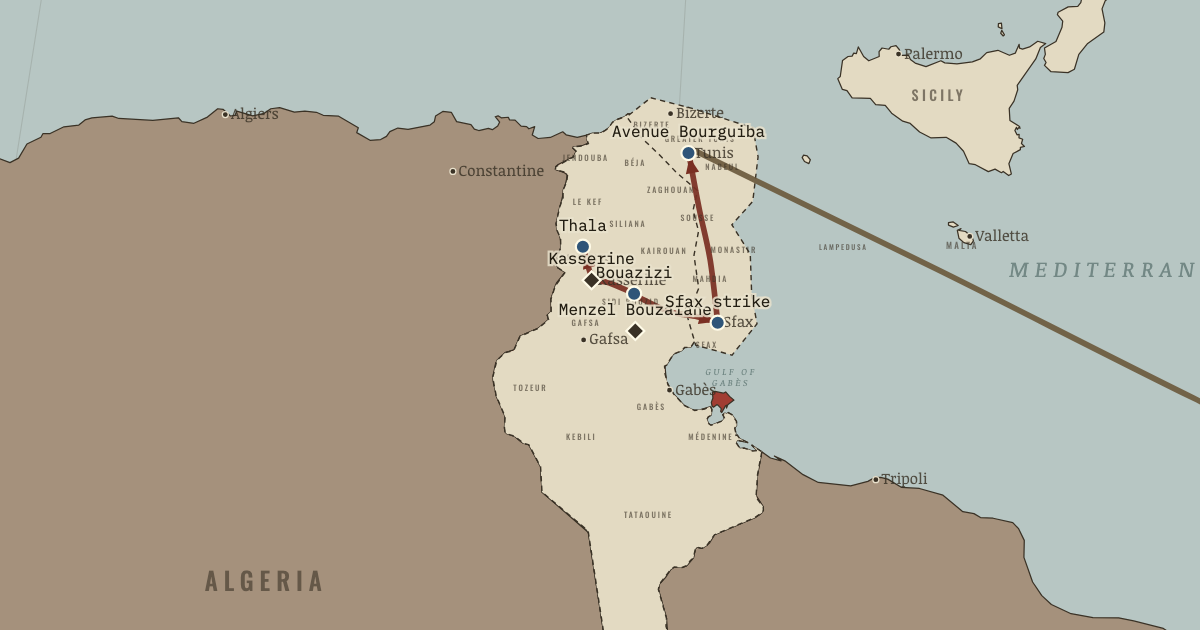
In Sidi Bouzid, Tunisia, the street vendor Mohamed Bouazizi sets himself on fire after officials confiscate his scales. Twenty-eight days later Ben Ali flees the country.
WW2 is free — every chapter. Try chapters 1–2 of any 2 other atlases (3 with a free account). Opening a new atlas uses one of them. Membership opens all 21 — Join.
Free printable Feminism and the Tunisian Revolution study guide, sent by email ↓
The moment in context
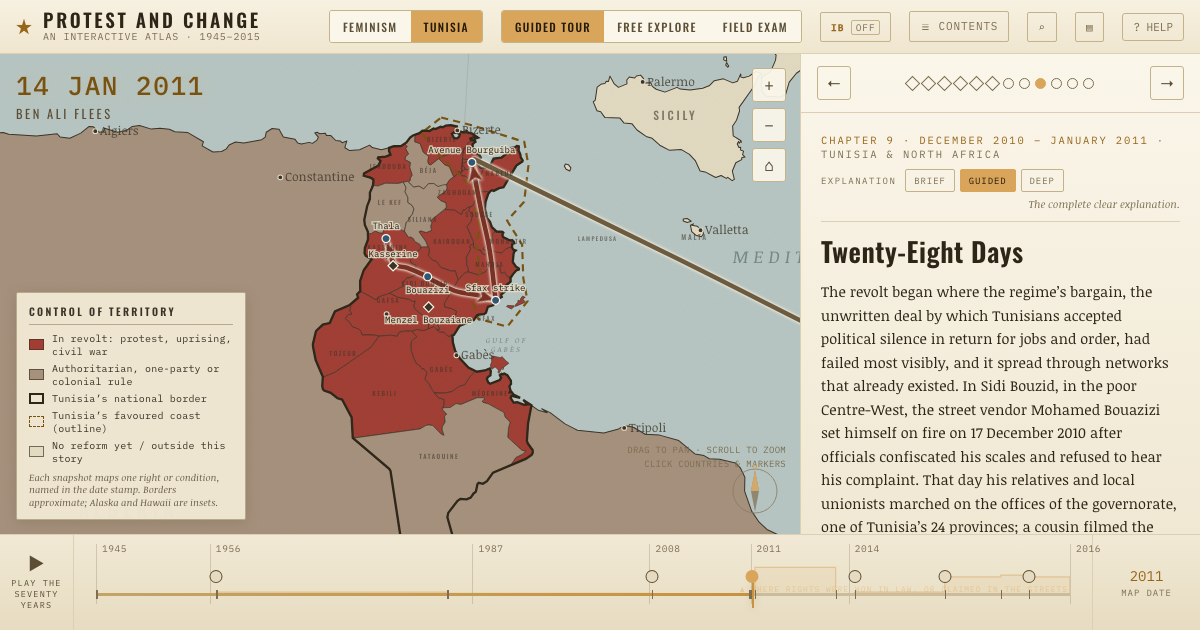
The revolt began where the regime’s bargain, the unwritten deal by which Tunisians accepted political silence in return for jobs and order, had failed most visibly, and it spread through networks that already existed. In Sidi Bouzid, in the poor Centre-West, the street vendor Mohamed Bouazizi set himself on fire on 17 December 2010 after officials confiscated his scales and refused to hear his complaint. That day his relatives and local unionists marched on the offices of the governorate, one of Tunisia’s 24 provinces; a cousin filmed the protest, and the footage reached Al Jazeera, which Tunisians watched by satellite. On 24 December the National Guard, a paramilitary police force, shot dead Mohamed Ammari, aged 18, in Menzel Bouzaiane, where a memorial marks the place. He was the first of the uprising’s martyrs, the name Tunisians give to those killed by the security forces. By 31 December protests had reached the eleven governorates coloured red in the second snapshot. Revolutions rarely start from nothing; they borrow the organisations that already exist.
From Tunisian Revolution, chapter 9 of Protest and Change: Second-Wave Feminism and Tunisia, 1945–2015 (2011).
Teach this in 5 minutes
- Why it happened — Blocked hopes in the interior. The revolt began in the interior because hope had been blocked there longest: Sidi Bouzid, Kasserine and Gafsa had unemployment far above the…
- The turn — The Sfax general strike, 12 January 2011. Bouazizi’s act lit the uprising, but the general strike in Sfax is the hinge, because it was the moment the revolt of the poor interior became a…
- What it changed — A dictator falls in four weeks. Ben Ali’s flight on 14 January ended 23 years of his rule and 55 years of one-party government. The interim authorities, led at first by figures of…
Then ask the room: Why did the protests that failed in the Gafsa mining basin in 2008 succeed in bringing down Ben Ali in 2010–11? The argued answer is on the chapter page →
The atlas that shows it
THE FREE PRINTABLE STUDY GUIDE
Join the Dispatch — a short welcome series, then a letter when a new atlas opens — and the printable study guide for Protest and Change is yours now, free.
NO TRACKING · YOUR ADDRESS IS USED FOR THE DISPATCH AND NOTHING ELSE · UNSUBSCRIBE ANYTIME