Feminism and the Tunisian Revolution · CHAPTER 9 ·
Tunisian Revolution
Chapter 9 of Protest and Change: Second-Wave Feminism and Tunisia, 1945–2015: “Twenty-Eight Days”
On 17 December 2010 the street vendor Mohamed Bouazizi set himself on fire in Sidi Bouzid after officials confiscated his scales, and protests spread from the interior to Tunis, Sfax and Sousse. Police killed protesters in Kasserine, Thala and Regueb, and after twenty-eight days the 23-year rule of President Ben Ali fell.
Chapter 9 is part of membership. WW2 is free — every chapter. Try chapters 1–2 of any 2 other atlases (3 with a free account). Opening a new atlas uses one of them. Membership opens all 21 — Join.
Free printable Feminism and the Tunisian Revolution study guide, sent by email ↓
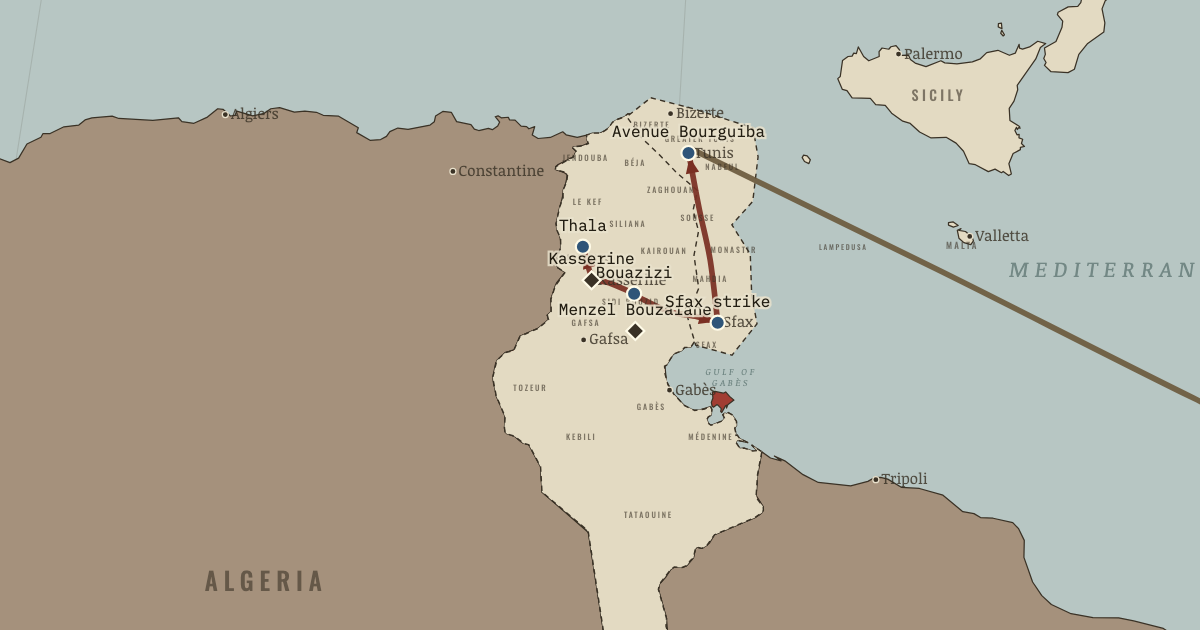
The map above is the world of Tunisia, 14 January 2011 — Ben Ali flees.
Part of IB History: Second-wave feminism and Tunisia →
BRIEF EXPLANATION — THE ESSENTIAL ARGUMENT
In twenty-eight days a protest in one interior town brought down the 23-year dictatorship of President Zine el-Abidine Ben Ali, and the map’s sequence of snapshots shows how, governorate by governorate (Tunisia’s 24 provinces, much like counties), from the neglected interior to the favoured coast. On 17 December 2010 Mohamed Bouazizi, a 26-year-old street vendor in Sidi Bouzid, set himself on fire outside the governorate building after a municipal inspector confiscated his scales and officials refused to hear his complaint. His act distilled a humiliation that millions recognised, and protests began that afternoon. Police shot the first protesters dead at Menzel Bouzaiane on 24 December, and by the end of the month demonstrations had reached eleven governorates, including Tunis, Sfax and Sousse. Between 8 and 10 January police killed at least 25 people in Kasserine, Thala and Regueb, according to Amnesty International, and the funerals turned a regional revolt into a national one.
Three mechanisms spread the protest, and one decided its outcome. Killings produced funerals, and funerals produced new protests. Lawyers and the regional branches of the UGTT, Tunisia’s national trade-union federation much like Britain’s TUC, organised strikes and marches. They culminated on 12 January in a general strike in Sfax, in which all the workers of the city stopped work at once. Videos filmed on phones, posted on Facebook and broadcast by the satellite channel Al Jazeera broke the state’s media blackout. The outcome was decided by the army, which stood aside and did not defend the president. On 14 January, during a general strike in Tunis, thousands gathered outside the Interior Ministry shouting “Dégage!” (“Get out!”), and that evening Ben Ali fled to Saudi Arabia. A national commission later counted 338 dead, including prisoners who died after his flight. The protest that failed in Gafsa in 2008 had found its way to spread.
The full story
The revolt began where the regime’s bargain, the unwritten deal by which Tunisians accepted political silence in return for jobs and order, had failed most visibly, and it spread through networks that already existed. In Sidi Bouzid, in the poor Centre-West, the street vendor Mohamed Bouazizi set himself on fire on 17 December 2010 after officials confiscated his scales and refused to hear his complaint. That day his relatives and local unionists marched on the offices of the governorate, one of Tunisia’s 24 provinces; a cousin filmed the protest, and the footage reached Al Jazeera, which Tunisians watched by satellite. On 24 December the National Guard, a paramilitary police force, shot dead Mohamed Ammari, aged 18, in Menzel Bouzaiane, where a memorial marks the place. He was the first of the uprising’s martyrs, the name Tunisians give to those killed by the security forces. By 31 December protests had reached the eleven governorates coloured red in the second snapshot. Revolutions rarely start from nothing; they borrow the organisations that already exist.
Repression multiplied the protest, because each death created a new grievance and a new funeral. President Zine el-Abidine Ben Ali, who had ruled since 1987, mixed gestures with threats: on 10 January he called the protesters terrorists while promising 300,000 jobs. Bouazizi died on 4 January, and about 5,000 people attended his funeral. From 8 to 10 January police fired on crowds and funeral processions in Kasserine, Thala and Regueb, killing at least 25 people by Amnesty International’s count; the government admitted 21, and unions said more than 50. On 11 January the UGTT, Tunisia’s national trade-union federation, pushed by its regional branches, authorised regional general strikes, in which all the workers of a region stopped work together. The International Crisis Group, an independent research body, calls this decision the true turning point. The next day between 30,000 and 50,000 people marched in Sfax and strikes closed Kairouan and Tozeur, while Tunis’s poorest suburbs rose and the army was deployed in the capital. On the map the red now crosses the dashed outline of the coast, which means the revolt had reached the regime’s own heartland.
Ben Ali fell when the institutions that had protected him stopped doing so. On 13 January he promised freedoms and an end to live fire. On 14 January the UGTT held a two-hour general strike in Tunis, around 10,000 people gathered before the Interior Ministry, and that evening the president flew to Jeddah in Saudi Arabia, as the arrow leaving the map shows. The army had stood aside, guarding buildings and refusing to coordinate repression with the presidential guard, although the famous story that its chief refused an order to fire is doubtful: General Rachid Ammar later testified that no such order was given. The official commission of inquiry later counted 338 dead and 2,147 injured, including 86 prisoners who died after Ben Ali left. On the map four governorates, Béja, Siliana, Le Kef and Tataouine, stay tan because no protest before 14 January has been documented there. A regime falls when its own elites decide it is no longer worth defending.
DEEP EXPLANATION — EVIDENCE & INTERPRETATION
Facebook, Al Jazeera or the unions?
Early accounts called the uprising a “Facebook revolution” or a “Twitter revolution”, and the role of new media was real. Activists such as the blogger Lina Ben Mhenni travelled to Sidi Bouzid and Kasserine and posted photographs from hospitals, and Al Jazeera, banned from operating in Tunisia, broadcast amateur footage every day. Yet historians and social scientists now give more weight to older forms of organisation. The sociologist Choukri Hmed describes “dormant networks” of trade unionists, teachers, lawyers and leftist activists, many of them veterans of the Gafsa defence campaign, who were reactivated in December. The International Crisis Group and Joel Beinin emphasise the UGTT’s regional federations, whose strikes in Sfax, Kairouan and Tozeur on 12 January turned scattered protests into a national movement, and the timing supports them, since the decisive escalation followed the union decision of 11 January. The most persuasive reading is that the media and the organisations did different jobs: images spread outrage and information faster than the police could stop them, while unions and lawyers turned outrage into coordinated action. Neither alone had been enough in Gafsa in 2008.
The army and the legend of the general who said no
The best-known story of the revolution is largely a legend, and testing it shows that the army mattered through a quiet withdrawal of support. Within days of Ben Ali’s fall a story spread that the army’s chief of staff, General Rachid Ammar, had refused the president’s order to fire on the crowds and told him he was finished. The political scientist Sharan Grewal has traced the story to a blog post by the activist Yassine Ayari, later amplified by foreign commentators, and Ammar himself told investigators in April 2011 that he was never ordered to shoot and therefore never refused. The International Crisis Group describes what actually happened: from about 10 January senior officers declined to coordinate with the presidential guard commander, Ali Seriati, and the army took over from the police in Kasserine and was welcomed there. Scholars of civil-military relations explain this restraint by the army’s position under Ben Ali, who kept it small, about 35,000 strong, and starved it of political influence in favour of the police, so it had little stake in his survival. Egypt’s army, by contrast, ran a business empire and steered its revolution. Restraint was not innocence, however, since the army also killed protesters during the curfew after 14 January. The legend matters because it shows how revolutions produce heroic stories that historians must test against testimony.
Counting the martyrs
The number of people killed in the revolution has changed with every count, and the changes show how political the counting of martyrs is. The human-rights federation FIDH compiled a named list of 66 dead by 13 January. The interim government spoke of 78 at the end of January, and on 1 February the Interior Ministry gave 147 dead in the protests plus 72 prisoners who died on 14 and 15 January, many in prison fires and escapes, including 42 at Monastir. The national investigative commission chaired by Taoufik Bouderbala, reporting in May 2012, counted 338 dead and 2,147 injured between 17 December 2010 and 21 January 2011, including 86 prisoners, as well as members of the security forces. When the official list of “martyrs of the revolution” was finally published in 2021, it named only 129, because it excluded many categories, and families protested. The differences come from the period covered, from whether prisoners and police are included, and from the benefits attached to the title of martyr. A sober statement is that roughly 300 to 340 people died, at least a quarter of them after Ben Ali fled, and that their names remain contested.
Key places on the map
On this day
Why it happened
Blocked hopes in the interior. The revolt began in the interior because hope had been blocked there longest: Sidi Bouzid, Kasserine and Gafsa had unemployment far above the national rate of 13 per cent and poverty about four times that of the coast. Young people had been educated for jobs that did not exist and were humiliated by police and officials when they tried to make a living informally. The interior had already revolted in 1984 and 2008, so the grievance was old; what changed was the speed and scale of its expression.
Dignity as the demand. Bouazizi’s act was a protest against humiliation as much as poverty, and Tunisians call the uprising the “Revolution of Freedom and Dignity”; many dislike the foreign label “Jasmine Revolution”. Demands for dignity unite people across classes in a way that economic demands often do not, because everyone has experienced the contempt of a corrupt official. That breadth helped the protest jump from the poor interior to the coastal middle class.
Networks ready to mobilise. Trade-union branches, the lawyers’ bar, teachers’ unions and human-rights activists had survived Ben Ali’s rule in weakened form and had gained experience defending the Gafsa prisoners. In December 2010 they organised marches, documented killings and called strikes. Spontaneous anger becomes a movement when organisations with national reach give it structure, and in 2008, when the UGTT’s national leadership held back, that was missing.
New media against an old blackout. Phone cameras, Facebook and Al Jazeera allowed Tunisians to see what state television hid, and the publication of US diplomatic cables by WikiLeaks in December 2010 confirmed what many suspected about the ruling family’s corruption. Footage filmed in Thala in the afternoon could be watched in Sfax the same evening. Information that crosses a regime’s barriers faster than police can block it removes one of a dictatorship’s main tools, the isolation of each protest from every other.
THE TURNING POINT
The Sfax general strike, 12 January 2011. Bouazizi’s act lit the uprising, but the general strike in Sfax is the hinge, because it was the moment the revolt of the poor interior became a national movement with the power to stop the economy. Sfax is Tunisia’s second city and industrial centre, inside the coastal outline on the map, and its regional union was the strongest in the country. Once the UGTT authorised regional strikes on 11 January, tens of thousands marched in Sfax and strikes followed in Kairouan and Tozeur, while Tunis’s suburbs rose that night. From that point Ben Ali faced organised workers able to stop the economy, a far greater threat than scattered riots, and two days later he was gone.
What it changed
A dictator falls in four weeks. Ben Ali’s flight on 14 January ended 23 years of his rule and 55 years of one-party government. The interim authorities, led at first by figures of the old regime, faced continuing protests that would force a far more radical break than they intended. The first were the Caravan of Liberation, a march of young people from the interior to the capital, and the sit-ins in the Kasbah square outside the prime minister’s offices. The most lasting change was that Tunisians no longer feared to speak in public.
The Arab uprisings. Tunisia’s example inspired protests across the Arab world within weeks: in Egypt from 25 January, where Hosni Mubarak fell on 11 February, in Libya from 17 February, and in Yemen, Bahrain and Syria. The slogan “the people want the fall of the regime” travelled with them. Only Tunisia’s revolution produced a democratic transition, and it lasted a decade before President Kaïs Saïed suspended parliament in 2021. The speed of Tunisia’s success encouraged protesters elsewhere to believe that regimes could fall quickly, an expectation that cost many lives in Libya and Syria.
A revolution without leaders. The uprising had no single party, leader or programme, which made it hard to suppress and hard to steer afterwards. The vacuum was filled by the old regime’s officials, by the UGTT, by returning exiles such as Rached Ghannouchi and by new parties, so the question of who would inherit the revolution became the central conflict of the next three years.
The dead and the wounded. Families of the dead and the wounded became a lasting pressure group, demanding recognition, compensation and trials of police officers. Their campaigns kept the memory of Kasserine and Thala alive, and the official list of martyrs, published only in 2021, showed how slowly the new state delivered justice, a grievance that resurfaced in every later crisis.
DISCUSSION QUESTION — Why did the protests that failed in the Gafsa mining basin in 2008 succeed in bringing down Ben Ali in 2010–11?
The grievances were the same in both cases: unemployment, corruption, regional neglect and police abuse. The difference lay in the mechanisms of spread and in the response of the regime’s pillars. In 2008 the revolt stayed in one isolated basin, the national union leadership held back, and images reached few people, so the police could cordon the region and jail its leaders. In 2010 protests broke out in many governorates within two weeks, faster than the police could contain them; videos on Facebook and Al Jazeera broke the blackout; the regional unions pushed the UGTT into authorising strikes; and the killings in Kasserine created national outrage. Finally the army, which had no stake in Ben Ali’s survival, stood aside. Historians weigh these factors differently, with some stressing new media and others the unions, but the comparison suggests that no single factor was sufficient. The transferable lesson is that revolutions usually need both a spreading mechanism and a defection among the regime’s defenders, and that a failed protest can supply the experienced organisers that a later success depends on.
An interesting fact
The most famous lines of the revolution came from a poem written in 1933 by Abu al-Qasim al-Shabbi, a young Tunisian poet who died of heart disease the following year, aged 25. His poem “The Will to Live” begins with a couplet promising that if a people one day wills to live, fate must answer and the chains must break. The couplet had been part of Tunisia’s national anthem since 1987, so it was sung at every official ceremony of Ben Ali’s regime. In January 2011 crowds chanted it in the streets of Tunis, so a verse the regime had made official became the anthem of its overthrow, and demonstrators in Cairo and other Arab cities soon took it up as well.
Related
THE FREE PRINTABLE STUDY GUIDE
Join the Dispatch — a short welcome series, then a letter when a new atlas opens — and the printable study guide for Protest and Change is yours now, free.
NO TRACKING · YOUR ADDRESS IS USED FOR THE DISPATCH AND NOTHING ELSE · UNSUBSCRIBE ANYTIME