MAPS OF HISTORY · China in Revolution · ALL CHAPTERS · CHAPTER 9
CHAPTER 9 · 1938–1944 · 1944
Stalemate — Two Chinas at War
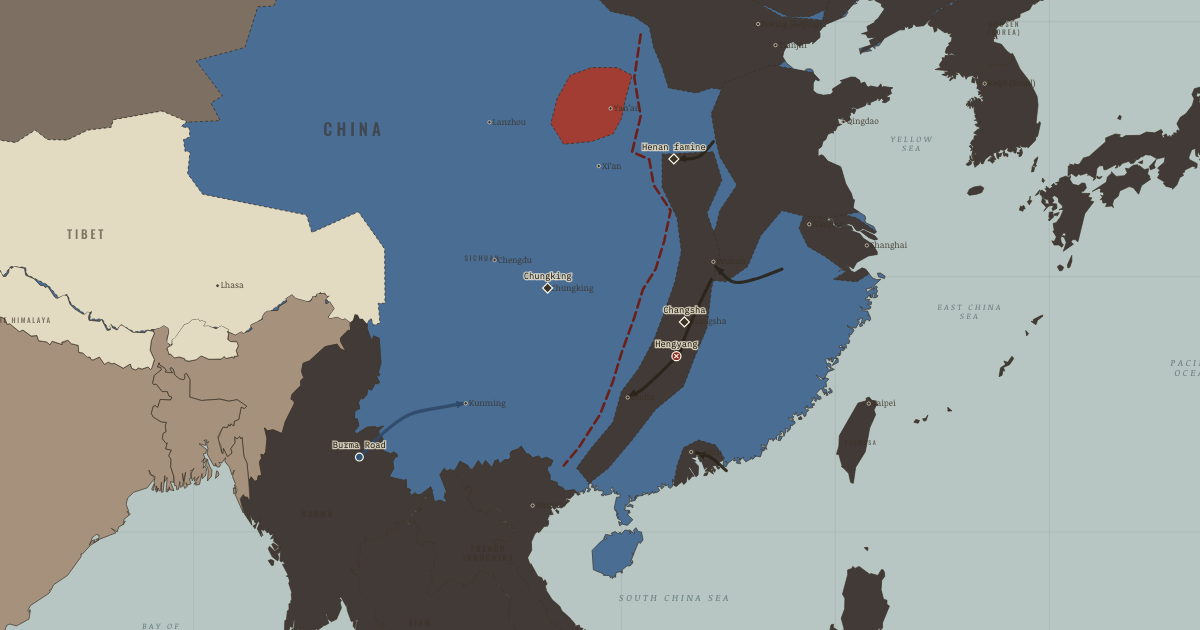
The map above is the world of 1944 — Ichigo — points and lines.
BRIEF EXPLANATION — THE ESSENTIAL ARGUMENT
From 1938 Japan held the major cities, railways and river corridors but struggled to govern the countryside between them. The Nationalists survived in the poor interior, dependent on the Burma Road and later the Hump airlift. Geography prevented a decisive conquest while making resupply painfully difficult for both sides.
War finance, requisition and inflation steadily weakened Nationalist rule, and the Henan famine killed perhaps two million people while grain levies continued. Communist forces meanwhile expanded village administrations behind Japanese lines, combining resistance with lighter taxation and, when needed, coercion. Operation Ichigo in 1944 then exposed how badly the Nationalist military state had been hollowed out, and it shaped the starting positions of the civil war to come.
GUIDED EXPLANATION
A points-and-lines occupation is one that controls cities and transport routes far more securely than the countryside lying between them. For six years the front barely moved, and that stillness is itself the story. The charcoal followed the cities, railways and river valleys, and between those lines Communist base areas spread across north China while government guerrillas held mountain districts. Japan stationed about a million men in China yet securely governed little beyond its garrisons. The blue interior, known as Free China, was vast, poor and besieged. Chungking (the ◆ there) was a capital bombed repeatedly while its government worked from tunnels and refused to surrender. Changsha (the ◆ there) was a city burned prematurely by its own garrison in 1938 and then defended against three Japanese offensives. The blue arrow to Lashio (the ●) is the Burma Road, 1,100 kilometers of mountain supply line that Japan cut in 1942 as Hong Kong, Burma and the Philippines turned charcoal. The Hump airlift over the Himalaya replaced part of that traffic at the cost of some 600 Allied aircraft. China was too large to conquer outright, yet geography also kept its essential supplies desperately scarce.
The siege changed the two Chinese rivals in opposite directions. Having lost the wealthy delta, the Nationalist government financed the war by printing money and requisitioning grain, so that prices in Chungking rose thousands-fold by 1945. The famine of 1942–43 (the ◆ in Henan) killed perhaps two million people while the levies continued, and in 1944 some peasants disarmed the retreating government soldiers who had taxed them. In the occupied north the Communists reduced rents, taxed more lightly and built village governments, and their costly Hundred Regiments Offensive of 1940 taught them to conserve their forces. Japan’s destructive sweeps then made local protection and organization politically decisive. In 1944 the map suddenly moved, when Operation Ichigo sent half a million Japanese troops south from Henan toward Indochina and cut the long charcoal corridor. At Hengyang (the ✕) the defenders held a rail city for 47 days against roughly six-to-one odds before it fell. Ichigo severed Free China’s rail spine and captured the American airfields it had targeted. Japan still lost the wider war, but the campaign exposed Nationalist military weakness both to Chinese observers and to Washington, so that Chiang survived Japan with a state far less able to win the civil war that followed.
DEEP EXPLANATION — EVIDENCE & INTERPRETATION
The Henan famine and the price of not seeing
The famine that killed perhaps two million people in Henan in 1942–43 is memorialized here as a governance catastrophe, and it survives as history largely because one reporter refused the official silence. Theodore White of Time rode into the province against the government’s wishes, saw the dead along the roads, and published, over the objections of both his editor and the government, an account documenting grain requisition that continued while people ate bark and clay. The causes were braided together: drought and locusts, but also the ruined drainage left by the 1938 Yellow River flood, a war that had made the province a fiscal frontier, and a state that kept on collecting. The episode is the sharpest single illustration of Chapter 9’s larger argument about Nationalist decay. It also illustrates a wider truth about famines that the economist Amartya Sen later generalized, namely that they are rarely simple failures of the harvest. They are failures of entitlement, and of a government’s willingness to look at what it would rather not see.
How do we know the base areas were popular?
The claim that the Communists won north China’s villages by better government rests on evidence that historians have learned to read with care. The base areas practised rent and interest reduction rather than outright confiscation, ran “three-thirds” councils that reserved seats for non-Communists, and mounted production drives in which soldiers farmed, all policies designed to widen support without frightening the middle peasant. Party sources record this proudly, which is a reason for caution rather than proof. Chen Yung-fa’s archival work showed the same base areas using coercion, opium revenue and managed elections when the military situation demanded it, and it showed consent and control being dialled up and down together as Japanese pressure rose and fell. The honest reconstruction is neither the party’s idyll nor its enemies’ terror-state. It describes a movement genuinely more responsive to peasant grievance than any rival, and prepared to compel when responsiveness fell short. Popularity here is a claim to be tested village by village, not a fact to be assumed from a slogan.
New here? Chapters 1–2 of every atlas are free to sample, and the WW2 atlas is free in full. One membership opens all thirteen — the Cartographer’s Circle.
THE SITES
ON THIS DAY
WHY IT HAPPENED
Why the front froze. By late 1938 Japan had outrun the arithmetic of conquest: every advance lengthened railways that guerrillas cut and garrisons bled to guard, against an enemy who refused decisive battle by policy. Tokyo’s answer — blockade, puppet governments (Wang Jingwei’s defection to a collaborationist “National Government” at Nanjing in 1940 was its prize catch), and terror bombing of Chungking — was a theory that China would tire. China’s answer was to be too big and too poor to strangle. Both were right enough to freeze the map for six years.
Two ways to tax a war. The Nationalists financed total war from a truncated tax base with the tools of a modern state — paper money and procurement. This produced hyperinflation, corruption and the loathing of everyone the requisition touched. The Communists financed insurgency from villages they lived in, with rent reduction, progressive levies and production drives — cheaper war, better politics. The divergence is not virtue but structure: one side had to run a state under bombardment. The other had to run a movement under occupation. The consequences compound into 1949.
Occupation as recruiting agent. Japan’s north China sweeps — the “three alls” of burn, kill, loot — depopulated whole belts (the base areas shrank terribly in 1941–42) and simultaneously proved the Communist case in every village they touched: the old order could not protect you. The party stayed and bled with you. Chalmers Johnson built his peasant-nationalism thesis on exactly this mechanism. Whatever its final weight (Chapter 12 argues it), the occupation was objectively the CCP’s best organizer.
The alliance of mutual disappointment. From 1942 China was a theater in someone else’s war: promised a seat among the Great Powers and delivered a trickle over the Hump. Asked by Stilwell to spend armies in Burma while Ichigo bore down. Audited by allies who compared a besieged, decaying state to their own unbombed economies. The Stilwell crisis of 1944 — Roosevelt demanding, then dropping, an American commander for China’s armies — marks the moment Washington began planning a postwar Asia that routed around Chiang. Alliances run on delivered power, not endured suffering.
THE TURN
Hengyang, June–August 1944. Choose the paradox deliberately: a heroic six-week defense, and the hinge is what its failure revealed. After Hengyang, Ichigo ran essentially unchecked. Everyone drawing conclusions (Washington, Yan’an, the Chinese public, Chiang’s own commanders) drew the same one: seven years of siege had hollowed the Nationalist state faster than it had hollowed the occupation. The campaign Japan designed to knock China out instead certified which China would be standing when Japan fell. Wars within wars are decided at moments like this, invisible on the day.
WHAT IT CHANGED
The verdict of 1944 shapes 1945–46. Ichigo left the Nationalist armies wrecked and mal-deployed — their best remaining forces deep in the southwest and Burma — while the Communist base areas, untouched by the campaign, stood closest to the Japanese-held north and Manchuria. The starting positions of the civil war’s race (Chapter 10) were set by a Japanese operation neither Chinese party controlled.
America’s China policy splits. The embassy’s field officers, reporting from Yan’an (the 1944 Dixie Mission) and from Ichigo’s wreckage, concluded the Communists would win a civil war. Policy in Washington kept betting on Chiang while hedging with mediation. The incoherence — support one side, broker with both — runs straight into the Marshall Mission’s failure.
Collaboration’s bill comes due. Wang Jingwei’s regime, the puppet governments and their armies (hundreds of thousands strong) face the reckoning of 1945: their territories and arms become the prize both Chinese parties race for, and “who truly resisted” becomes the legitimacy currency of the postwar. The occupied east, misgoverned twice over, greets its “liberation” by carpetbagging officials. It remembers.
FIELD QUESTION — Who fought Japan — the Nationalists, the Communists, or neither as much as each claimed? And why does the answer still matter politically?
Count what can be counted. The Nationalists fought virtually every conventional battle of the war — Shanghai, Wuhan, three Changshas, Ichigo. They took the overwhelming share of military casualties. Twenty-two major engagements to the Communists’ one large offensive (the Hundred Regiments, 1940), after which Yan’an deliberately husbanded its forces. The Communists fought the other war — sabotage, ambush, village defense across an occupied north the Nationalists could not reach. They absorbed brutal reprisal campaigns. Their claim to have been the resistance is inflated, but “they hid for eight years” is propaganda in the other direction. The honest formulation: the Nationalists fought Japan’s army, and were broken by the effort. The Communists fought Japan’s occupation, and were built by it. The answer matters because both regimes founded their legitimacy on this war — Taipei’s and Beijing’s textbooks still disagree. It also matters because van de Ven, Mitter and Yang Kuisong have spent decades correcting both official memories. When a question stays politically alive for eighty years, historiography is part of the history.
AN INTERESTING FACT
When the coastal universities fled inland in 1937–38, three of the greatest — Peking, Tsinghua and Nankai — merged into the National Southwestern Associated University (Lianda) in Kunming, teaching eight years in tin-roofed sheds under air raids, with professors hauling their libraries by the basket. Its faculty and students included a startling share of modern China’s intellectual founders — among them Yang Chen-ning and Tsung-Dao Lee, who would share the 1957 Nobel Prize in Physics, taught in classrooms that paused for bombing runs. The state was decaying; the civilization it was defending was not.
THE DISPATCH
One short letter when a new atlas opens — and the printable study guide for China in Revolution is yours now, free.
NO TRACKING · YOUR ADDRESS IS USED FOR THE DISPATCH AND NOTHING ELSE · UNSUBSCRIBE ANYTIME