Industrial Revolution · CHAPTER 3 ·
Steam power, coal and iron
Chapter 3 of The Industrial Revolution, 1750–1914: “Steam, Coal and Iron”
James Watt’s steam engine, patented in 1769 and built from 1775 with Matthew Boulton at Soho near Birmingham, used about a quarter of the coal of Newcomen’s engines. Coke smelting at Coalbrookdale freed iron from charcoal, and canals moved coal cheaply to the towns, turning coal into power, metal and transport.
Chapter 3 is part of membership. WW2 is free — every chapter. Try chapters 1–2 of any 2 other atlases (3 with a free account). Opening a new atlas uses one of them. Membership opens all 21 — Join.
Free printable Industrial Revolution study guide, sent by email ↓
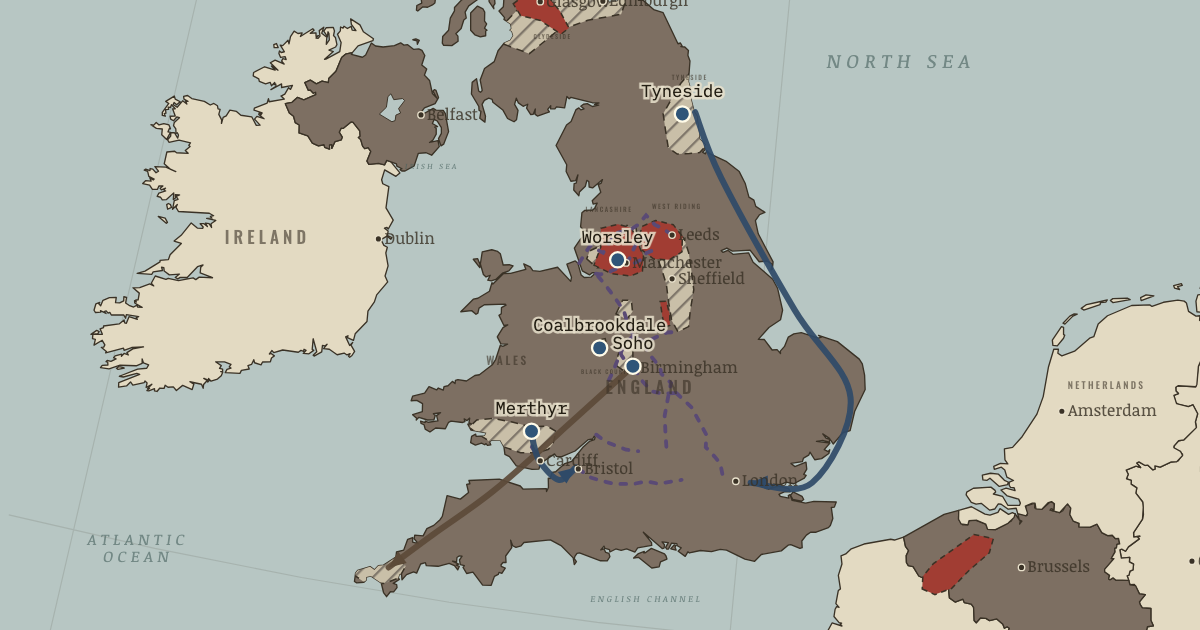
The map above is the world of The Industrial Revolution in Europe, 1820 — Coal, iron and the canal network.
Part of IB History: The Industrial Revolution →
BRIEF EXPLANATION — THE ESSENTIAL ARGUMENT
The deepest change of the Industrial Revolution was a change of energy, from water, wood and muscle to coal, and this chapter explains how coal became power, metal and transport. The steam engine converted the heat of burning coal into motion. The Scottish engineer James Watt’s version, patented in 1769 and built from 1775 with the Birmingham manufacturer Matthew Boulton at his Soho works, used about a quarter of the coal of the older mine-pumping engines designed by Thomas Newcomen because it condensed its steam in a separate chamber, much as a modern engine travels further than its ancestors on the same tank of fuel. Coke, which is coal baked to drive off impurities, let the ironworks at Coalbrookdale melt iron out of its ore without charcoal from forests. Canals, finally, moved coal cheaply to the towns, and together the three turned a natural resource into the energy of a whole economy.
The change came slowly before it came everywhere. In 1800 water wheels still supplied about three times as much power as steam engines in Britain, and steam overtook water only around 1830. Iron output, however, rose about tenfold between 1788 and 1830, and coal output doubled between 1800 and 1830 to about 30 million tons. On the map, the hatched patches are the coalfields where the new industry gathered, from Tyneside to South Wales, and the blue lines are the canals that carried their coal; by 1830 England and Wales had about 4,000 miles of navigable waterway. Coal explains why the industrial districts lie where they do, since it was cheaper to bring iron ore, cotton and workers to the coal than to move the coal itself.
The full story
Coal mattered because it removed the limit that land had always placed on energy. Britain had burned coal for heating since the sixteenth century, and the pits of Tyneside shipped much of it down the coast to London. Deeper mines flooded, however, and in 1712 the inventor Thomas Newcomen built the first practical steam engine to pump them dry. It wasted most of its fuel by heating and cooling the same cylinder with every stroke, but at the mine itself coal cost almost nothing. James Watt, an instrument maker at Glasgow University, realised in 1765 that condensing the steam in a separate chamber would keep the cylinder hot and save fuel. He patented the idea in 1769, and from 1775 he and the manufacturer Matthew Boulton built engines at Soho near Birmingham; by 1800 they had built between 450 and 500, many of them pumping the copper and tin mines of Cornwall, where coal was dear. Efficiency mattered most where fuel was expensive, which is why the improved engine found its first customers far from the coalfields.
Coal transformed iron as well, the material from which machines, engines and bridges were made. Iron had been smelted, or melted out of its ore, with charcoal, and charcoal meant forests, so iron output was limited by woodland. At Coalbrookdale in Shropshire the ironmaker Abraham Darby smelted iron with coke, coal baked to drive off its impurities, in 1709, and in 1779 his grandson’s works cast the Iron Bridge across the Severn. The ironmaker Henry Cort’s puddling and rolling process of 1783–84 stirred pig iron, the brittle metal that came out of the blast furnace, to burn out its carbon, turning it in large batches into wrought iron, the tough metal that could be hammered and rolled. The industry moved onto the coalfields, above all to South Wales, where the Cyfarthfa and Dowlais works at Merthyr Tydfil became the largest ironworks in the world. British pig iron output rose from about 68,000 tons in 1788 to about 678,000 tons in 1830, and that cheap iron lowered the cost of every engine, rail and machine, so the growth of one industry now made the next one cheaper.
Coal was heavy and cheap, so whoever could move it cheaply could build industry wherever they liked, and canals were the first answer. In 1761 the Duke of Bridgewater opened a canal from his mines at Worsley to Manchester, and the price of coal in the town fell by about half. Investors rushed to copy him, and the map’s blue lines show the network that followed: the Trent and Mersey linked the pottery towns of Staffordshire to both coasts, the Grand Junction joined Birmingham to London, and by 1830 England and Wales had about 4,000 miles of navigable waterway. The age of steam nevertheless arrived slowly, since in 1800 water wheels still delivered about three times the power of steam engines. The energy revolution was gradual in its pace and total in its consequences, because every later industry, from railways to steel, ran on the coal that these engines, furnaces and canals first put to work.
DEEP EXPLANATION — EVIDENCE & INTERPRETATION
From an organic to a mineral economy
The essence of the Industrial Revolution, the historian E. A. Wrigley argues, was a change in the energy base of the economy, a case he summed up in Energy and the English Industrial Revolution (2010). In an organic economy all energy comes from the annual product of the land, so more fuel means less food or timber, and growth is real but bounded. Coal released millions of years of stored plant growth. Using the rule of thumb that a ton of coal yields about as much heat as an acre of woodland grows in a year, Britain’s output of about 30 million tons around 1830 was worth perhaps 30 million acres of forest, close to the whole land area of England. The historian Kenneth Pomeranz makes the same calculation the core of his comparison with China. Critics point out that coal alone explains little about timing, since England had burned it on a large scale since the 1600s and most early factories ran on water. Wrigley’s answer is that coal’s importance lay in the long run, because it let growth continue after the land had been fully used, which an organic economy could never do. In this reading, the Industrial Revolution was first of all a revolution in energy, and its famous machines mattered because they put coal to work.
How slowly steam spread
Economic historians have repeatedly found that steam’s contribution to growth came late. The economic historian N. F. R. Crafts estimated that steam added little to British productivity before the 1830s, and the economic historian G. N. von Tunzelmann showed that for many mills the engineer James Watt’s improved engine saved only modest sums over a good water wheel. The historian Alan Kanefsky’s estimates suggest that around 1800 Britain’s steam engines delivered about 35,000 horsepower against about 120,000 from water wheels, and that steam passed water only around 1830. Engines were expensive, early ones broke down, and water power kept improving with iron wheels and larger reservoirs. Steam’s great advantages were location and scale, because an engine could run beside a canal in a town, wherever coal and workers were, while water power was tied to particular rivers and failed in droughts. Once the Cornish engineer Richard Trevithick’s high-pressure engines of around 1800 made steam lighter and stronger, it could move as well as pump and turn, which led to the locomotive. Crafts and the economic historian C. K. Harley’s estimates of slow overall growth, about 1.4 per cent a year in 1780–1801 and about 1.9 per cent in 1801–31, reflect this gradual spread. The revolution in power was real, but it was a slow one.
Iron, coke and the move to the coalfields
Coke smelting, which used a fuel of baked coal to melt iron out of its ore, spread slowly at first, because the ironmaker Abraham Darby’s coke iron of 1709 suited objects cast in moulds, such as cooking pots, but was too brittle for the tough wrought iron that blacksmiths hammered into shape. Only after better blast furnaces, steam-driven bellows from the 1770s and the ironmaker Henry Cort’s puddling process of 1783–84, which stirred molten iron to burn out its carbon, did coke iron replace charcoal iron for most uses. The consequence was a new industrial geography. Charcoal ironworks had been scattered through the wooded Weald, the Forest of Dean and Furness, while coke ironworks gathered where coal and ironstone, a local iron ore, lay together, in Shropshire, the Black Country west of Birmingham, South Wales and later Scotland. Merthyr Tydfil grew from a village into Wales’s largest town, and in 1845 Dowlais ran 18 blast furnaces making about 88,000 tons of iron a year. Historians debate how far iron drove growth before the railways, since much early demand came from war, nails, tools and farm implements. The work was harsh and dangerous for ironworkers and coal miners, and Merthyr’s workers rose against wage cuts and debt in 1831. Cheap iron nonetheless made the railway affordable, since only a country that made iron cheaply could lay thousands of miles of iron track.
Key places on the map
Why it happened
Coal close to towns and the sea. Britain’s coal seams lay near navigable rivers and the coast, so coal could reach customers by water long before railways existed. Tyneside had shipped coal to London since the Middle Ages, and the Midland and Lancashire fields lay beside growing towns. By 1800 Britain mined about 15 million tons a year. That accessibility made coal cheap where it was needed, and cheap coal made the machines that burned it worth inventing.
Flooded mines demanded engines. As miners dug deeper, water became the limit on the output of coal and metal, and horses or water wheels could not pump it out fast enough. The inventor Thomas Newcomen’s atmospheric engine of 1712, worked by air pressure on a piston, solved the problem for coal mines, where waste coal was free, and by 1800 hundreds worked across Britain. Cornish copper and tin mines, far from any coalfield, needed something more efficient, and that need created the first market for the engineer James Watt’s improved engine.
Skilled hands and patient capital. The engineer James Watt’s separate condenser, a chamber that cooled the steam outside the cylinder, became a working engine only because skill, money and legal protection came together around it, beginning with the accurate cylinders that the ironmaster John Wilkinson bored from 1775 on a machine he had patented in 1774 for cannon. Birmingham’s metalworkers supplied the parts, and the manufacturer Matthew Boulton supplied capital, a factory and a gift for selling. An Act of Parliament in 1775 extended Watt’s patent to 1800, giving the partners twenty-five years to recover their investment. Behind every famous inventor stood the craftsmen, investors and lawmakers who turned an idea into a product.
Cotton and war created demand. The new cotton mills wanted reliable power, and the wars with France between 1793 and 1815 wanted iron for cannon, shot and ships. Government contracts and wartime prices pushed ironworks owners such as the Crawshays of Cyfarthfa, in South Wales, to expand, while mill owners who had outgrown their streams turned to steam. Each new industry became a customer for the next, which made the expensive new technologies worth adopting. Demand set the timing of change, because an invention spread only once enough buyers needed what it could do.
THE TURNING POINT
Boulton and Watt at Soho, 1775. The partnership formed at Soho near Birmingham in 1775 is the hinge because it turned a clever modification into an industry. The engineer James Watt had the idea of the separate condenser, which cooled the used steam outside the cylinder to save fuel, but the manufacturer Matthew Boulton’s factory, capital and salesmanship, together with the ironmaster John Wilkinson’s accurate cylinders and an extended patent, produced engines in numbers. The partners charged customers a yearly fee worth a third of the money they saved on coal, which made the engine’s advantage easy to see. In the 1780s Watt’s rotative design let steam turn machinery as well as pump water. From then on, factories could be built wherever coal could be delivered, and the canals delivered it.
What it changed
Locomotives grow out of colliery engines. High-pressure steam engines, light enough to move themselves, were first put on rails at collieries, or coal mines, and ironworks. The Cornish engineer Richard Trevithick ran a locomotive at Penydarren near Merthyr in 1804, and colliery engineers on Tyneside, among them George Stephenson, built locomotives to haul coal wagons. Chapter 4 follows their engines from the coalfields to the first public railways. Within about forty years the colliery locomotive had grown into a national transport system, because an engine built to haul coal could carry goods and people just as well.
Industry gathers on the coalfields. Because coal was heavy, the industries that burned it moved to it. The textile towns of Lancashire and Yorkshire, the iron towns of South Wales and the shipbuilding towns of the north-east all stood on or beside coalfields, and so did the Black Country, a metalworking district west of Birmingham named for its smoke. Chapter 5 follows the towns they became. The map of coal had turned into the map of where Britons lived and worked.
The continent copies the model. Belgium’s coal belt from Mons to Liège, the Ruhr valley in western Germany and Upper Silesia, now in Poland, repeated Britain’s pattern of coal, iron and canals, often with British machines and engineers. On the map Belgium and Switzerland are already shaded as industrialising by 1820, and chapter 7 follows how the continent learned from Britain and where it chose a different path. Coal decided where heavy industry could grow, on the continent as in Britain, while coal-poor Switzerland industrialised on water power and skill.
DISCUSSION QUESTION — Was the steam engine the cause of the Industrial Revolution, or one of its results?
The steam engine is the most famous symbol of the Industrial Revolution, yet the evidence suggests it was as much a result as a cause. The inventor Thomas Newcomen’s engine was designed to solve a problem created by an existing coal industry, the engineer James Watt’s improvement found its market in mines and mills that were already expanding, and steam supplied less power than water until about 1830. Economic historians who measure growth, such as N. F. R. Crafts, find steam’s contribution to productivity small before the railway age. On the other side, steam freed industry from rivers and let factories, ironworks and later railways cluster on the coalfields and in towns, which made concentration and scale possible. It also turned coal’s heat into motion, the step that made the mineral economy, one powered by coal dug from the ground, fully productive. A balanced judgement treats steam as a late but decisive cause: it arrived after the revolution had begun, and it was steam that made the revolution self-sustaining. Technologies that become the symbols of an age often matter most in its second phase, after the pioneers have proved the market.
An interesting fact
The unit still used to rate car engines began as a sales tool. The engineer James Watt needed to tell mine and mill owners how many horses one of his engines could replace, so he estimated the work of a horse turning a mill and defined one horsepower as 33,000 foot-pounds of work per minute, enough to lift 33,000 pounds by one foot, a generous figure that made his engines look modest. Customers bought engines rated in horses, and the habit stuck. In 1882, long after his death, the British Association for the Advancement of Science, a national society of scientists, named the scientific unit of power the watt in his honour. Watt is thus remembered by two units, one named after him and one he devised to sell engines.
Related
THE FREE PRINTABLE STUDY GUIDE
Join the Dispatch — a short welcome series, then a letter when a new atlas opens — and the printable study guide for The Industrial Revolution is yours now, free.
NO TRACKING · YOUR ADDRESS IS USED FOR THE DISPATCH AND NOTHING ELSE · UNSUBSCRIBE ANYTIME