Stalin’s Soviet Union · CHAPTER 11 ·
High Stalinism (1945–53)
Chapter 11 of The Soviet Union under Stalin, 1924–1953: “High Stalinism”
After victory in 1945 Stalin’s rule hardened rather than relaxed. The regime rebuilt heavy industry first, a famine in 1946–47 killed an estimated 1 to 2 million, campaigns targeted writers, scientists and Jews, and satellite states from East Germany to Bulgaria took orders from Moscow.
Chapter 11 is part of membership. WW2 is free — every chapter. Try chapters 1–2 of any 2 other atlases (3 with a free account). Opening a new atlas uses one of them. Membership opens all 21 — Join.
Free printable Stalin’s Soviet Union study guide, sent by email ↓
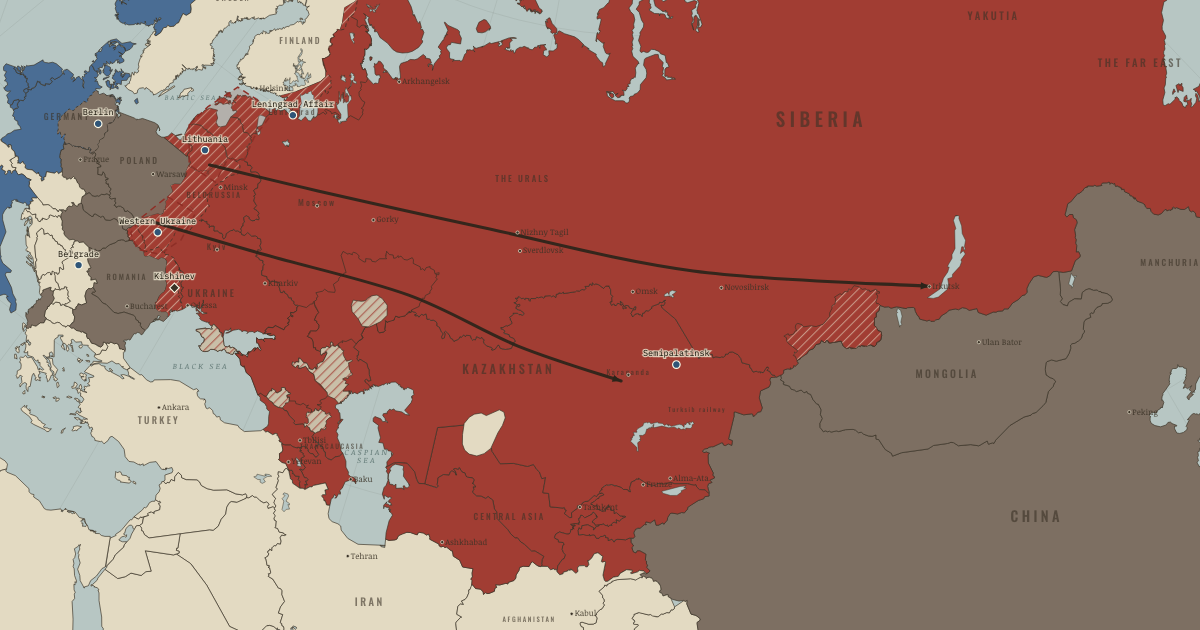
The map above is the world of The Soviet Union, October 1949 — NATO, the GDR and the People’s Republic of China.
Part of IB History: The Soviet Union under Stalin →
BRIEF EXPLANATION — THE ESSENTIAL ARGUMENT
Victory hardened Stalin’s rule, and the years from 1945 to his death in 1953 are known as High Stalinism. Many Soviet citizens hoped that the war’s sacrifices would be rewarded with fewer controls, more food and an end to collective farms, the state-run farms peasants had been forced into in 1929–33. Instead the regime rebuilt heavy industry first, let famine kill an estimated 1 to 2 million people in 1946–47, and launched new campaigns against writers, scientists and Jews. The map shows the regime at its widest reach. The hatched red lands annexed in 1939–45 were now Soviet. A belt of grey-tan satellite states, nominally independent countries whose communist governments took orders from Moscow, ran from East Germany to Bulgaria. China became a communist ally in 1949, and the blue states of NATO, the Western military alliance founded that year, faced them in the west. The test of a Soviet atomic bomb in Kazakhstan in August 1949 made the Union a nuclear power, and it emerged from victory both stronger and more closed than before.
Control at home and abroad rested on the same methods, and both met resistance. In the annexed borderlands, the dashed outlines mark armed insurgencies in western Ukraine and the Baltic states, which the NKVD and its successor, the MGB, both forerunners of the KGB, fought with mass arrests and the deportations the arrows show. In Eastern Europe, Stalin imposed communist governments and, when Yugoslavia’s Tito refused to take orders, expelled him from the communist bloc in 1948 and put suspected “Titoists” on trial everywhere else. In Moscow, the Leningrad Affair destroyed a group of senior leaders, and the Doctors’ Plot of January 1953 accused mostly Jewish doctors of murder. Stalin’s death in March 1953 cut short what many feared would be a new Great Terror, the mass arrests and shootings of 1937–38.
The full story
At home the regime put reconstruction before relief, and the famine of 1946–47 shows the cost. A drought in 1946 hit Ukraine, Moldavia and the Volga, yet the state kept high procurement quotas, the grain each farm had to deliver, held large grain reserves and kept exporting grain to Eastern Europe. Estimates of the dead run from under 1 million to about 2 million, many of them in Moldavia, annexed only in 1940. New laws of June 1947 punished theft of state property with up to 25 years in camps, and the Gulag, the forced-labour camp system, reached its peak of about 2.5 million prisoners. The state rebuilt Ukraine’s mines and the Dnieper dam within a few years, while millions still lived in dugouts, which shows what the regime valued.
Stalin’s last years saw a series of campaigns against ideas and against people. In August 1946 a party resolution condemned the Leningrad journals Zvezda and Leningrad and drove the poet Anna Akhmatova and the satirist Mikhail Zoshchenko out of literary life. It opened the Zhdanovshchina, a campaign named after the party secretary Andrei Zhdanov to force writers and artists back to the party line, much as a censor vets every script. Composers such as Shostakovich and Prokofiev were attacked in 1948 for “formalism”, the party’s charge against art it judged too experimental for ordinary people, and the agronomist Trofim Lysenko had genetics banned the same year. From 1949 a campaign against “rootless cosmopolitans” targeted Jewish intellectuals, and members of the Jewish Anti-Fascist Committee were shot in 1952. The Leningrad Affair of 1949–50, a purge of leaders who had risen in wartime Leningrad, ended in the execution of the party secretary Aleksei Kuznetsov, the chief planner Nikolai Voznesensky and others. The Doctors’ Plot, a fabricated charge announced on 13 January 1953 that Kremlin doctors had murdered Soviet leaders, suggested worse to come. Because each campaign named a new enemy within just as the Cold War hardened, a regime more secure than ever behaved as if it were under siege.
Abroad, Stalin built an empire of satellite states, nominally independent countries run from Moscow, and its edges are where his power met its limits. Communist parties backed by the Red Army, the Soviet armed forces, took power in Poland, Romania, Bulgaria and Hungary between 1945 and 1948, and in Czechoslovakia by a coup in February 1948. The Cominform, a bureau of European communist parties founded in 1947, worked as Moscow’s channel of command to them. Yugoslavia, expelled in June 1948 when Tito resisted Soviet direction, survived as the first communist state to defy Moscow. Stalin’s blockade of West Berlin in 1948–49 failed and helped create NATO, the Western defensive alliance, and a West German state. Resistance continued in the borderlands: the Ukrainian Insurgent Army fought on until the early 1950s, and the Baltic “forest brothers”, guerrillas who lived in the woods, like wartime resistance fighters, lost about 20,000 men in Lithuania alone. Operation Priboi in March 1949 deported about 95,000 people from the Baltic states, as the arrows show, which broke the partisans by removing their support.
DEEP EXPLANATION — EVIDENCE & INTERPRETATION
Late Stalinism as a system
Stalin’s last years were more orderly in their routine and more dangerous at the top than older accounts assumed, as Yoram Gorlizki and Oleg Khlevniuk’s Cold Peace (2004) showed. Using Politburo and ministry records, they show that the regime after 1945 became more bureaucratic and more predictable in its ordinary workings, with ministries and the Council of Ministers handling economic affairs while Stalin intervened selectively, often from his dachas. At the top, however, Stalin ruled through small groups of favourites whom he kept off balance: Molotov and Mikoyan were humiliated in 1952, Beria was threatened by the Mingrelian Affair in Georgia, and the Leningrad group was destroyed. Gorlizki and Khlevniuk describe a “neo-patrimonial” state, run through personal loyalty to the ruler alongside formal institutions. This explains the paradox of late Stalinism: the economy recovered and elite violence fell compared with 1937–38, yet no one near Stalin was safe. The Doctors’ Plot, which began as a case against Kremlin physicians, showed how quickly the system could tip back into terror when the ruler chose.
The campaign against “cosmopolitans”
Stalin’s last years took an antisemitic turn that historians still debate in its extent and its aims. During the war the regime had sponsored the Jewish Anti-Fascist Committee to win support abroad, and in May 1948 the Soviet Union recognised the new state of Israel. The actor Solomon Mikhoels, the committee’s chairman, had already been murdered by the security police in January 1948 in a staged accident. After Moscow’s Jews gave Israel’s envoy Golda Meir an enthusiastic welcome that autumn, the alarmed leadership dissolved the committee in November 1948, and in August 1952 thirteen of its members were shot after a secret trial. From 1949 newspapers attacked “rootless cosmopolitans”, a code for Jewish intellectuals, and Jews were removed from many posts. Historians such as Gennadi Kostyrchenko and Joshua Rubenstein document these events. Whether Stalin planned a mass deportation of Jews after the Doctors’ Plot is disputed: memoirs claim it, but no order has been found in the archives, and most historians treat the question as open.
The war after the war
Fighting did not end in 1945 in the territories annexed in 1939–40. In western Ukraine the Ukrainian Insurgent Army, which had fought both Germans and Soviets and had also carried out mass killings of Poles in Volhynia in 1943, waged a guerrilla war against Soviet rule until the early 1950s. In Lithuania, Latvia and Estonia tens of thousands of “forest brothers” took to the woods. Soviet forces answered with collective punishment: arrests, burned farms and the deportation of entire families. The largest were Operation West in October 1947, which sent about 76,000 people from western Ukraine east, and Operation Priboi in March 1949, which deported about 95,000 people from the Baltic republics in four days. Soviet security records, used by Jeffrey Burds and Alexander Statiev, count about 150,000 people killed in western Ukraine in 1944–53 as insurgents or their helpers, and some 20,000 partisans died in Lithuania alone. Burds and Statiev show that deportations and collectivisation, which removed the partisans’ village base, did as much as combat to end the fighting. Deportation won these wars by emptying the countryside the partisans depended on, which is why their memory still divides Ukrainians, Lithuanians, Poles and Russians.
Key places on the map
On this day
Why it happened
Victory confirmed Stalin’s methods. The war appeared to prove that the collective farms, the plans and the purges had made the country strong enough to survive. Stalin had no reason to change a system that had won, and every reason to restore the controls that had loosened during the fighting, when peasants had expanded private plots and soldiers had seen how Europeans lived. The regime now treated such contacts as a source of dangerous comparisons.
The Cold War revived the fear of enemies. The breakdown of the wartime alliance in 1946–47, the Marshall Plan and the American atomic monopoly convinced Stalin that the capitalist powers were again preparing for war. Churchill’s Fulton speech of March 1946 and the Truman Doctrine of 1947 confirmed this reading for Stalin. Contacts with the West became suspect, and anyone with foreign connections, from returning prisoners of war to Jewish intellectuals with relatives abroad, could be treated as a potential spy.
Reconstruction demanded sacrifice. The war had destroyed much of the western Soviet Union, and the Fourth Five-Year Plan of 1946–50 gave priority to steel, coal, electricity and arms, including the atomic bomb. Food, housing and consumer goods again came last. The famine of 1946–47 and the harsh labour and theft laws followed from the decision to rebuild heavy industry first, so the population again paid for the state’s priorities as it had in the 1930s.
The new borderlands rejected Soviet rule. The lands annexed in 1939–40 had lived under Soviet rule for less than two years before the German invasion and resented the deportations of 1940–41. After 1944 armed nationalist movements, forced collectivisation and the arrival of Russian-speaking officials and settlers made them the most rebellious regions of the Union, and the regime treated them as zones of counter-insurgency long after the war had ended elsewhere. Deportation became its main weapon there.
THE TURNING POINT
Tito’s expulsion, 28 June 1948. The expulsion of Yugoslavia from the Cominform is the hinge of High Stalinism because it was the first successful defiance of Stalin from within the communist world. Tito had his own army, his own revolution and popular support, and he survived Soviet threats and economic blockade. Stalin’s response showed what the empire had become: show trials of alleged Titoists in Hungary, Bulgaria and Czechoslovakia, including those of László Rajk in 1949 and Rudolf Slánský in 1952, and tighter Soviet control over the satellites. The break proved that Soviet power rested on the Red Army, which would matter again in Hungary in 1956.
What it changed
An empire held by force. The satellite states of Eastern Europe remained under Soviet control until 1989, but the methods used to install them, rigged elections, purges and Soviet advisers in their security services, left them without popular legitimacy, and their leaders knew it. Revolts in East Germany in 1953, Hungary in 1956 and Czechoslovakia in 1968 followed, because what force had installed only force could keep.
The Gulag at its height. Postwar theft laws, repatriated prisoners of war, insurgents from the borderlands and new waves of arrests drove the camp population to about 2.5 million by 1950–53, with another 2.7 million special settlers. The camps had become too large and too costly, and after Stalin’s death their own officials and his successors moved quickly to shrink them, which shows that even the regime saw the camps as a burden.
A frightened leadership waiting for change. Stalin’s heirs, Malenkov, Beria, Khrushchev and Bulganin, had all seen colleagues destroyed and feared being next. The Doctors’ Plot and the purge of Molotov and Mikoyan in 1952 suggested a new round of terror. When Stalin died in March 1953, his colleagues acted within weeks to release the doctors and reduce the camps, which shows how much they had wanted change.
Nuclear power and a frozen society. The atomic bomb of 1949 made the Soviet Union a superpower and justified the secrecy and mobilisation of the late Stalin years. The same years froze culture and science, as Lysenko’s rejection of genetics damaged Soviet biology and agriculture for a generation. The postwar settlement left a powerful state and a constrained society, a combination that shaped the next forty years.
DISCUSSION QUESTION — Was High Stalinism a continuation of the terror of the 1930s, or a different kind of dictatorship?
The evidence supports a qualified view: the system kept the tools of the 1930s but used them differently. Mass repression continued, since the Gulag reached its largest size, theft laws imprisoned millions and deportations broke resistance in the borderlands. Famine was again allowed to kill in 1946–47. Yet there was no repeat of 1937–38: elite violence was targeted at specific groups, such as the Leningrad leaders and the Jewish Anti-Fascist Committee, and Gorlizki and Khlevniuk show that ordinary government became more routine and bureaucratic. Stalin’s personal power was, if anything, greater, and the cult reached its peak in 1949, but he governed through fear of possible purges more than through mass killing at the top. The Doctors’ Plot suggests he might have launched a new terror had he lived longer, though historians disagree on how far it would have gone. A good answer distinguishes repression of society, which remained massive, from terror within the elite, which was threatened more than practised. The transferable lesson is that dictatorships often stabilise by keeping fear in reserve, using it against a few to discipline the many.
An interesting fact
The first Soviet atomic bomb, tested on 29 August 1949 at the Semipalatinsk site in Kazakhstan, was a close copy of the American “Fat Man” bomb dropped on Nagasaki. Its design had been passed to Soviet intelligence by the physicist Klaus Fuchs, who worked at Los Alamos, and the project’s scientific director, Igor Kurchatov, chose to build a proven copy first to avoid any risk of failure while Beria watched. A Soviet design followed in 1951. Western intelligence had expected a Soviet bomb no earlier than the early 1950s, so the test shocked Washington and helped push the United States towards the hydrogen bomb.
Related
THE FREE PRINTABLE STUDY GUIDE
Join the Dispatch — a short welcome series, then a letter when a new atlas opens — and the printable study guide for The Soviet Union under Stalin is yours now, free.
NO TRACKING · YOUR ADDRESS IS USED FOR THE DISPATCH AND NOTHING ELSE · UNSUBSCRIBE ANYTIME