Stalin’s Soviet Union · CHAPTER 10 ·
Stalin in World War II
Chapter 10 of The Soviet Union under Stalin, 1924–1953: “Stalin at War”
Stalin ignored warnings of the German attack of 22 June 1941, and the Red Army lost millions of men as occupation spread from Leningrad to the Volga and the Caucasus by November 1942. Yet his state evacuated more than 1,500 factories east in 1941 and mobilised people and industry on an enormous scale.
Chapter 10 is part of membership. WW2 is free — every chapter. Try chapters 1–2 of any 2 other atlases (3 with a free account). Opening a new atlas uses one of them. Membership opens all 21 — Join.
Free printable Stalin’s Soviet Union study guide, sent by email ↓
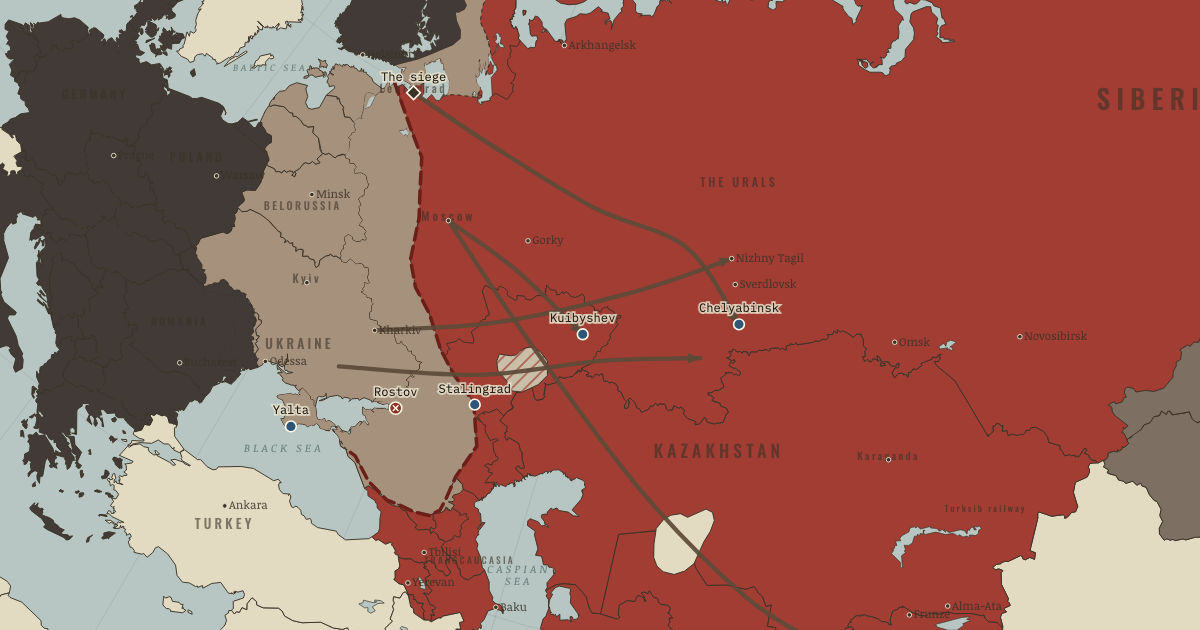
The map above is the world of The Soviet Union, November 1942 — The high-water mark: Stalingrad and the Caucasus.
Part of IB History: The Soviet Union under Stalin →
BRIEF EXPLANATION — THE ESSENTIAL ARGUMENT
The war of 1941–45 nearly destroyed Stalin’s state and then gave it a new legitimacy, and the map shows how close the first outcome came. The tan zone is Soviet land under German occupation in November 1942, at its greatest extent, from the outskirts of Leningrad to the Volga at Stalingrad and the foothills of the Caucasus; the dashed line is the front. Stalin had ignored repeated warnings of the German attack of 22 June 1941, and in the first months the Red Army, the Soviet armed forces, lost millions of men. Yet the regime he had built proved able to mobilise people and industry on an enormous scale. The arrows trace the evacuation of more than 1,500 factories to the Urals, the Volga, Siberia and Central Asia in the second half of 1941. Many were producing weapons within months, because the Five-Year Plans, the state’s programmes of forced industrial growth since 1928, run like a company’s five-year budget with the force of law, had already built a second industrial heartland beyond the reach of German armies.
Stalin led the war as head of the State Defence Committee, a five-man war cabinet that could issue orders to any institution in the country, and as Supreme Commander, and he learned during it to listen to his generals. He stayed in Moscow in October 1941 when the government left for Kuibyshev on the Volga. After the fall of Rostov in July 1942 he issued Order No. 227, “Not one step back!”, which forbade retreat without permission, and he turned to Russian patriotism and even the Orthodox Church to rally the population. The cost to Soviet society was immense: about 26 to 27 million Soviet citizens died. Victory in 1945 allowed Stalin to present the sacrifices of the 1930s as the price of survival, which became the regime’s strongest argument for itself.
The full story
The disaster of June 1941 grew partly from Stalin’s own decisions, and his recovery shows how the system worked under pressure. He had trusted the Nazi–Soviet Pact, the 1939 non-aggression treaty with Hitler, dismissed intelligence warnings as British provocations and forbidden actions that might provoke Hitler, so the Red Army, the Soviet armed forces, was caught unprepared along a new and unfortified border. In the first week German forces took Minsk, and witnesses describe Stalin withdrawing to his dacha, his country house outside Moscow. His colleagues came to him there on 30 June to propose a State Defence Committee, known as the GKO, a small war cabinet with power over every institution, with Stalin at its head. On 3 July he spoke to the country by radio, addressing listeners as “brothers and sisters”. Order No. 270 of August 1941 branded soldiers who surrendered as traitors and made their families liable to arrest. The state that had terrorised its people now asked them to save it, and combined that appeal with threats.
The evacuation of industry was the home front’s greatest feat, and the arrows on the map show its routes. A Council for Evacuation, created two days after the invasion, organised the dismantling of factories in Ukraine, Belarus, Leningrad and Moscow and their shipment east by rail, often under bombing. About 1,500 large enterprises were moved in July–November 1941 to the Urals, the Volga, western Siberia, Kazakhstan and Central Asia, together with millions of workers. Chelyabinsk received the Kirov works from Leningrad and the Kharkiv diesel plant and became “Tankograd”. Factories restarted in unheated sheds before walls and roofs were finished. The industrial base built in the Urals under the Five-Year Plans, the binding industrial targets set from 1928 much like a company’s five-year budget, made this possible, so the plans’ most costly choice became the war’s decisive asset.
Stalin’s war leadership combined ruthlessness with a growing willingness to delegate, and both shaped the outcome. When Rostov fell in July 1942, opening the way to the Caucasus, he issued Order No. 227, which created penal battalions, units of punished soldiers sent to the most dangerous sectors, and blocking detachments, rear units ordered to stop retreating troops by force. From late 1942 he relied more on professional commanders such as Georgy Zhukov and Aleksandr Vasilevsky, and the counter-offensive at Stalingrad, told in The War Room, turned the war. To rally the people he appealed to Russian history and faith: officers’ ranks and shoulder boards returned, and in September 1943 he allowed the Orthodox Church to elect a patriarch, its head, for the first time since 1925. By the time Stalin met Roosevelt and Churchill at Yalta in February 1945, the conference of the “Big Three” allied leaders, the Red Army’s advance had given him control of Eastern Europe. Victory cost 26 to 27 million Soviet lives, and the regime would present that sacrifice as proof that Stalin’s harsh methods had saved the country.
DEEP EXPLANATION — EVIDENCE & INTERPRETATION
How good a war leader was Stalin?
Stalin made catastrophic errors in 1941 and learned from them, a record that both Khrushchev’s picture of a blundering amateur and his own propaganda’s military genius distort. Khrushchev claimed in 1956 that Stalin planned operations on a globe and caused the disasters of 1941–42, while Soviet histories under Brezhnev restored him as a wise commander. Western scholars such as Richard Overy, in Russia’s War (1997), and Geoffrey Roberts, in Stalin’s Wars (2006), offer a more balanced picture drawn from the records of Stavka, the Soviet high command, and commanders’ memoirs. Stalin made catastrophic errors in 1941, ignoring warnings, forbidding retreats and insisting on holding Kyiv until more than 600,000 men were encircled in September. He also learned: from 1942 he accepted his generals’ advice more often, coordinated military and industrial planning through the GKO, and handled the alliance with Britain and the United States skilfully. Oleg Khlevniuk stresses that his centralisation of every decision caused confusion and waste. The balance of evidence suggests a leader who nearly lost the war in 1941 and then helped win it by learning, inside a system whose capacity for mobilisation was its greatest asset.
The evacuation in numbers
The railways made the evacuation work, as the records of the Council for Evacuation, studied by Mark Harrison and the Soviet historian G. A. Kumanev, show. Between July and November 1941 about 1,500 industrial enterprises, most of them large plants, were moved east, the largest groups to the Urals and western Siberia, together with about 12 million people by the end of 1941 and 16 to 17 million by early 1942. Moving a factory meant loading machine tools, workers and their families onto trains that also carried troops west, so the railways became the decisive instrument of the home front. Output fell sharply in the winter of 1941–42 before recovering. By 1943 the Urals produced a large share of Soviet steel and tanks. Harrison emphasises that the Soviet economy, smaller than Germany’s, out-produced it in many weapons by concentrating ruthlessly on the war and cutting civilian consumption to the bone. Lend-Lease aid from the United States and Britain, including some 400,000 trucks and jeeps and large food deliveries, supplied the mobility and food that Soviet industry could not, so the war economy rested on ruthless priorities at home and on Allied help.
Counting the cost
Soviet war losses were concealed under Stalin, who spoke of 7 million dead, and raised to 20 million under Khrushchev. Demographic studies after 1991, including those by Evgeny Andreev, Leonid Darsky and Tatiana Kharkova, put total excess deaths at about 26 to 27 million. Some 8.7 million were military dead, counted by G. F. Krivosheev’s team. The rest were civilians who died from occupation, siege, hunger, forced labour and mass murder, among them the Jews killed in the Holocaust, about 1 million within the pre-1939 borders and some 2.5 million within those of 1941. The siege of Leningrad alone killed between about 630,000 civilians (the Soviet figure at Nuremberg) and more than a million. These figures include deaths caused by the Soviet state itself, such as executions of soldiers, deaths in the Gulag and among deported peoples, which historians count in different ways. The ranges depend on how pre-war population, migration and wartime births are estimated. Whatever the exact figure, the losses fell so heavily on men of fighting age that the Soviet population had far more women than men for decades.
Key places on the map
On this day
Why it happened
Stalin misjudged Hitler’s intentions. Stalin believed Germany would not attack while fighting Britain and treated warnings from his spies, from Churchill and from his own border commanders as provocations. He forbade measures that might give Hitler a pretext, so frontier units were not on alert on 22 June 1941, and much of the air force was destroyed on the ground that day. The Terror had also removed experienced officers and made subordinates afraid to contradict him, which helped turn a surprise into a catastrophe.
The industrial base of the 1930s. The Urals and Siberian plants built under the Five-Year Plans gave the Soviet Union an industrial heartland beyond the reach of German armies. The experience of building factories from nothing in the 1930s, and a planning system used to ordering resources around, made the evacuation of 1941 possible. Without Magnitogorsk and Kuznetsk the losses in Ukraine, which had produced much of the Union’s coal, iron and steel, might have been fatal.
A system built for mobilisation. A state that controlled every factory, farm and newspaper could redirect the whole economy to war faster than a market economy. Rationing, labour conscription and the transfer of millions of workers were familiar tools from the 1930s. The same centralisation that produced waste in peacetime allowed the regime to concentrate on tanks, aircraft and shells once survival was at stake, so that by 1942 more than half of national output went to the war.
German brutality strengthened Soviet resistance. Nazi policy treated Soviet citizens as racial inferiors: prisoners of war were starved, villages burned, Jews murdered and civilians deported for labour. Some people in the newly annexed lands and among deported or persecuted groups first welcomed the Germans, but occupation soon taught most that the alternative to Stalin was worse. Resistance and partisan warfare grew as German rule hardened, so Nazi rule itself became one of the strongest arguments for defending Stalin’s state.
THE TURNING POINT
Kuibyshev and Moscow, October 1941. The decision of mid-October 1941 is the home front’s hinge because it settled whether the regime would survive its worst crisis. On 15 October the GKO ordered the government, foreign embassies and much of the bureaucracy to Kuibyshev on the Volga, and on 16 October panic swept Moscow as officials fled. Stalin chose to stay in the capital. A state of siege was declared on 19 October, and on 7 November troops paraded through Red Square straight to the front. His presence steadied the capital and the army at the moment when collapse seemed possible, and it became central to his wartime image.
What it changed
Victory as the regime’s new legitimacy. The war became the strongest justification for Stalinism after 1945: collectivisation, the plans and even the purges were presented as harsh but necessary preparations for victory. Stalin’s toast of May 1945 to the Russian people as the leading nation of the Union set the tone. Memory of the war, and of sacrifice, remained central to Soviet and post-Soviet identity, and let the regime answer criticism of the 1930s by pointing to 1945.
An empire in Eastern Europe. The Red Army’s advance to Berlin left Soviet forces occupying Poland, eastern Germany, Hungary, Romania, Bulgaria and Czechoslovakia, and agreements at Tehran in 1943 and Yalta in 1945 recognised Soviet interests there. Within three years communist governments loyal to Moscow ruled most of the region. The grey-tan satellites on the postwar map are the war’s political result, a buffer of dependent states between the Union and Germany.
Returning prisoners and new suspicions. Soviet soldiers captured by the Germans, forced labourers and those who had lived under occupation returned to a state that suspected them of disloyalty. More than four million repatriated people were screened by the NKVD in filtration camps, and many were sent to the Gulag or to labour battalions. The war thus refilled the camps it had emptied, and suspicion of anyone who had seen the West lasted until Stalin’s death.
A demographic wound and a ruined west. The loss of 26 to 27 million people, mostly young men, left a population with millions more women than men and a lower birth rate for decades. Germany’s retreat left 1,710 towns and some 70,000 villages destroyed, by Soviet count, and the famine of 1946–47 struck regions already exhausted by war. Reconstruction therefore dominated Stalin’s last years, and its costs fell again on the villages and the camps.
DISCUSSION QUESTION — How far was Stalin’s leadership responsible for the Soviet victory in 1945?
Stalin’s role cuts both ways, and the evidence suggests that his system mattered more than his personal decisions. His errors in 1941, ignoring warnings and forbidding retreats, contributed to catastrophic early losses, and the purges of 1937–38 had weakened the officer corps. Yet he stayed in Moscow in October 1941, learned to rely on able commanders like Zhukov after 1942, coordinated the war economy through the GKO and managed the alliance with Britain and the United States skilfully. Beyond Stalin himself, the industrial base built in the 1930s, the ability to evacuate and convert industry, the endurance of soldiers and workers, and Lend-Lease supplies all made victory possible, as did the brutality of German occupation that turned people against the invader. Historians such as Overy and Roberts credit Stalin with more than Khrushchev allowed, while Khlevniuk stresses the costs of his centralisation. A balanced answer argues that Stalin’s regime was well suited to total war and that Stalin both endangered and helped secure its victory. The broader lesson is that wartime success can legitimise a dictatorship regardless of the price its people paid.
An interesting fact
Even Lenin’s body was evacuated in the war. In July 1941, as German armies advanced, it was secretly taken from the Mausoleum on Red Square and sent by special train to Tyumen in western Siberia, more than 2,000 kilometres east. There it was kept under guard in the building of the local agricultural technical college, together with the scientists who maintained it. The Mausoleum was disguised with camouflage, and parades in Red Square, including that of 7 November 1941, passed an empty tomb. The body returned to Moscow in 1945.
Related
THE FREE PRINTABLE STUDY GUIDE
Join the Dispatch — a short welcome series, then a letter when a new atlas opens — and the printable study guide for The Soviet Union under Stalin is yours now, free.
NO TRACKING · YOUR ADDRESS IS USED FOR THE DISPATCH AND NOTHING ELSE · UNSUBSCRIBE ANYTIME