Stalin’s Soviet Union · CHAPTER 8 ·
Stalin’s cult of personality
Chapter 8 of The Soviet Union under Stalin, 1924–1953: “Propaganda and the Cult”
Stalin’s cult of personality began with page after page of tributes in Pravda for his fiftieth birthday on 21 December 1929. His portrait and words then filled schools, factories and squares, places from Stalingrad to Stalinabad took his name, and socialist realism, adopted in 1934, bound art to the party’s vision.
Chapter 8 is part of membership. WW2 is free — every chapter. Try chapters 1–2 of any 2 other atlases (3 with a free account). Opening a new atlas uses one of them. Membership opens all 21 — Join.
Free printable Stalin’s Soviet Union study guide, sent by email ↓
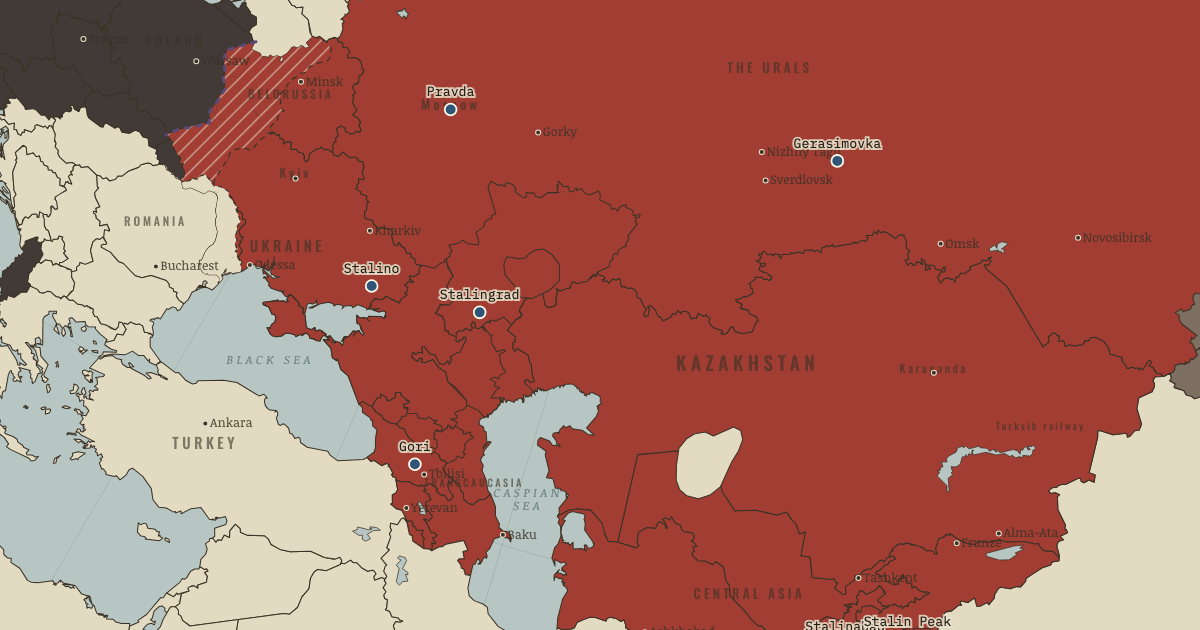
The map above is the world of The Soviet Union, September–December 1939 — Eastern Poland annexed; Stalin turns sixty.
Part of IB History: The Soviet Union under Stalin →
BRIEF EXPLANATION — THE ESSENTIAL ARGUMENT
Stalin’s rule depended on persuasion as well as fear, and the cult of personality was its most visible instrument. A cult of personality is the official worship of a living leader as wise, kind and infallible, much as a modern brand is built around a founder’s image, except that here doubting the image could lead to arrest. From Stalin’s fiftieth birthday in December 1929 his portrait, name and words filled newspapers, schools, factories and public squares, and he was hailed as the vozhd (“leader”), the “Lenin of today” and the “father of peoples”. The map shows one sign of the cult: the markers are places renamed in his honour, from Stalingrad on the Volga to Stalinabad in Tajikistan and Stalin Peak, the highest mountain in the Union. Writing his name across the land made the leader seem as permanent as the map itself.
The cult was one part of a larger propaganda state that tried to shape what people knew, read and remembered. Writers and artists had to follow socialist realism, the doctrine that art should show reality “in its revolutionary development”, which meant portraying life as it was supposed to become, much as an architect’s drawing shows a building before it exists. History was rewritten in the Short Course of 1938, a party history edited by Stalin that made him Lenin’s chief helper and erased leaders removed in the purges, the waves of expulsions and arrests, from the record, even from photographs. Schools taught Russian national heroes again, and children were offered martyrs such as Pavlik Morozov, a village boy said to have denounced his father and been killed by relatives for it. Many people believed much of what they heard, especially the young, while others repeated it in public and joked about it in private. The cult made loyalty to the system and loyalty to one man the same thing, which is why its later demolition shook the system itself.
The full story
The cult was manufactured deliberately, and its starting point is precise. For Stalin’s fiftieth birthday on 21 December 1929, Pravda (“Truth”), the party’s daily newspaper, printed page after page of tributes from his colleagues, at the very moment the forced collectivisation of the Great Turn began. From then on, his image was linked to the “revolution from above”, the transformation of the country by state command: speeches ended with ovations, letters thanked him personally, and his name was attached to cities, factories, collective farms and the Union’s highest peak. Stalingrad had been named in 1925, and in the 1930s Stalino, Stalinabad, Stalinsk and Stalinogorsk followed, as the markers show. Stalin corrected drafts of his own praise and sometimes toned it down, presenting himself as a modest servant of the party. The cult worked because it attached a human face to an abstract and often frightening state.
Propaganda reached into art, education and history, and in each field it combined revolutionary language with older traditions. The First Congress of Soviet Writers in 1934 adopted socialist realism, the rule that art must show life as the party said it was becoming. Writers were reminded that Stalin had called them “engineers of human souls” in 1932, meaning that literature should shape people as engineers shape machines. In the mid-1930s schools returned to textbooks, exams and discipline, and history lessons restored Russian heroes such as Alexander Nevsky and Peter the Great, whom Sergei Eisenstein’s film of 1938 and new textbooks presented as forerunners of Soviet patriotism. The Short Course of 1938, the official party history edited by Stalin, became compulsory reading for every party member, with tens of millions of copies printed by 1953. It inflated Stalin’s role in the civil war, including at Tsaritsyn, later renamed Stalingrad, and turned the leaders purged, or expelled and arrested, in 1936–38 into traitors from the start. The past was rewritten so that it pointed only towards Stalin.
How far people believed the propaganda is hard to measure, and historians use diaries, letters and police reports on popular mood to test it. Diaries studied by Jochen Hellbeck show young people trying sincerely to remake themselves as good Soviet citizens. NKVD reports studied by Sarah Davies record jokes, rumours and complaints, such as peasants who called the collective farms a second serfdom. Many people believed in the goals while doubting the methods, and learned what Stephen Kotkin calls “speaking Bolshevik”, using the official language to make claims and protect themselves. Children were offered heroes like Pavlik Morozov, said to have denounced his own father, and the Young Pioneers and the Komsomol, the communist youth organisations, enrolled millions. The cult needed everyone’s public participation, whatever they privately believed, and that demand turned each citizen into a performer of loyalty.
DEEP EXPLANATION — EVIDENCE & INTERPRETATION
How the cult was made
The cult was a system with many authors organised around one man, as Jan Plamper’s The Stalin Cult (2012) shows by studying it as a production process involving artists, editors, censors and Stalin himself. Paintings and posters followed rules: Stalin was usually shown slightly above or beside Lenin, calm and taller than those around him, and his pockmarked face and withered left arm were never shown. Approval passed through committees, and artists competed for commissions and prizes, including the Stalin Prizes established in 1939. Stalin intervened selectively, sometimes cutting excessive praise, sometimes ordering a play or a history rewritten. Plamper argues that the cult drew on older traditions of veneration for the tsar and for Orthodox saints, while using modern mass media, radio, cinema and mass-circulation newspapers, to reach the whole population. Other historians, such as Sarah Davies and Jeffrey Brooks, analyse how newspapers organised gratitude: citizens were shown thanking the leader for gifts such as new factories, which turned public goods into personal favours from Stalin. Its many authors explain how the cult could look spontaneous while being managed in detail.
The return of Russian history
Propaganda in the 1930s changed direction because its original revolutionary message was failing, as David Brandenberger’s research, especially National Bolshevism (2002) and Propaganda State in Crisis (2011), shows. Early Soviet propaganda had celebrated class struggle and internationalism, with heroes drawn from the revolution and the civil war. The Terror destroyed many of those heroes, since commanders and party leaders praised one year were exposed as traitors the next, and textbooks had to be withdrawn. From 1934 the regime increasingly turned to Russian history: the 1937 school textbook edited by Andrei Shestakov, films about Alexander Nevsky and Peter the Great, and the celebration of Pushkin’s centenary in 1937. The 1937 textbook even judged the tsars’ conquest of Ukraine and Georgia a “lesser evil”, since the alternative had been rule by Poland, Persia or Turkey. Brandenberger argues that these traditional national heroes mobilised ordinary people more effectively than abstract Marxism. The shift also elevated Russians as the “first among equals” of Soviet peoples, a theme that grew stronger in the war and helps explain the growing suspicion of other nations.
Belief, performance and dissent
Soviet citizens ranged from sincere believers to quiet sceptics, and historians have argued since the 1950s over which was typical. Older totalitarian theory, from Hannah Arendt and Carl Friedrich and Zbigniew Brzezinski, assumed that propaganda and terror together created atomised individuals with no independent views. Social historians found more varied attitudes. Sarah Davies’s Popular Opinion in Stalin’s Russia (1997) uses police reports on the popular mood to show widespread grumbling, especially about prices, privileges and the 1936 constitution’s empty promises. Jochen Hellbeck’s Revolution on My Mind (2006) uses diaries to show people who genuinely wanted to become new Soviet persons and struggled with their own doubts. Stephen Kotkin’s “speaking Bolshevik” describes a middle ground in which people used official language to pursue their interests. The sources themselves are problematic: police reports looked for enemies, and diaries were written in fear of being read. The likeliest picture is a society in which belief, doubt and pretence coexisted, often inside the same person.
Key places on the map
On this day
Why it happened
A leader without rivals needed a public image. Stalin had defeated every rival by 1929, yet he lacked Lenin’s authority and Trotsky’s fame. The cult gave him a legitimacy based on wisdom and success, linking him to Lenin and to every achievement of the plans. His colleagues, who had known him as one leader among several, competed to praise him, because public devotion became a test of their own loyalty. Without it, the sacrifices of collectivisation and industrialisation would have been demanded by a committee; with it, they were demanded by the leader of the revolution.
A poorly educated society needed simple messages. Millions of new workers and peasants had little schooling, and the regime set out to reach them through posters, radio, film and slogans. A single heroic leader was easier to understand than Marxist theory, and images of Stalin among workers, children and soldiers carried the message without words. Literacy campaigns, which raised literacy sharply in the 1930s, also gave propaganda a larger reading audience, and wired radio loudspeakers in squares and workplaces reached those who still could not read.
Russian traditions of the ruler as father. Many peasants had grown up with the image of the tsar as a distant father whose officials were to blame for injustice. The cult reused that pattern: Stalin was kind and wise, and local officials were blamed for “excesses”, as in the article “Dizzy with Success” of 1930. Plamper and others argue that this continuity helped the cult take root among people who disliked the regime’s policies but could still hope the leader would correct them.
The Terror required a new history. Each show trial turned former heroes into traitors, which made existing histories and textbooks obsolete overnight. Libraries removed books by and about the condemned, and owners inked out their faces in photographs. The regime needed a single authoritative account that explained the purges and placed Stalin at the centre of the revolution. The Short Course of 1938, written to Stalin’s instructions and corrected by him, supplied it and became the basis of all teaching.
THE TURNING POINT
Pravda, 21 December 1929. The birthday issue of Pravda in December 1929 marks the turn because it launched the public cult at exactly the moment Stalin began the revolution from above. Until then he had presented himself as one member of a collective leadership; afterwards, the newspapers attributed policy and success to him personally, and every colleague competed to praise him. Linking the cult to the Great Turn meant that support for the plans became loyalty to Stalin, so that criticism of collectivisation or industrialisation could be treated as an attack on the leader himself.
What it changed
Loyalty to one man became loyalty to the state. Because propaganda presented every achievement as Stalin’s, any doubt about policy became a political crime under Article 58 on “anti-Soviet agitation”. Telling a joke about Stalin could bring a camp sentence, and thousands were convicted for such remarks. The cult therefore reinforced the Terror and the Gulag, which punished what it forbade, and made silence the safest form of loyalty.
Russian patriotism mobilised for war. The return to Russian heroes prepared the population for a national war. In 1941 Stalin invoked Alexander Nevsky, Dmitry Donskoy, Suvorov and Kutuzov, and wartime propaganda appealed to the motherland as much as to socialism. Soldiers went into battle with the cry “For the Motherland, for Stalin!”, which joined the two loyalties in one slogan, and the war completed the turn from revolutionary to patriotic legitimacy.
The cult reached its peak after victory. For his seventieth birthday in December 1949, gifts from around the world filled a Moscow museum and his portrait was lit in the night sky above the city. The cult spread to the new satellite states of Eastern Europe, where cities and streets were renamed for him too, so the cult became one of the exports of Soviet power, imposed along with it.
Its demolition shook the system. When Khrushchev denounced the “cult of personality” in 1956, he attacked the image on which the regime had built its legitimacy for a generation. Cities were renamed again, statues removed and Stalin’s body taken out of the Lenin Mausoleum in 1961. The shock to believers, and the protests it set off in Georgia and Eastern Europe, showed how much legitimacy had rested on one face.
DISCUSSION QUESTION — Did most Soviet citizens believe the propaganda of the Stalin era?
The evidence suggests that belief varied by age, place and experience, and that public participation mattered more to the regime than private conviction. Diaries studied by Hellbeck show sincere efforts, especially among the young and the newly educated, to become good Soviet citizens, and many workers who rose through the plans had reasons to believe in a system that promoted them. Police reports studied by Sarah Davies record widespread jokes, complaints and rumours, particularly among peasants who had lived through collectivisation and famine. Kotkin’s idea of “speaking Bolshevik” suggests that many people adopted the official language without full belief, using it to advance and protect themselves. These sources have limits: police looked for dissent, and diarists feared discovery. A careful answer therefore avoids a single verdict and distinguishes belief in socialist goals, which was common, from belief in specific claims, which was weaker. The broader insight is that authoritarian propaganda often succeeds by making public conformity normal, whatever people think in private.
An interesting fact
Photographs were edited to follow the purges, and the most famous example involves Nikolai Yezhov, the police chief who ran the Terror. In 1937 he was photographed walking beside Stalin along the bank of the new Moscow–Volga Canal. After Yezhov was arrested in 1939 and shot in 1940, the image was retouched so that Stalin walked alone beside the water, Yezhov replaced by the canal behind him. The British designer David King collected hundreds of such altered images, from removed faces to painted-over figures, and published them in The Commissar Vanishes (1997), which shows how thoroughly the visual record was revised.
Related
THE FREE PRINTABLE STUDY GUIDE
Join the Dispatch — a short welcome series, then a letter when a new atlas opens — and the printable study guide for The Soviet Union under Stalin is yours now, free.
NO TRACKING · YOUR ADDRESS IS USED FOR THE DISPATCH AND NOTHING ELSE · UNSUBSCRIBE ANYTIME