ONE LAND · 7 ATLASES
History of Kenya in maps
Kenya as it appears in 7 interactive history atlases, from 1890 to 2015: Kenya. Each era below lists who ruled the land and when control changed, linked to the dated map that shows it.
WW2 is free — every chapter. Try chapters 1–2 of any 2 other atlases (3 with a free account). Opening a new atlas uses one of them. Membership opens all 21 — Join.
Free printable Haiti and Kenya independence study guide, sent by email ↓
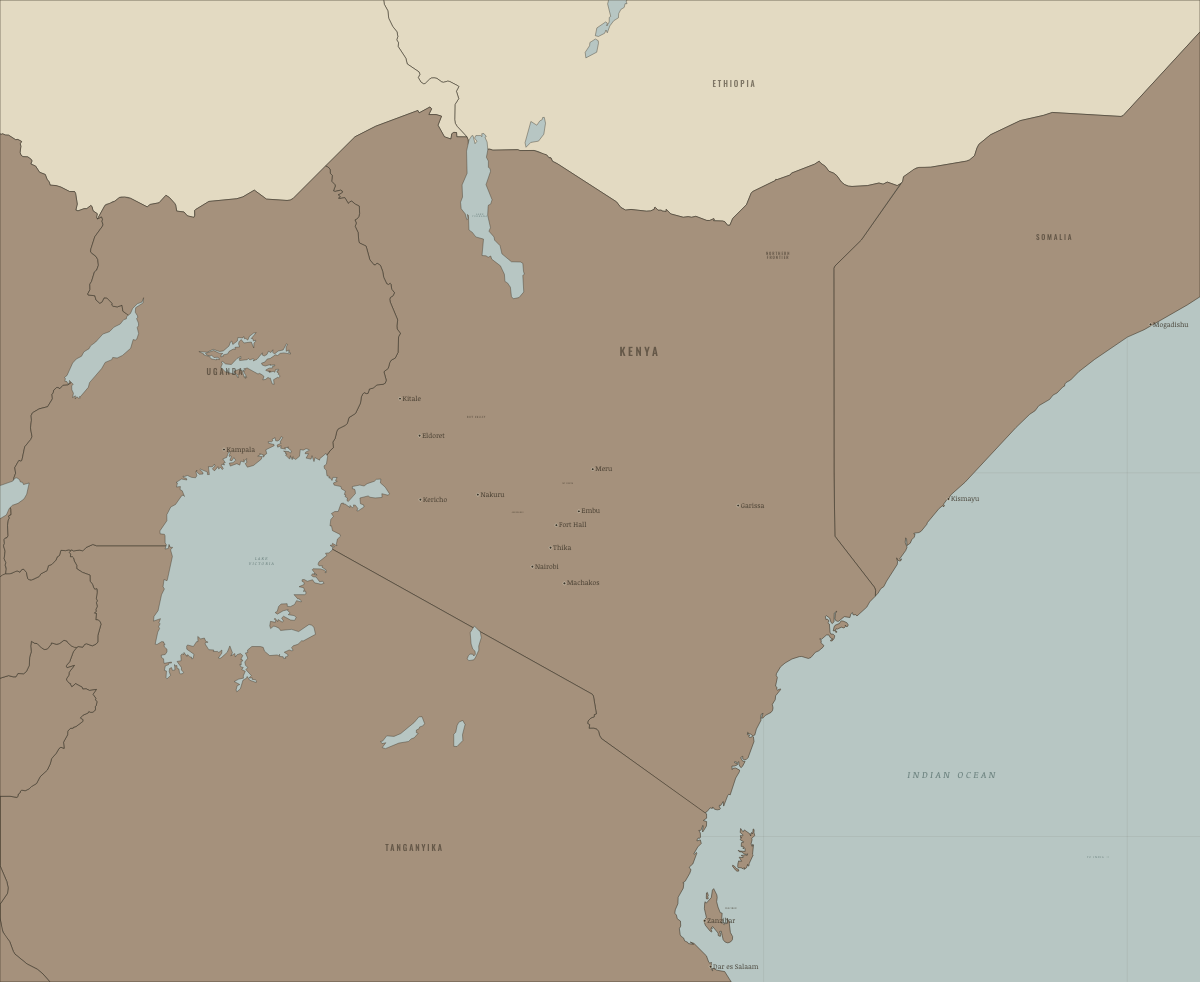
What was Kenya before it was Kenya? Below, every era of this land in the Maps of History atlases — who ruled it, what it was called, and when control changed — each line linked to the dated map that shows it. Modern borders stand in as an honest approximation; every atlas says so on the map itself.
Kenya · Industrial Revolution
| Colony or dependency — the opening position | |
| Colony or dependency |
INDUSTRIAL REVOLUTION: EVERY CHAPTER AND MAP →
Kenya (East Africa Protectorate; Kenya Colony) · Haiti and Kenya independence
Kenya began as the East Africa Protectorate in 1895 and became Kenya Colony in 1920, its highlands reserved for European settlers along the Uganda Railway. Land and labour were its central grievances, from the kipande to the squatters’ evictions, and they exploded in the Emergency of 1952–60. Independence came on 12 December 1963 under Jomo Kenyatta, through negotiation, with the colonial state, its borders and a market in land passed on intact.
| Other states and societies — the opening position | |
| Under colonial rule | |
| Self-rule in all but name | |
| Independence won |
HAITI AND KENYA INDEPENDENCE: EVERY CHAPTER AND MAP →
Kenya · WWI
| Entente-aligned & imperial territories — the opening position |
Kenya · Road to WW2
| Colonial empires & possessions — the opening position |
ROAD TO WW2: EVERY CHAPTER AND MAP →
Kenya · Cold War
| NATO & core Western allies — the opening position | |
| Non-aligned & neutral |
COLD WAR: EVERY CHAPTER AND MAP →
Kenya · Decolonization of Africa
Kenya was a settler colony, and so its road ran through war: the Mau Mau uprising of the 1950s and its brutal suppression — detention camps, tens of thousands dead — preceded a negotiated independence in December 1963. Jomo Kenyatta, jailed by the British as a Mau Mau leader, took power preaching Harambee and reconciliation with the settlers who remained. Freedom bought with an insurgency the British fought savagely and long tried to forget.
| British-ruled — the opening position | |
| Independent Africa |
DECOLONIZATION OF AFRICA: EVERY CHAPTER AND MAP →
Kenya · Feminism and the Tunisian Revolution
Kenya acceded to CEDAW in 1984 and in July 1985 hosted the Nairobi conference that closed the UN Decade for Women, where most of the 12,000 to 15,000 participants in the NGO Forum came from the Global South. The Kenyan biologist Wangari Maathai, founder of the Green Belt Movement in 1977, showed how rural women organised around land, trees and water.
| Authoritarian, one-party or colonial rule — the opening position | |
| No reform yet / outside this story | |
| Right won in law |
FEMINISM AND THE TUNISIAN REVOLUTION: EVERY CHAPTER AND MAP →
Related
THE FREE PRINTABLE STUDY GUIDE
Join the Dispatch — a short welcome series, then a letter when a new atlas opens — and a printable atlas study guide of your choice is yours now, free.
NO TRACKING · YOUR ADDRESS IS USED FOR THE DISPATCH AND NOTHING ELSE · UNSUBSCRIBE ANYTIME