Russian Revolution · NOV 1905
Why did 1905 fail when 1917 succeeded?
The seminar question: “1905 failed and 1917 succeeded. What was different — the regime, the revolutionaries, or the circumstances?”
Under Nicholas II, Russia industrialised without political reform: an autocracy with no constitution or parliament, crowded factory cities and a land-hungry peasantry. In 1905 defeat by Japan and the shooting of petitioners on Bloody Sunday set off revolution, and the Tsar answered with the October Manifesto.
Chapter 3 is part of membership. WW2 is free — every chapter. Try chapters 1–2 of any 2 other atlases (3 with a free account). Opening a new atlas uses one of them. Membership opens all 21 — Join.
Free printable Russian Revolution study guide, sent by email ↓
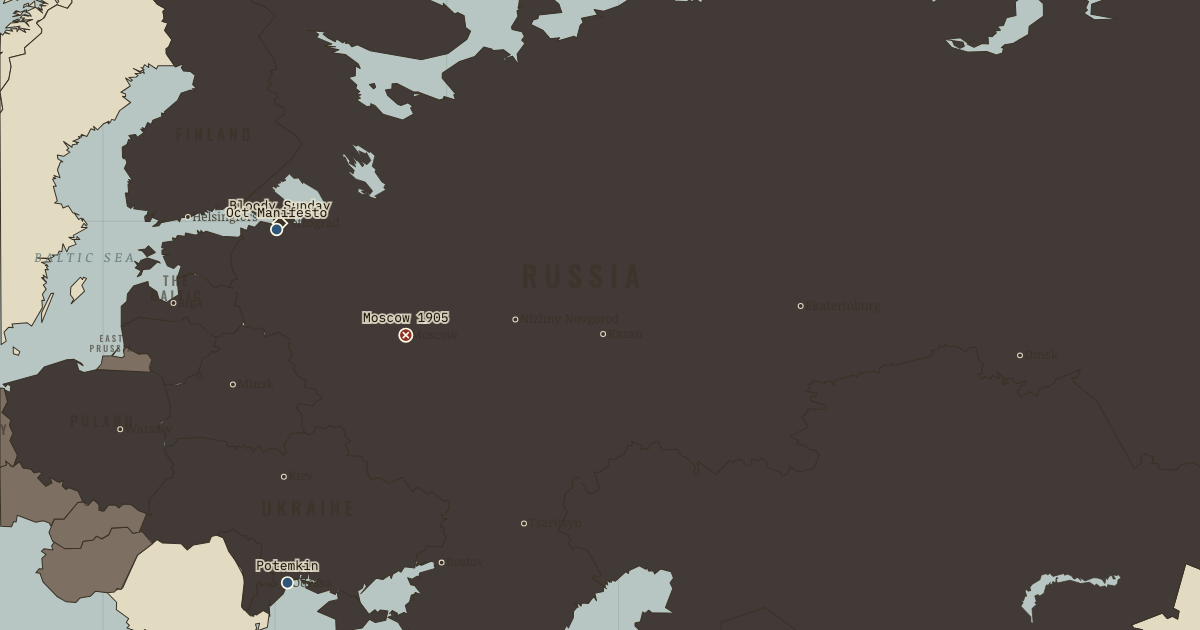
Autocracy in Russia meant personal rule, and its central weakness was the absence of any institution that could take the responsibility when things went wrong. Nicholas II inherited a throne with no constitution, no responsible ministry, and no legal opposition, so every grievance, over wages, land, censorship or defeat, flowed directly to him. Every European monarchy that survived the century had learned to place a parliament between the crown and popular anger, and Russia had not, so a system with no way to release pressure eventually bursts under it.
The short answer
- Autocracy without a shock-absorber. Every European monarchy that survived the century had learned to share power with a parliament that could take the blame for hard times. Russia’s did not. With no legal way to channel discontent, every grievance. Wages, land, ethnic grievance, censorship. Flowed straight to the throne. A system with no valves eventually bursts.
- Industrialization outran the state. Witte modernized the economy without modernizing the politics. He built the factories that concentrated hundreds of thousands of workers in a handful of cities, and the railways that could carry a strike nationwide in days. Then left them under a police regime designed for a nation of scattered villages. Modernization created the very class the autocracy could least control.
- The unanswered land question. Freed in 1861 but land-hungry and debt-burdened, the peasantry. Four in five Russians. Wanted the gentry’s fields, full stop. No government dared give them away and none could survive refusing forever. This single unresolved demand would decide 1917, the civil war, and the fate of every army that promised or threatened the villages.
- A war lost to Japan. The 1904–05 war with Japan. Undertaken partly for prestige, “a short victorious war” to calm unrest. Ended in the loss of a fleet at Tsushima and a humiliating peace. Defeat by an Asian power the regime had despised stripped away its last aura of competence at the exact moment the cities exploded.
THE TURNING POINT
The October Manifesto, 17/30 October 1905. The autocracy’s cleverest and most fateful act. By conceding a parliament and liberties under duress, Nicholas divided a united opposition into satisfied liberals and betrayed radicals. And then survived to revoke most of it. The lesson each side drew was lethal: the regime learned that force plus a paper concession would work again. The left learned that the bourgeoisie would settle, and that next time the workers must not stop at a Duma.
What it changed
A pseudo-constitution. The Duma that met from 1906 was real enough to raise expectations and hollow enough to frustrate them: the Tsar could dissolve it, and Stolypin rigged the franchise until it was tame. Russia now had the forms of representative government without its substance. A grievance machine that taught a generation that reform inside the system was a dead end.
The soviet is invented. The 1905 Petersburg Soviet of Workers’ Deputies. A strike committee that became a rival authority. Was the template. Trotsky cut his teeth as its chairman. Twelve years later the word “soviet” would name the whole revolution. The institution was born here, in a dress rehearsal.
Stolypin’s wager on the peasant. The regime’s ablest servant tried to defuse the land bomb by creating a class of prosperous independent farmers out of the commune. “a wager on the strong.” It needed twenty years of peace. It got nine, and an assassin’s bullet in 1911. The land question rolled on, undefused, toward 1917.
The revolutionaries learn their trade. 1905 was a school. Lenin, Trotsky, the Mensheviks and the SRs all drew tactical conclusions. About soviets, about the army, about the peasantry, about not trusting liberal allies. That they would apply in 1917. A failed revolution that trains its survivors is more dangerous than one that never happened.
The full answer, argued
Mostly the circumstances, sharpened by learning. In 1905 the army stayed loyal and came home from a small colonial war to crush the cities. In 1917 the army was the revolution, millions of armed peasants broken by three years of industrial slaughter. The regime was no more flexible in 1917. Arguably less, with Nicholas at the front and Rasputin at court. And the revolutionaries were better organized and clearer-eyed. But the decisive variable was the World War, which did to the state in 1917 what a quick defeat by Japan could not do in 1905: dissolve its instrument of force. Note the pattern for every revolution you study. The question is rarely “are people angry?” (they usually are) but “does the state still command its soldiers?”
An interesting fact
The priest who led the Bloody Sunday procession, Father Georgy Gapon, ran a workers’ assembly founded with the blessing of the Okhrana — “police socialism,” the regime’s scheme to keep unions loyal by sponsoring them itself. The state’s own tame organization thus delivered the crowd to the guns; Nicholas, for his part, was not even in the Winter Palace that day but out at Tsarskoe Selo. Gapon escaped abroad, was briefly the most famous man in revolutionary Europe, and in 1906 was hanged in an empty Finnish dacha by Socialist-Revolutionaries convinced he was informing for the police again.
This is the study layer of Russian Revolution of 1905, chapter 3 of The Russian Revolution, 1855–1924; the full index of the atlas is here.
Related questions
THE FREE PRINTABLE STUDY GUIDE
Join the Dispatch — a short welcome series, then a letter when a new atlas opens — and the printable study guide for The Russian Revolution is yours now, free.
NO TRACKING · YOUR ADDRESS IS USED FOR THE DISPATCH AND NOTHING ELSE · UNSUBSCRIBE ANYTIME