Russian Revolution · FEB 1917
Was February 1917 a revolution or a self-made collapse?
The seminar question: “Was February 1917 a revolution the people made, or a collapse the regime brought on itself — the “leaderless revolution” thesis?”
Russia entered the First World War in 1914 unable to arm or supply its armies, and Tannenberg, the Great Retreat of 1915 and more than 1.8 million dead followed. In February 1917 bread queues in Petrograd swelled into strikes, the garrison deserted the regime, and Nicholas II abdicated at Pskov on 2/15 March.
Chapter 4 is part of membership. WW2 is free — every chapter. Try chapters 1–2 of any 2 other atlases (3 with a free account). Opening a new atlas uses one of them. Membership opens all 21 — Join.
Free printable Russian Revolution study guide, sent by email ↓
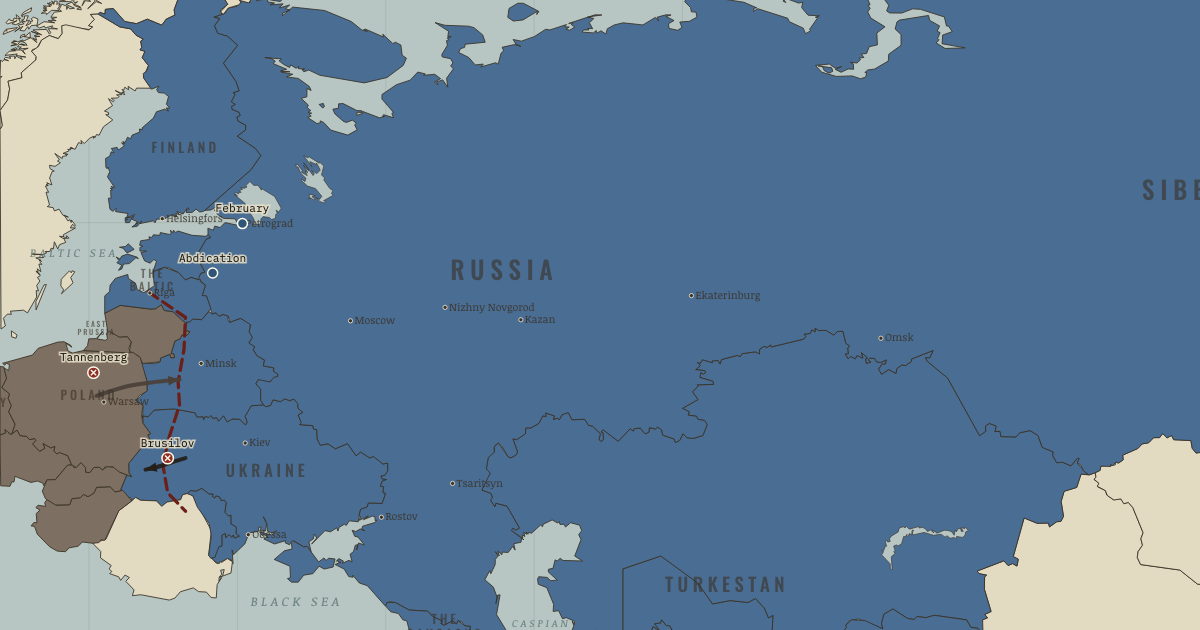
A state does not collapse simply because it loses battles; it collapses when it can no longer replace what it loses, feed its cities, and keep its soldiers believing that the sacrifice has a purpose. Imperial Russia failed on all three counts. It put millions of men into the field but often could not supply them with rifles or shells, so that courage turned into casualty lists of more than 1.8 million dead. Tannenberg destroyed one army in 1914, the Great Retreat lost Poland and Lithuania in 1915, and Brusilov’s costly 1916 offensive hurt Austria-Hungary while consuming the reserves Russia could not spare.
The short answer
- A war the state could not supply. Russia had the men and the courage and neither the industry nor the transport to sustain a modern war. Shell famine, rifle shortages, and a rail network that could carry troops or food but not both turned bravery into casualty lists. Over 1.8 million military dead. And casualty lists into a garrison that would not march.
- The Tsar takes command. By personally assuming supreme command in 1915, Nicholas fused the fate of the monarchy with the fate of a losing war and removed himself from a capital sliding into chaos. Every retreat was now his. The government left behind, discredited by the Rasputin scandal, commanded neither respect nor obedience.
- Cities starved while grain rotted. This was not a famine of absolute shortage but of breakdown: inflation destroyed the peasants’ reason to sell, and the railways could not move what there was. When the bread failed in Petrograd in February, the regime discovered that a hungry capital full of armed, mutinous reservists is a detonator, not a grievance.
- A monarchy that had run out of defenders. By 1917 Nicholas had alienated everyone: liberals wanted a real parliament, generals wanted competent government, workers wanted bread, peasants wanted land and peace. When the test came, not one significant group. Not even his own high command. Was willing to fight to keep him. Revolutions succeed when the regime’s own servants stop defending it.
THE TURNING POINT
Abdication at Pskov, 2/15 March 1917. The generals’ telegrams, not the Petrograd crowd, ended the dynasty: asked whether the army would restore order in the capital, every front commander advised the Tsar to go. This is the deep mechanism of February. The revolution did not defeat the autocracy’s army. The autocracy’s army declined to defend it. A regime is only as strong as the willingness of its men to kill for it, and in March 1917 that willingness was gone.
What it changed
Dual power is born the same week. Two bodies emerged from the ruins: a Provisional Government of liberal notables claiming legal authority, and the Petrograd Soviet of workers’ and soldiers’ deputies commanding the actual loyalty of the streets and the garrison. Neither could govern without the other, and they wanted opposite things. That contradiction is the whole plot of 1917.
Order No. 1 dissolves the old army. The Soviet’s first decree told soldiers to obey their officers only when the Soviet agreed, and to elect committees. It was meant to protect the revolution from a counter-coup. It also meant the army as a disciplined instrument was finished. From here the millions of armed peasants in uniform would vote with their feet. Toward home and land.
A dynasty gone, with no plan for what replaces it. Nobody had prepared to govern. The men who inherited power were as surprised as the crowd, committed to a war the crowd would not fight, and legitimated by nothing but the emergency. The vacuum they could not fill is what Lenin would step into.
The full answer, argued
Both, and the tension is the point. No party organized the February rising. The Bolshevik leaders were in exile or Siberia and as astonished as anyone. In that sense it was a spontaneous, leaderless collapse. The state simply lost the loyalty of its soldiers, and fell. But “leaderless” can be overstated: years of underground organizing, the 1905 template, war-weariness deliberately fanned, and a working class schooled in strikes all shaped how the collapse turned into a transfer of power. The transferable lesson: mass anger topples nothing by itself. It topples a regime when the regime’s own coercive core defects. And whoever is organized enough to fill the resulting vacuum, however small, inherits the state. In February no one was ready. By October someone was.
An interesting fact
Russia arguably had one more tsar after Nicholas — for about a day. He first abdicated in favor of his son, then, once his physician confirmed that the hemophiliac Alexei could not live apart from his parents, rewrote the manifesto that same evening for his brother, Grand Duke Michael. Sounded out in a Petrograd apartment the next morning and told his safety could not be guaranteed, Michael declined the crown unless a constituent assembly offered it — so the dynasty ended in two abdications, the second by a “Michael II” whom no one had crowned and whom jurists doubted was ever legally tsar at all.
This is the study layer of February Revolution, chapter 4 of The Russian Revolution, 1855–1924; the full index of the atlas is here.
Related questions
THE FREE PRINTABLE STUDY GUIDE
Join the Dispatch — a short welcome series, then a letter when a new atlas opens — and the printable study guide for The Russian Revolution is yours now, free.
NO TRACKING · YOUR ADDRESS IS USED FOR THE DISPATCH AND NOTHING ELSE · UNSUBSCRIBE ANYTIME