Russian Revolution · JUL 1918
How did the Czechoslovak Legion start a full civil war?
The seminar question: “How did a stranded foreign legion turn a simmering conflict into a full civil war — and what does that say about contingency in history?”
In 1918 a clash with some 40,000 soldiers of the Czechoslovak Legion strung along the Trans-Siberian Railway turned into revolt, and anti-Bolshevik governments such as Komuch at Samara rose in its wake. After Kazan and the imperial gold fell in August, Trotsky’s armoured train at Sviyazhsk halted the Red rout.
Chapter 8 is part of membership. WW2 is free — every chapter. Try chapters 1–2 of any 2 other atlases (3 with a free account). Opening a new atlas uses one of them. Membership opens all 21 — Join.
Free printable Russian Revolution study guide, sent by email ↓
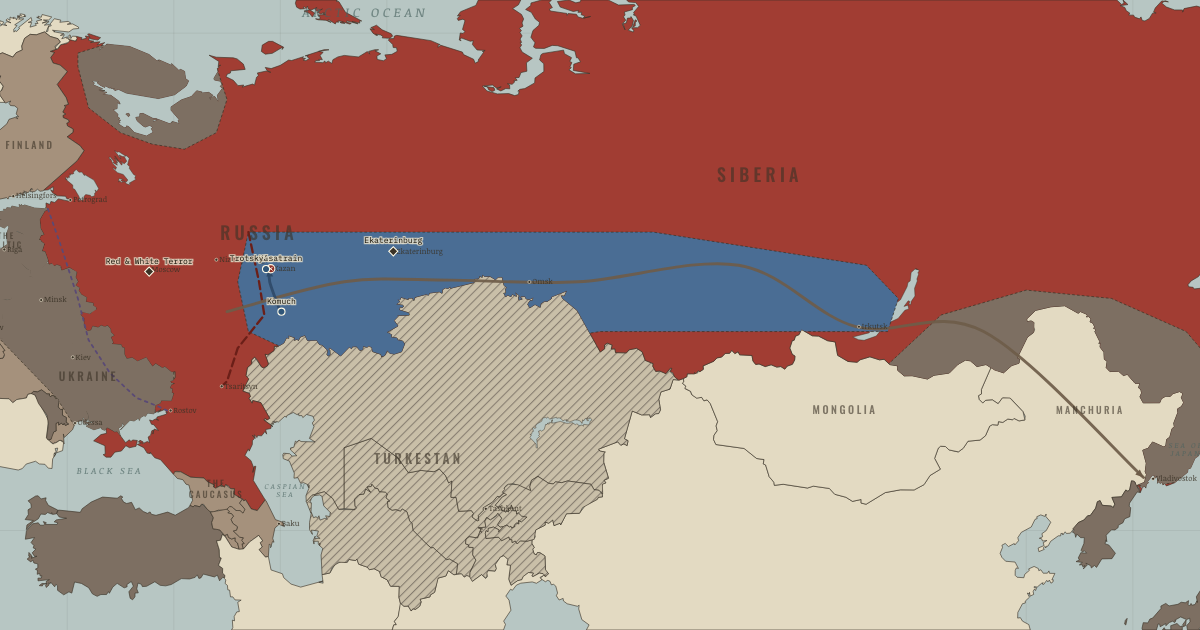
The event that turned a set of scattered risings into a continental civil war was not planned by anyone. The Czechoslovak Legion consisted of former prisoners traveling east to keep fighting for the Allies, and a chance clash together with a Bolshevik disarmament order turned their movement into revolt. Because the Trans-Siberian was Siberia’s single main artery, seizing its stations gave the Legion control of enormous stretches of the country, and the Socialist-Revolutionaries who had been thrown out of the Constituent Assembly used that opening to form Komuch at Samara and raise a People’s Army. Suppressing the democrats had not made them vanish; it had turned them into belligerents with an army behind them.
The short answer
- The accident of the Legion. Nobody planned the event that started full-scale civil war. A stranded foreign army, a botched disarmament order, a railway that was the only thing holding Siberia together. And suddenly the Bolsheviks had lost the entire east. It is the purest case in this atlas of contingency: a chance revolt handing shape and territory to a scattered opposition.
- The dispersed Assembly finds an army. The SRs who had won the election and been thrown out of the Constituent Assembly now had, in the Legion, the bayonets to set up a rival state. October’s refusal to accept the ballot came back as armed “democratic counter-revolution” on the Volga. Suppressing democracy did not make the democrats disappear. It made them belligerents.
- Geography: the railway is the country. In a roadless land of colossal distances, whoever held the Trans-Siberian held Siberia. The war would be fought along rail lines and rivers because there was almost no other way to move an army. The Legion’s seizure of the railway, and later the Reds’ command of the dense rail hub around Moscow, mattered more than any battle.
- A regime with its back to the wall. Cornered. The west ceded, the east lost, the cities starving, an assassin’s bullets in Lenin. The Bolsheviks reached for the tools of a state fighting for its life: conscription, ex-tsarist officers under commissar guard, requisitioning, and terror. The civil war made the Soviet state as much as the Soviet state fought the civil war.
THE TURNING POINT
Trotsky’s train at Sviyazhsk, August 1918. The moment the Reds stopped running. With Kazan lost and the road up the Volga to Moscow open, Trotsky arrived at the front in the armoured train that would become his mobile headquarters for the whole war, and stopped the collapse by every means at once. Medals and rations for the steadfast, ex-tsarist “military specialists” to command, commissars to watch them, and the firing squad for those who fled. Improvised here, this became the machine that won the war: a disciplined mass army wrung out of a country that had just abolished discipline.
What it changed
Full civil war, on every front. By late 1918 the fronts the map will show for two years are set: the Whites in Siberia (soon under Kolchak), in the south (Denikin), in the north-west (Yudenich), and the foreign contingents in the ports. The Soviet heartland is a red island in a ring of fire.
Terror becomes an institution. The Cheka, founded in December 1917 and unleashed in the autumn of 1918, made political terror a permanent organ of the state. Not a spasm but a department. The Whites’ counter-terror was as savage and less organized. This is the civil war’s deepest and most lasting bequest to the Soviet future.
The Red Army is built. From Trotsky’s summer of 1918 came a conscript army of five million, officered by 50,000 former tsarist professionals held hostage to their families and shadowed by political commissars. The irony is total: the workers’ state won its war with the Tsar’s officer corps.
The full answer, argued
The Czech Legion did not create the antagonisms. The dispersed Assembly, the requisitioning, the officers and Cossacks in revolt were all there. But it supplied the one thing the scattered opposition lacked: a disciplined army holding territory, along the one axis (the railway) that could turn local grievances into a continental front. Remove the Legion and the anti-Bolshevik forces might have stayed a set of uncoordinated risings the Reds could crush piecemeal. With it, they got Siberia, the gold, and a rival government overnight. This is the historian’s tension between structure and accident: the fuel had been laid (structure), but a chance spark chose the time and the shape of the fire (contingency). The mature view refuses to collapse one into the other. The civil war was made likely by conditions and made actual by an accident nobody intended.
An interesting fact
The imperial gold seized at Kazan went on one of history’s strangest journeys: loaded into trains, it followed Kolchak’s retreat east across Siberia until the Czechoslovak Legion, bargaining for its own passage home, handed the remainder — and Kolchak himself — over at Irkutsk in early 1920. Soviet accountants reckoned that roughly a third of the treasure was gone, spent on White arms or simply vanished en route; the exact shortfall is still argued. Legends of a lost consignment at the bottom of Lake Baikal persist to this day — submersibles went looking as recently as 2009.
This is the study layer of Outbreak of the Russian Civil War, chapter 8 of The Russian Revolution, 1855–1924; the full index of the atlas is here.
Related questions
THE FREE PRINTABLE STUDY GUIDE
Join the Dispatch — a short welcome series, then a letter when a new atlas opens — and the printable study guide for The Russian Revolution is yours now, free.
NO TRACKING · YOUR ADDRESS IS USED FOR THE DISPATCH AND NOTHING ELSE · UNSUBSCRIBE ANYTIME