Russian Revolution · FEB 1919
What mattered most in the Reds’ civil war victory?
The seminar question: “Blockaded, outnumbered in territory and faced by professional armies with foreign backing, the Reds won. Which mattered most — geography, organization, or politics?”
The Reds won the civil war of 1918–20 despite blockade and foreign-backed enemies because they held the Moscow–Petrograd core, with its arms factories, railway hub and two-thirds of the population. They fought on interior lines against White armies that never attacked together, and peasants feared the Whites’ landlords more.
Chapter 9 is part of membership. WW2 is free — every chapter. Try chapters 1–2 of any 2 other atlases (3 with a free account). Opening a new atlas uses one of them. Membership opens all 21 — Join.
Free printable Russian Revolution study guide, sent by email ↓
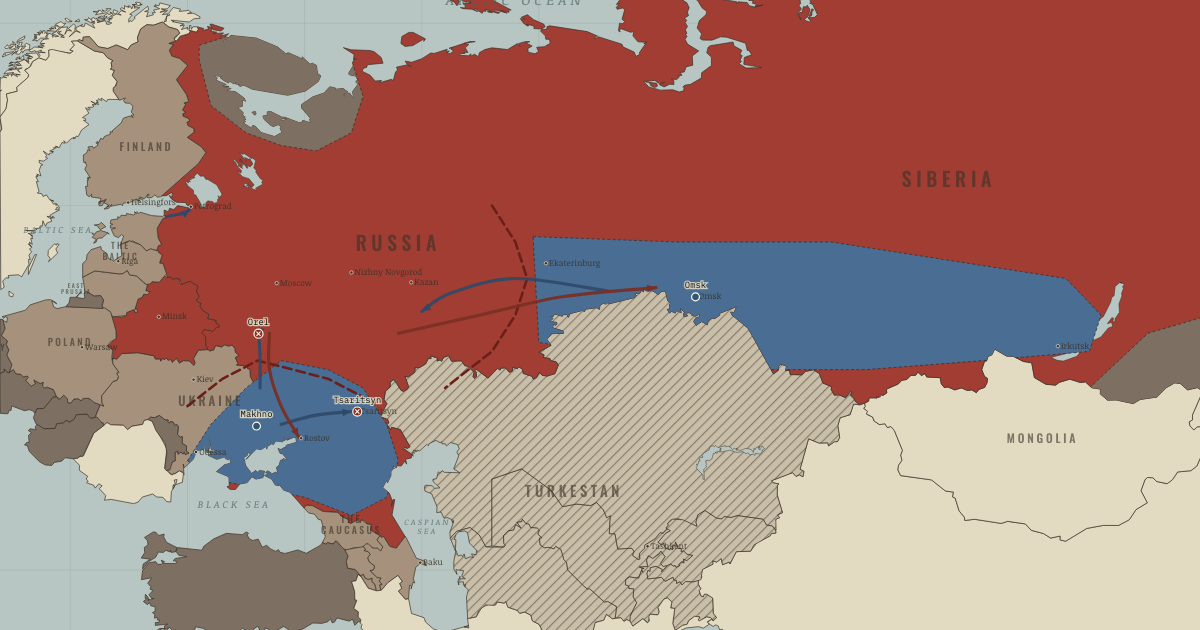
The Red position looked desperate but rested on a decisive advantage of geography. The compact central region the Reds held was small on the map yet contained the capital, the main arms factories, the government offices and the densest railway network, along with most of the population. Because they held the center, the Reds fought on interior lines, meaning the shorter routes inside an encircling ring, and could move a division from the Siberian front to the southern front within a week. Kolchak in Siberia, Denikin in the south and Yudenich before Petrograd stood thousands of kilometers apart and never coordinated their offensives, so the Reds were able to mass against one enemy at a time and defeat them in turn.
The short answer
- Interior lines and the railway hub. Holding the center meant the Reds could move a division from the Siberian front to the southern front in a week. The Whites, on the circumference, could not move troops between fronts at all. In a war fought on railways across a continent, geometry was destiny. The compact red core on the map is not a weakness. It is the reason for victory.
- One command against three. The Reds had unity of purpose, party and army. The Whites had a quarrel of generals. Kolchak, Denikin and Yudenich never mounted a coordinated offensive, so the Reds never had to fight more than one seriously at a time. A divided enemy attacking in sequence can be beaten by a smaller force attacking in turn.
- The peasant fears the landlord more than the commissar. The Whites could never escape their social base. Committed to “Russia one and indivisible” and shadowed by returning landlords, they alienated both the peasants (over land) and the nationalities (over independence). The two largest constituencies in the country. The Reds’ requisitions were hated. The Whites’ program was feared. Hatred loses to fear.
- War Communism and mass mobilization. By nationalizing the economy and requisitioning ruthlessly, the Reds concentrated a poor country’s whole surplus on the war, and conscripted an army of five million. It wrecked the economy. Production fell to a fifth of 1913. But it won the war. The bill came due in 1921.
THE TURNING POINT
Orel, October 1919 — the high-water that broke. Denikin’s advance on Moscow reached Orel, 400 km from the Kremlin. The closest the Whites ever came. And there it broke, for the reasons this chapter argues: the drive was a thin spearhead with no reserves, its rear was on fire with peasant and Makhnovist revolt, and the Reds. Fighting on interior lines. Massed everything they had for the counterstroke. The furthest White advance and the start of the Red flood outward happen at the same place and the same moment. After Orel, the map only reddens.
What it changed
The Whites doomed by their politics, not their soldiers. White armies fought superbly and still lost, because they could not answer the two questions that decided the war. Who gets the land, and what happens to the nations of the empire. A movement that offers the majority nothing they want cannot win a civil war, however good its cavalry.
A victorious but deformed state. The Reds won with the tools of War Communism, one-party rule, terror and a hostage officer corps. And those tools did not vanish with victory. The party that emerged in 1920 was more militarized, more centralized and more ruthless than the party that had seized power in 1917. You do not win a civil war by these means and stay unchanged.
The countryside pays and then revolts. The peasants let the Reds win, and were rewarded with more requisitioning. Once the White threat was gone, the arithmetic reversed. And in 1920–21 the villages that had tolerated the Reds rose against them. Victory over the Whites removed the only reason peasants had to endure War Communism.
The full answer, argued
All three braided together, but politics is the deepest. Geography (interior lines, the railway hub, the industrial and demographic core) gave the Reds a decisive operational advantage. They could always concentrate against one enemy at a time. Organization (one party, one army, unity of command, War Communism’s total mobilization) let them exploit that geography where the fractious Whites could not. But both served a political fact: the Reds had made a revolution the majority would not see reversed. The Whites lost because they could not offer the peasants land or the nationalities freedom without ceasing to be what they were. Defenders of “one and indivisible” Russia and, in the villages’ eyes, of the landlord. The transferable lesson of every civil war: military skill cannot rescue a cause the population has decided against, and the side that answers “who gets the land?” in the majority’s favor starts with the war half-won.
An interesting fact
Nestor Makhno’s afterlife is one of the war’s stranger codas. The peasant anarchist who had commanded tens of thousands across the steppe escaped over the Dniester into Romania in 1921, passed through internment camps and a Polish prison, and washed up in Paris — where the terror of Ukraine’s landlords worked shifts at the Renault plant and died of tuberculosis in 1934. His ashes were placed in Père Lachaise, the same cemetery where the Paris Communards had been shot in 1871.
This is the study layer of Why the Reds won the Russian Civil War, chapter 9 of The Russian Revolution, 1855–1924; the full index of the atlas is here.
Related questions
THE FREE PRINTABLE STUDY GUIDE
Join the Dispatch — a short welcome series, then a letter when a new atlas opens — and the printable study guide for The Russian Revolution is yours now, free.
NO TRACKING · YOUR ADDRESS IS USED FOR THE DISPATCH AND NOTHING ELSE · UNSUBSCRIBE ANYTIME