Russian Revolution · NOV 1917
Was the October Revolution a popular revolution or a coup?
The seminar question: “Was October a popular revolution or a coup — and does the distinction actually matter?”
On the night of 24–25 October 1917 Trotsky’s Military Revolutionary Committee occupied Petrograd’s bridges, telegraph and stations, and the Winter Palace fell with little fighting. The Bolsheviks presented the seizure as soviet power, issued decrees on peace and land, and dispersed the Constituent Assembly in January 1918.
Chapter 6 is part of membership. WW2 is free — every chapter. Try chapters 1–2 of any 2 other atlases (3 with a free account). Opening a new atlas uses one of them. Membership opens all 21 — Join.
Free printable Russian Revolution study guide, sent by email ↓
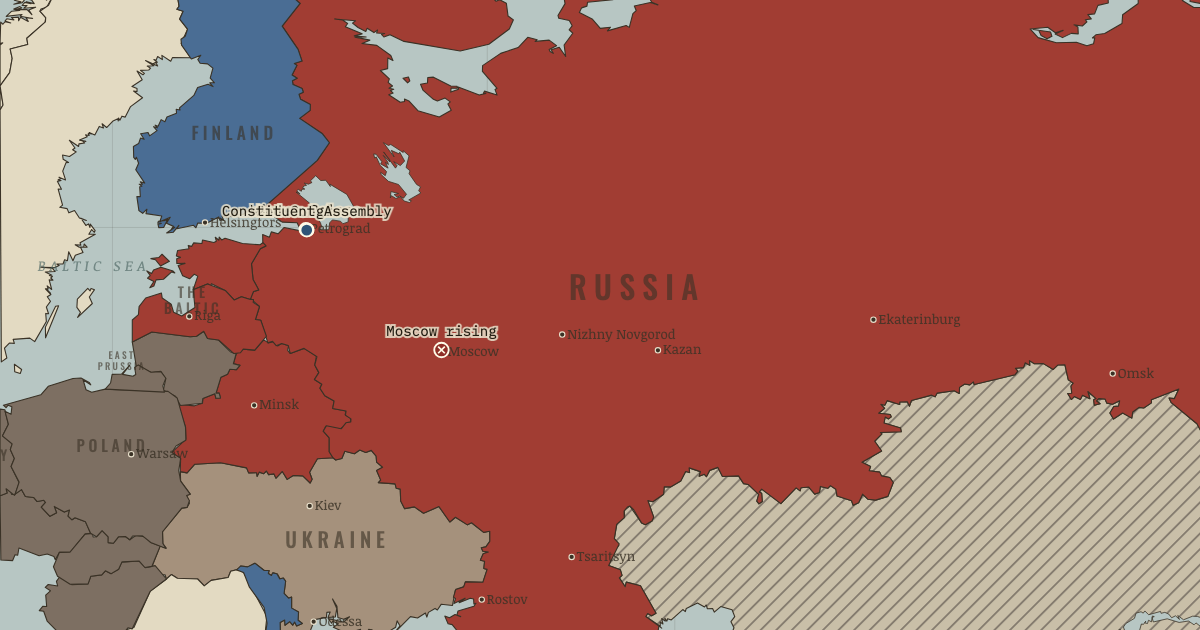
The seizure of power in October looked less like a storming than a quiet occupation of the machinery of a modern state. Trotsky, chairing the Petrograd Soviet, built a Military Revolutionary Committee that won over the garrison’s key units and then took control of the bridges, telegraph, railway stations, banks and power stations on which the government depended. The Winter Palace fell through scattered entry and arrest rather than the heroic mass assault of later films, Kerensky had already fled, and few people were prepared to fight for his government. Power in 1917 had become so hollow that a determined committee with a few thousand armed men could lift it off the floor.
The short answer
- Organization beats numbers. The Bolsheviks were never a majority of Russians, but in October they were the best-organized force in the two cities that ran the state, with a clear plan and a single will. Trotsky’s Military Revolutionary Committee turned the garrison’s passivity into an instrument. Revolutions are won at decisive points by whoever is concentrated there. Not by whoever is popular in general.
- The cover of the soviets. Seizing power in the name of the soviets, on the eve of their Congress, let a party coup wear the clothes of a mass mandate. It neutralized the many soldiers and workers who backed “soviet power” in the abstract but would not have marched for the Bolshevik Party by name. Legitimacy is often less about what is done than about the name under which it is done.
- A government no one would defend. The mirror of February: as almost no one had died for the Tsar, almost no one died for Kerensky. Eight months of postponement had left the Provisional Government without a constituency willing to fight for it. The Winter Palace fell easily because there was nothing left inside worth defending.
- Lenin’s insistence on timing. Lenin overrode cautious comrades who wanted to wait for the Congress or the Assembly, demanding the seizure come first, so power would be a fact the Congress merely blessed. Had they waited for the election they lost, October would have been impossible. He understood that in revolutions the calendar is a weapon.
THE TURNING POINT
The Winter Palace, night of 25 October/7 November 1917. The reality against the myth. There was no heroic storm. A few casualties, doors found open, a government arrested at a table. But the modesty of the event is exactly its lesson: state power in 1917 was so hollowed out that a determined committee with a few thousand armed men could pick it up off the floor. What made October world-historical was not the fighting but the claim staked that night. That this was Soviet power. And the willingness, three months later, to disperse an elected assembly rather than surrender it.
What it changed
“Soviet power” — and the decrees that bought it. The first acts were the Decree on Peace (an immediate armistice) and the Decree on Land (abolishing gentry property, ratifying the peasant seizures). By promising the soldiers home and the peasants the land, the new regime instantly out-bid every rival. And committed itself to a peace it would have to buy at Brest-Litovsk at a terrible price.
The Constituent Assembly dispersed — democracy’s fork. Losing the only free election it ever allowed, the regime chose the party over the ballot. This is where a plausible democratic revolution became a one-party state. Every later Soviet claim to represent “the people” has to be read against this single day in January 1918.
The lines of civil war are drawn. A minority party ruling by decree, having dissolved parliament and signing away the west, handed its enemies. Officers, Cossacks, SRs, nationalists, the Allies. Both motive and pretext. Within months armies would be forming on every frontier. October did not end the struggle for Russia. It started it.
The full answer, argued
By mechanism it was a coup: a disciplined minority seized the state at gunpoint in a single city and then dispersed the parliament that a majority had elected. By content it rode a genuine mass tide. The soviets really had gone Bolshevik, the soldiers really did want peace, the peasants really were taking the land, and the regime really did promise them all three. Both are true, which is why the argument never ends. Does it matter? Enormously, for how you read everything after. If October expressed the people’s will, the party dictatorship that followed is a betrayal to explain. If it was a coup wearing a mass costume, that dictatorship is the seed visible from the first night. The honest historian holds both: a real revolutionary situation, seized by a party that then refused to let the revolution be counted.
An interesting fact
The Winter Palace’s real siege began after it fell. Beneath it lay what was reputedly the largest wine cellar in the world, and for weeks Petrograd was convulsed by drunken looting as soldiers, sailors and passers-by fought over the Tsar’s vintages; guards posted on the cellars got drunk themselves. The Bolsheviks tried machine-guns, martial law and finally pumping the wine into the gutters — where crowds knelt to drink it out of the snow. The new regime’s first sustained security operation was directed not at counter-revolution but at a city-wide binge.
This is the study layer of October Revolution, chapter 6 of The Russian Revolution, 1855–1924; the full index of the atlas is here.
Related questions
THE FREE PRINTABLE STUDY GUIDE
Join the Dispatch — a short welcome series, then a letter when a new atlas opens — and the printable study guide for The Russian Revolution is yours now, free.
NO TRACKING · YOUR ADDRESS IS USED FOR THE DISPATCH AND NOTHING ELSE · UNSUBSCRIBE ANYTIME