Russian Revolution · JUL 1917
Could the Provisional Government have left the war?
The seminar question: “The Provisional Government kept Russia in the war — the decision that destroyed it. Given the pressures, could it realistically have chosen otherwise?”
From March to September 1917 the Provisional Government held legal authority while the Petrograd Soviet held the loyalty of soldiers and workers. Its decision to keep fighting the war, the failed June Offensive, the July Days and the Kornilov affair of late August made Lenin’s call for soviet power persuasive.
Chapter 5 is part of membership. WW2 is free — every chapter. Try chapters 1–2 of any 2 other atlases (3 with a free account). Opening a new atlas uses one of them. Membership opens all 21 — Join.
Free printable Russian Revolution study guide, sent by email ↓
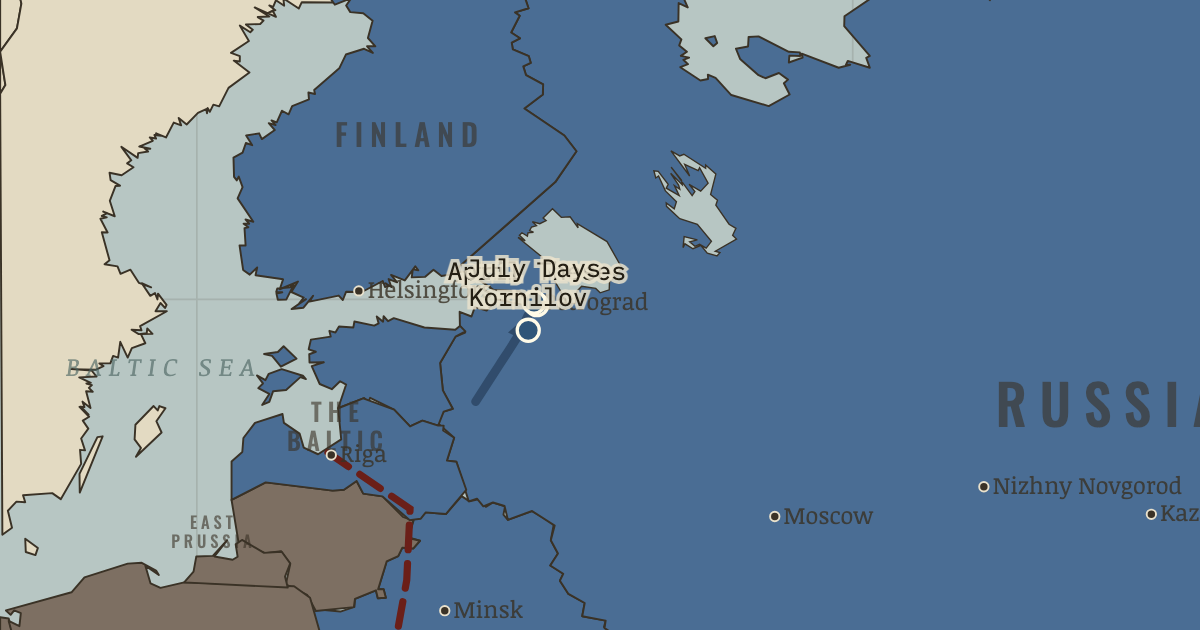
Dual power meant that the two things a government needs, legal authority and dependable force, had come apart. The Provisional Government possessed the offices and the recognition of Russia’s allies but could not be sure its orders would be obeyed, while the Petrograd Soviet commanded the loyalty of soldiers and workers without holding formal power. Into this deadlock stepped Lenin, returned in April with the April Theses, which rejected the war and the government outright and called for power to pass to the soviets. His stance isolated him at first, but the government’s own choices steadily made it look less like fantasy and more like a program.
The short answer
- Two powers, opposite aims. The Provisional Government wanted to keep faith with the Allies and postpone every hard question. Land, the constitution, the war. Until an elected assembly could meet. The Soviet answered to soldiers who wanted peace and peasants who wanted land now. A government that governs by postponement, over a population that has stopped waiting, is living on borrowed time.
- The fatal decision to continue the war. Every other choice flowed from this one. Fighting on meant no peace for the soldiers, no bread for the cities, and no land reform (you cannot redistribute land while the men who would farm it are at the front). The June Offensive’s failure destroyed the government’s last credit. Lenin’s genius was simply to promise the three things the government could not: “Peace, Land, Bread.”
- Lenin’s clarity in a fog. Alone among the leaders, Lenin refused all compromise and named a single goal. Soviet power. While everyone else sought coalitions and delay. In a revolution, a small, disciplined party that knows exactly what it wants has an overwhelming advantage over larger, decent, divided ones that do not.
- The Kornilov affair arms the left. Kerensky’s decision to arm the Bolsheviks against a general he feared more than he feared them was the hinge of 1917. It rescued a party that July had nearly destroyed, legitimized it as the revolution’s defender, and put guns in the hands of the Red Guard that would take the Winter Palace ten weeks later.
THE TURNING POINT
The Kornilov affair, late August 1917. The boomerang that armed the Bolsheviks. Whether Kornilov intended a coup or Kerensky imagined one, the effect is what matters: to stop the general, the premier legalized and armed the very radicals he had been jailing in July. The threat evaporated on the railways. But the Bolsheviks kept the weapons and gained the halo of the capital’s saviours. This is how October became possible: not through a surge of Bolshevik strength in the abstract, but through a self-inflicted wound by the government they would replace.
What it changed
The soviets go Bolshevik. Through September the Bolsheviks won majorities in the Petrograd and Moscow soviets. “All power to the soviets” now meant, in practice, power to them. And Lenin, from hiding, began bombarding the party’s cautious leaders with letters demanding insurrection at once, before the Constituent Assembly could meet and make a coup look illegitimate.
Kerensky discredited from both sides. The premier who had armed the Bolsheviks to stop a general was now trusted by neither. The right saw him as the man who had broken the army’s last defender. The left as a would-be dictator. He governed on nothing but momentum.
The countryside takes the land itself. While the politicians argued in Petrograd, peasants stopped waiting and seized the gentry’s estates through the summer and autumn. The greatest transfer of land in European history, accomplished from below. Whoever took power would either bless this or fight it. The Bolsheviks would bless it, then try to take the grain.
The full answer, argued
This is the great “what if” of 1917. The case that it was trapped: Russia was bound to the Allies by treaty and loans, the liberal ministers genuinely feared a separate peace would betray the democratic cause and let Germany win, and a unilateral armistice risked German occupation on far worse terms (as Brest-Litovsk would soon prove). The case that it chose wrongly: every month of war deepened the collapse it was trying to survive, and a government that had made peace and land its first acts might have stolen the Bolsheviks’ entire program. The likeliest judgment is that continuing the war was rational for the elite and suicidal for the state. The two were simply no longer the same thing. When a government’s survival and its commitments point in opposite directions, that is usually the moment a revolution becomes possible.
An interesting fact
The famous “sealed train” that carried Lenin home was sealed mostly by chalk: a line drawn across the corridor floor marked off the Russian exiles from their two German escort officers, and by agreement neither side crossed it. Lenin, characteristically, spent the journey legislating — he banished smokers to the lavatory, then issued paper permits when the queue of smokers and non-smokers began to quarrel. Churchill later fixed the image of the trip for good: Germany, he wrote, had transported Lenin into Russia “like a plague bacillus.”
This is the study layer of Dual power in Russia (1917), chapter 5 of The Russian Revolution, 1855–1924; the full index of the atlas is here.
Related questions
THE FREE PRINTABLE STUDY GUIDE
Join the Dispatch — a short welcome series, then a letter when a new atlas opens — and the printable study guide for The Russian Revolution is yours now, free.
NO TRACKING · YOUR ADDRESS IS USED FOR THE DISPATCH AND NOTHING ELSE · UNSUBSCRIBE ANYTIME