Road to WW2 · 1940
Did US economic pressure on Japan provoke war in 1941?
The seminar question: “Did American economic pressure cause war, determine its timing, or fail to prevent it?”
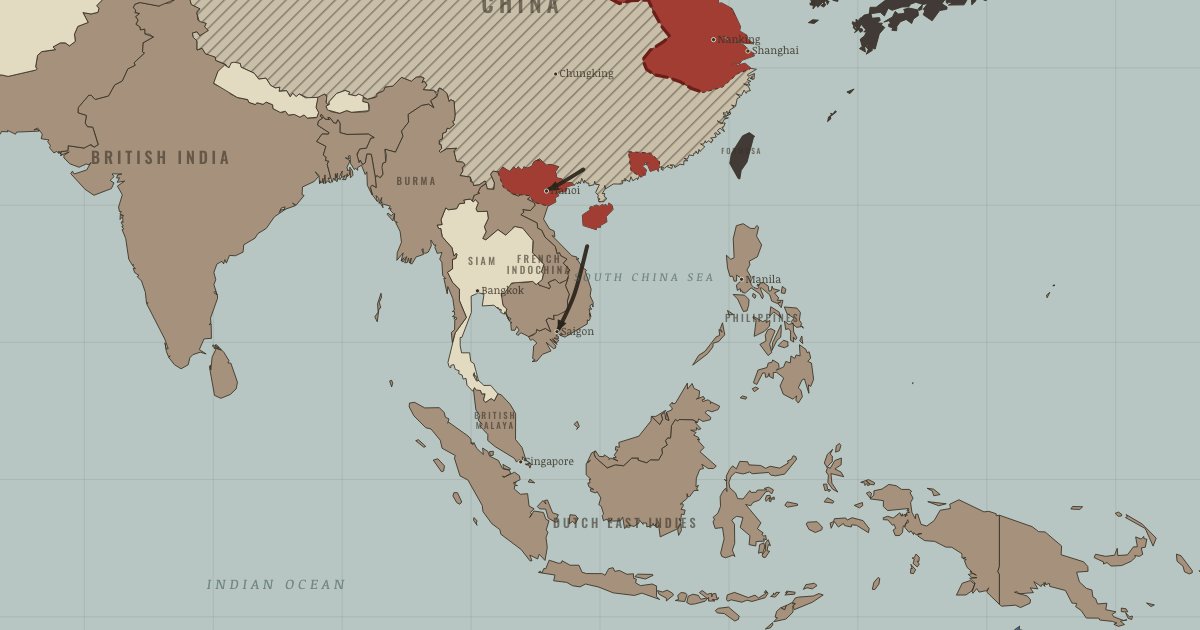
Defeat at Khalkhin Gol in 1939 undercut Japan’s case for expanding north, while the stalled China war pushed it toward Southeast Asia. In 1940 Japan occupied northern Indochina and joined the Tripartite Pact. When it took southern Indochina in July 1941, the US, Britain and the Dutch froze its assets, in effect an oil embargo.
Chapter 10 is included with every paid plan. WW2 is free in full, and chapter 1 of every atlas is free. A free account opens 3 more chapters a day. Starter, at $9 a month, opens all 21 with no daily limit — see the plans.
In 1939 a border battle on the Manchukuo–Mongolia frontier changed the choices before Japan. The Kwantung Army fought Soviet forces under Zhukov at Khalkhin Gol and lost. Advocates of a northern advance against the Soviet Union now had to reckon with a demonstrated defeat. Japan’s other war offered no easy answer either: China had not surrendered, and the fighting continued to consume men and materials.
The short answer
- The defeat at Khalkhin Gol. Some Japanese officers expected Soviet forces in the Far East to be brittle after the purges. At Khalkhin Gol they encountered artillery, massed armor, and combined arms that inflicted one of modern Japan’s worst military defeats. The Kwantung Army’s prestige suffered, along with the case for striking north. Japan still sought resources, and the south now appeared more attractive; its costs had not yet been demonstrated in a comparable war.
- The costs of the China war. By 1940 the China “incident” was absorbing much of Japan’s army and budget, while the front lines shown on the map had settled. The army’s leaders were reluctant to abandon what they had sacrificed. They sought instead to cut Chiang’s supply routes through Indochina and the Burma Road and obtain southern resources that might protect Japan against blockade. At home these advances could be presented as a means to end the China war. They also brought Japan into conflict with a wider range of opponents.
- Opportunity after Europe’s defeats. The timing made Southeast Asia tempting. The Netherlands was occupied in May 1940, and that summer Tokyo began pressing the Dutch East Indies over oil. France fell in June; Japanese troops entered Tonkin in September. Northern Indochina lay on a supply route to China, while the Indies held oil. Britain, already at war, temporarily closed the Burma Road rather than add another enemy. The United States faced its own decision about resisting change in the Pacific. European defeat exposed the colonies, but a Japanese attempt to take and hold them could still bring a wider war.
- Pressure understood as a siege. American officials expected Japan’s dependence on resources to make it stop short of war. Yet each restriction could support a different conclusion in Tokyo: that America meant to weaken Japan gradually. If that was the prospect, fighting while stocks lasted could appear preferable to waiting. Pressure intended to deter expansion thus made a decision more urgent for Japanese leaders, even as the two governments sought different outcomes.
THE TURNING POINT
The freeze, 26 July – 1 August 1941. The asset freeze left a channel through which Japan could apply for funds to buy oil, but licenses were not released, producing an effective cutoff. One interpretation holds that Roosevelt had not intended a complete embargo: officials including Assistant Secretary Acheson kept the channel closed while the president was away meeting Churchill, and reopening it could then appear to be a retreat. Whatever the intention, naval planners now estimated roughly two years of oil at wartime rates. Hull and Nomura continued their talks that autumn, but time spent negotiating also consumed fuel Japan would need if they failed. Withdrawal from China, declining capability, and war before reserves fell too far remained possibilities. The army considered withdrawal unacceptable.
What it changed
Planning a southern war. Oil in the Dutch East Indies was the objective, but Japanese planners believed the route also required security on its flanks. British Malaya and the American Philippines therefore entered their calculations. A southern advance implied war against several powers at once, and Yamamoto wanted the US Pacific Fleet disabled at the outset. The effort to secure resources became a plan for simultaneous attacks, including the one described in the next chapter.
A neutral Soviet frontier. Japan and the Soviet Union signed the Matsuoka–Molotov neutrality pact in April 1941. It gave Japan security on its northern frontier as it looked south and helped the USSR manage its Far Eastern frontier. Soviet forces from the east later joined the December 1941 counterattack before Moscow (Ch. 11). The pact remained in force until August 1945.
The pact and American strategy. Japan intended the Tripartite Pact partly to deter the United States with the prospect of war across two oceans. American planning instead connected pressure on Japan with aid to Britain. Early in 1941, before the United States entered the war, Washington and London agreed on a “Europe first” strategy.
The full answer, argued
The answers differ in what they take to be decisive. The Provocation argument begins with the Japanese cabinet’s earlier approval of southern expansion only “so long as war with America is avoided.” The oil cutoff made delay costly and turned that preference into a countdown. The Date-stamp argument places greater weight on Japan’s ambitions in China and the Indies, including its Co-Prosperity Sphere: these already clashed with a Pacific order Washington would accept, so oil set the calendar rather than creating the collision. The Prevention-that-failed account points to alternatives still under discussion. Konoe sought a summit, the navy doubted victory, and negotiations continued through Hull’s November demand for withdrawal. Army resistance to leaving China made agreement exceptionally difficult. Each government also had to judge what the other could concede. Japanese army leaders saw withdrawal after years of sacrifice as dishonor; American leaders had seen reports and photographs of atrocities in China and could not easily accept continued conquest. The cutoff mattered through these judgments and choices.
An interesting fact
In autumn 1941 Richard Sorge reported that Japan had chosen a southern course and would not attack Siberia. Sorge was a German journalist in Tokyo, working inside the German embassy for Soviet intelligence. Stalin had disregarded his warning of Barbarossa, but could use such intelligence to judge the Far Eastern threat as Soviet forces moved west; those forces joined the December counterattack before Moscow. Arrested in Tokyo in October 1941, Sorge was hanged in 1944. The Soviet Union honored him posthumously as a Hero of the Soviet Union in 1964, and a Moscow street also bears his name.
This is the study layer of Japan’s road to Pearl Harbor, chapter 10 of The Road to War, 1931–1941; the full index of the atlas is here.
Related questions
THE FREE PRINTABLE STUDY GUIDE
Get the printable study guide for The Road to War free. I’ll send you a few short letters, then one when a new atlas opens. That’s all. — Paul
NO TRACKING · YOUR ADDRESS IS USED FOR THE DISPATCH AND NOTHING ELSE · UNSUBSCRIBE ANYTIME