Russian Revolution · MAY 1919
Did foreign intervention help or hurt the Whites?
The seminar question: “Did foreign intervention help the Whites or hurt them — and whom did it ultimately serve?”
Fourteen foreign states sent troops into Russia between 1918 and 1922, mostly to ports such as Murmansk, Archangel, Odessa and Vladivostok, where Japan kept the largest force longest. War-weary publics would not support a real war, so the intervention mainly armed the Whites and achieved little militarily.
Chapter 10 is part of membership. WW2 is free — every chapter. Try chapters 1–2 of any 2 other atlases (3 with a free account). Opening a new atlas uses one of them. Membership opens all 21 — Join.
Free printable Russian Revolution study guide, sent by email ↓
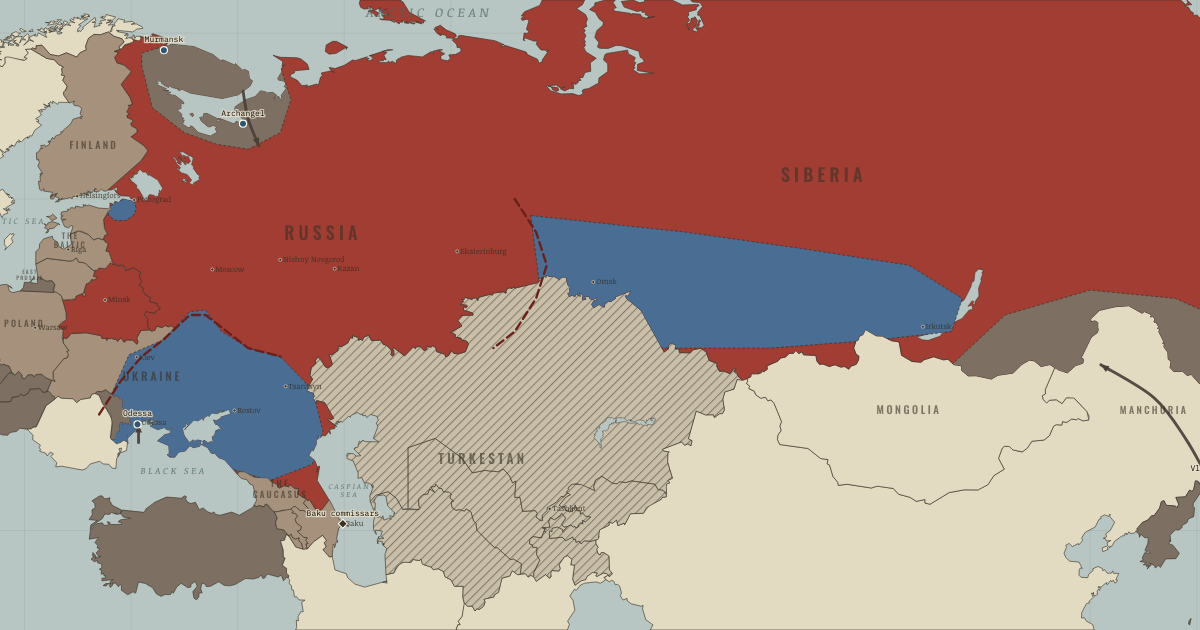
Foreign motives shifted over time, which is why the intervention never cohered into a single war. In 1918 the Allied governments wanted to protect the huge munitions dumps at the ports, rescue the Czechoslovak Legion, and if possible reopen an eastern front against Germany, and those were coherent aims while the World War lasted. When Germany surrendered in November 1918 that rationale vanished, and although anti-Bolshevism, Caucasus oil, unpaid debts and regional ambition remained as motives, no common purpose replaced the original one. The result was a coalition whose members agreed on almost nothing about what they were trying to accomplish.
The short answer
- Keep Russia in the war (1918). The first and most coherent motive was the World War: to reopen an eastern front against Germany, guard the huge Allied munitions dumps at the ports, and rescue the Czech Legion. When Germany surrendered in November 1918, this rationale vanished. And the intervention lost its only clear purpose while its troops were still ashore.
- Anti-Bolshevism and specific interests. After the armistice the motive shifted to strangling communism and grabbing advantages: French claims in Ukraine, British eyes on Caucasus oil, and above all Japanese ambitions in the Russian Far East. But no Western government would pay in the one currency that mattered. Mass conscript armies. For aims its exhausted public did not share.
- War-weariness caps the whole enterprise. The deepest constraint was at home. Having buried a generation from 1914–18, no democracy could send armies to die in Russia. So the intervention was always half-hearted. Enough to arm the Whites and enrage the Reds, never enough to decide the war. A policy the public will not fund cannot be a serious policy.
THE TURNING POINT
Vladivostok — the intervention that outstayed its purpose. The Far East is where intervention showed its true, small nature. Japan sent the largest force and kept it longest. Not to defeat Bolshevism but to carve out a sphere in Siberia. While the Americans mostly watched the Japanese. When Tokyo finally withdrew from Vladivostok in October 1922, four years after landing and long after the Whites were gone, it marked the civil war’s last foreign departure. The episode did nothing to change the war’s outcome and everything to convince Moscow that the capitalist powers were predators awaiting their moment. That conviction, not any battle, was the intervention’s real result.
What it changed
“Capitalist encirclement” as founding myth. The intervention handed the regime its permanent story: a socialist island besieged by imperialist wolves. True enough to be persuasive, it justified the security state, the arms build-up, and decades of suspicion of the West. A myth with a long half-life running straight into the Cold War.
Little military weight, much White dependence. The foreigners’ arms kept the Whites in the field, but their reluctance to fight, and their abrupt departures, left the Whites exposed and tainted as puppets of foreigners. A propaganda gift to the Reds, who could pose as the defenders of Russia against invaders.
Poisoned relations for a generation. The intervention left a residue of mutual bad faith: the West had tried to strangle the regime and failed. The regime never forgot. It is one of the reasons the Soviet Union entered the 1920s and 1930s certain that it would eventually have to fight the capitalist world. A certainty the next World War would seem to confirm.
The full answer, argued
On balance it hurt the cause it meant to help and served the enemy it meant to destroy. It gave the Whites weapons, which mattered, but far too few troops to be decisive, and it branded them as agents of foreign invaders in a war where the Reds were increasingly able to pose as Russia’s defenders. Its half-heartedness was the worst of both worlds: enough to enrage and legitimize the Bolsheviks, not enough to beat them. The lasting beneficiary was the Soviet state, which converted a bungled, minor intervention into the master-myth of capitalist encirclement. A story that justified its garrison mentality for seventy years. The lesson is about limited war: an intervention the intervening public will not fully back tends to strengthen the very regime it targets, by supplying it with a nationalist grievance and a foreign face to hang on its enemies.
An interesting fact
The Americans at Archangel — a Michigan-heavy regiment nicknamed the “Polar Bears” — fought one of their sharpest actions on 11 November 1918: while Paris celebrated the Armistice, they were beating off Red attacks in the forest villages along the Dvina, and the shooting ran on into 1919. Some 235 of them died in a campaign Congress never declared; in 1929 a private expedition went back to dig comrades’ bodies out of Russian ground, and a white stone polar bear has stood over their graves in Troy, Michigan, since 1930 — a memorial to a war with Russia most Americans have never heard of.
This is the study layer of Allied intervention in Russia, chapter 10 of The Russian Revolution, 1855–1924; the full index of the atlas is here.
Related questions
THE FREE PRINTABLE STUDY GUIDE
Join the Dispatch — a short welcome series, then a letter when a new atlas opens — and the printable study guide for The Russian Revolution is yours now, free.
NO TRACKING · YOUR ADDRESS IS USED FOR THE DISPATCH AND NOTHING ELSE · UNSUBSCRIBE ANYTIME