Decolonization of Africa · MAY 1960
Why did France lose the Algerian War?
The seminar question: “France could crush the FLN in open battle yet still lost the war. What does Algeria teach about how colonial and settler wars are actually decided?”
Algeria was legally part of France and home to about a million European settlers, so the demand for independence met a wall. The FLN launched its insurrection on 1 November 1954, France committed about half a million soldiers and used torture in the 1957 Battle of Algiers, and Algeria became independent in July 1962.
Chapter 4 is part of membership. WW2 is free — every chapter. Try chapters 1–2 of any 2 other atlases (3 with a free account). Opening a new atlas uses one of them. Membership opens all 21 — Join.
Free printable Decolonization of Africa study guide, sent by email ↓
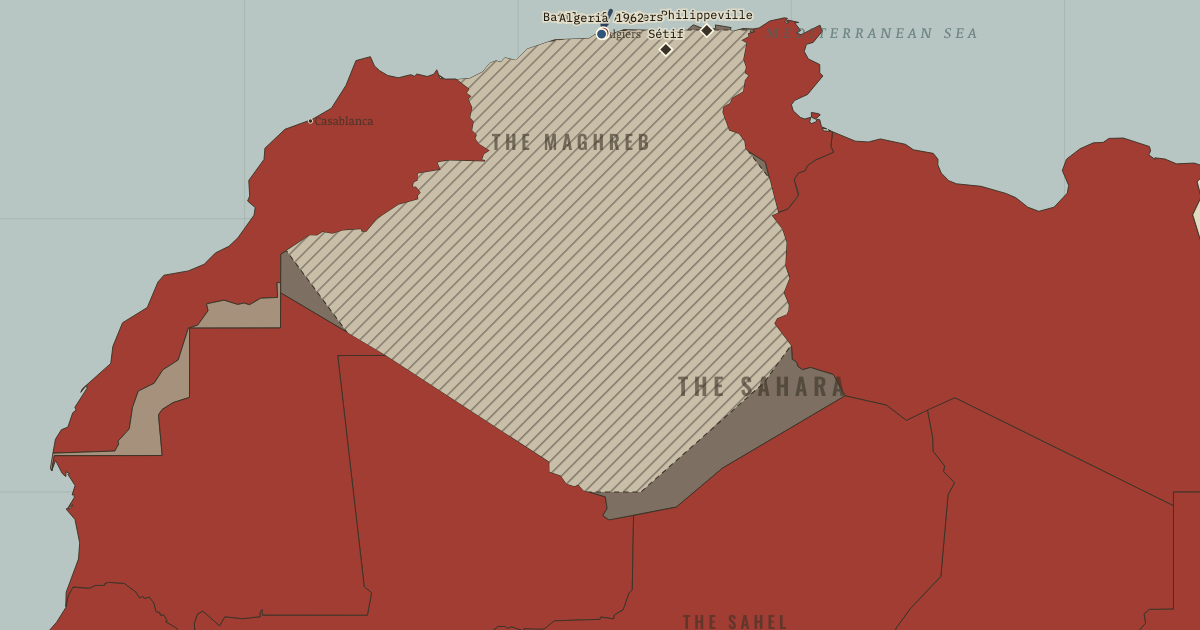
The road to war had been marked out in advance. At Sétif in 1945 a victory-day march gave way to killings and then to weeks of French reprisal that left thousands dead and buried a generation’s faith in gradual reform. On 1 November 1954 the FLN launched a coordinated insurrection built from cells and regional zones, designed less to hold territory than to make Algeria impossible to rule. France committed about half a million soldiers. In the 1957 Battle of Algiers, paratroopers dismantled the FLN’s urban network through mass arrests and torture, a tactical success that damaged France’s standing in the wider world as the methods became known.
The short answer
- Settlers change the equation. A million Europeans regarded Algeria as their country, held its economy and land, and had the political weight in Paris to veto compromise. Independence for them meant not a lowered flag but the loss of home, farm and status. So they, and the army that identified with them, fought with a desperation that had no equivalent in Ghana or Nigeria. Every settler colony on this map. Algeria, Kenya, Rhodesia, South Africa. Turns violent for the same structural reason.
- The FLN’s strategy: provoke, internationalize, endure. The FLN could not defeat the French army and did not try. It aimed to make Algeria ungovernable, to provoke reprisals that would radicalize the population and shame France abroad, and to internationalize the war at the UN and in the non-aligned world. It was a strategy of political attrition. Accept terrible military losses to win the argument. And it worked precisely as designed.
- Torture and the loss of legitimacy. The systematic use of torture in the Battle of Algiers won a tactical victory and inflicted a strategic wound: exposed by French intellectuals and the press, it turned metropolitan and world opinion against the war and split France against itself. A democracy fighting a colonial war found that the methods required to win it destroyed the values it claimed to defend. Winning the Casbah helped lose Paris.
- De Gaulle’s cold arithmetic. Brought back to power in 1958 amid a settler-military revolt, de Gaulle concluded that Algérie française was impossible: it was bleeding France, isolating it internationally, and blocking the modern European future he wanted. His pivot to self-determination. “a war without a name” he chose to end. Enraged the settlers and army into the OAS revolt and the barricades, and he faced them down. Leadership here meant recognizing an unwinnable war and paying the political price of saying so.
THE TURNING POINT
The Battle of Algiers, 1957 — victory as defeat. Massu’s paratroopers dismantle the FLN’s bombing network in the Casbah through mass arrests, checkpoints and torture. Militarily it is a clear French win. Yet it is the hinge of the whole war: the methods become an international scandal, the FLN’s cause gains the moral high ground it needs, and French society begins to turn against a war it can win in the field and never in the world’s eyes. It is the clearest case in this atlas of a settler power “winning” militarily while losing the only battle that decides a colonial war. The one over legitimacy.
What it changed
Independence at a catastrophic price. Algeria was free in July 1962, but the cost. Hundreds of thousands of Algerian dead (estimates range wildly and remain politically charged), a shattered economy, a traumatized France. Cast a long shadow. Ahmed Ben Bella led a country bled white. Within three years he was overthrown by his own defence minister, and Algeria’s war-forged army has held power ever since.
The harkis and pieds-noirs: two exoduses. Nearly a million European settlers fled to a France that barely wanted them. Worse, the harkis. Algerians who had fought for France. Were largely abandoned. Tens of thousands were killed in reprisals after independence. Settler wars end in mass movements of frightened people. The memory poisons French-Algerian relations to this day. These are memorial facts, not scorecards.
A warning read across the settler south. Algeria proved that a determined settler minority would fight, that the war would be savage, and that the colonizer might still lose. Both sides in southern Africa studied it: Rhodesia’s and South Africa’s whites drew the lesson “never surrender”. The liberation movements drew the lesson “endure and internationalize.” The Algerian template shapes chapters 8 and 9 directly.
The full answer, argued
They are decided by legitimacy and endurance, not battlefield outcomes. The FLN understood that it could not win militarily and did not need to: by surviving, provoking, and internationalizing, it made the war politically and morally unsustainable for France. Expensive in blood and treasure, corrosive of French democratic values, and indefensible at the UN and in the press. France’s military victories (Algiers, the Challe offensives) were strategically empty because they did not change the fundamental fact that France could not govern eleven million unwilling Algerians forever, and increasingly did not want to pay the price of trying. The transferable lesson. Confirmed later in Rhodesia, Namibia and South Africa. Is that a settler power facing a patient, organized majority can win every battle and still lose the war, because the decisive terrain is political will and international legitimacy, not territory.
An interesting fact
For thirty-seven years France refused to call it a war. Officially the fighting of 1954–62 was “operations for the maintenance of order” — in everyday French speech, simply les événements, “the events” — and only in June 1999 did the National Assembly finally vote to write the words “Algerian war” into French law. Even the dead have no agreed number: Algeria honours 1.5 million martyrs, most French historians estimate several hundred thousand Algerian dead, and the distance between those figures is itself part of the war’s unfinished history.
This is the study layer of Algerian War, chapter 4 of The Decolonization of Africa, 1945–1994; the full index of the atlas is here.
Related questions
THE FREE PRINTABLE STUDY GUIDE
Join the Dispatch — a short welcome series, then a letter when a new atlas opens — and the printable study guide for The Decolonization of Africa is yours now, free.
NO TRACKING · YOUR ADDRESS IS USED FOR THE DISPATCH AND NOTHING ELSE · UNSUBSCRIBE ANYTIME