Decolonization of Africa · JAN 1945
Why did colonial rule in Africa fall so fast after 1945?
The seminar question: “If the colonial system was so thin and cheap, why had it not fallen sooner — and why did it fall so fast after 1945?”
In 1945 nearly all of Africa was ruled from Europe, yet colonial states were thin: Britain governed Nigeria’s roughly thirty million people through about 1,200 officials. Around a million Africans served in the Second World War, and the 1945 Pan-African Congress in Manchester demanded independence outright.
WW2 is free — every chapter. Try chapters 1–2 of any 2 other atlases (3 with a free account). Opening a new atlas uses one of them. Membership opens all 21 — Join.
Free printable Decolonization of Africa study guide, sent by email ↓
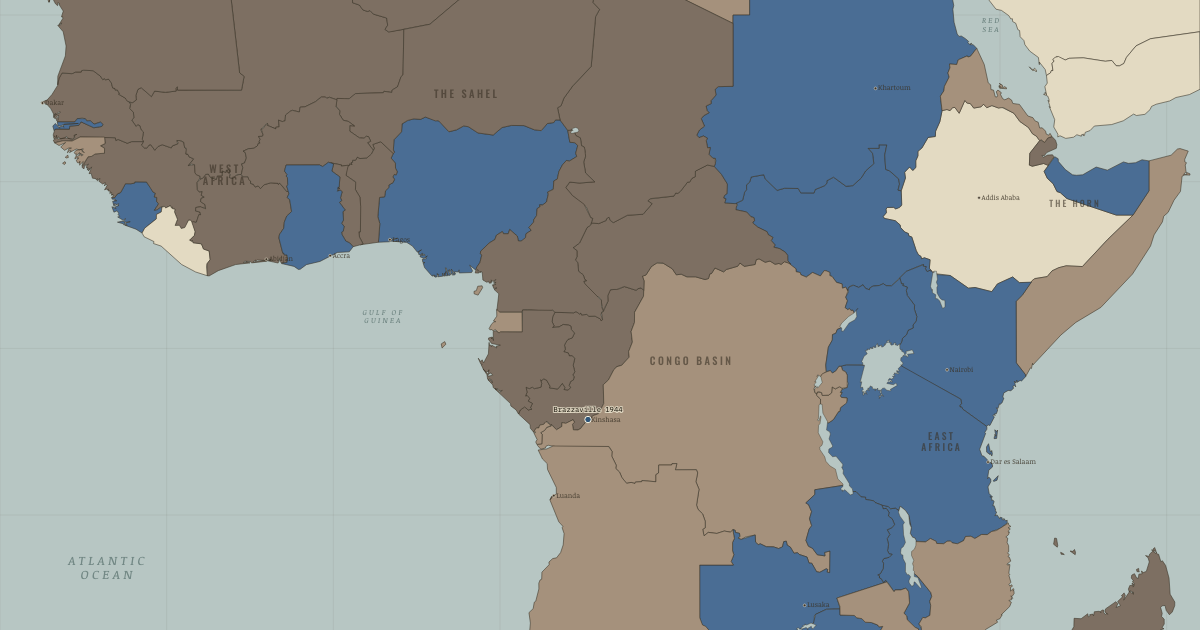
A colonial map is a claim about authority, and the depth of that authority is what actually decided how fast empire could be undone. Britain administered Nigeria’s millions with roughly 1,200 officials by delegating the daily work of rule to local chiefs and emirs, a doctrine known as indirect rule. The railways and roads it built ran from mine and plantation to the coast rather than linking African towns to one another, because the economy was arranged to move raw materials outward — Gold Coast cocoa, Rhodesian and Katangan copper, Congolese rubber and uranium, South African gold — and to send European manufactures back in. Almost nothing was invested in African industry or higher education, which is why the profit accumulated in Europe while the colony stayed a supplier.
The short answer
- Rule by a handful, through intermediaries. Colonial administration was astonishingly thin. “indirect rule,” Frederick Lugard’s doctrine, governed through existing chiefs and emirs precisely because Britain could not afford anything else. The same thinness that made empire cheap made it brittle: it depended on African collaboration, and the moment that collaboration became refusal, there was almost nothing behind it.
- An economy built for extraction, not development. Colonies were designed as suppliers of raw materials and buyers of finished goods. Roads and railways ran from mine and plantation to port, not town to town. Almost nothing was invested in African education or industry. At independence, the Belgian Congo had a handful of African university graduates for thirteen million people. The grievance this bred was economic as much as political.
- The war as solvent. 1939–45 shattered the myth of European invincibility (Singapore, the fall of France) and mobilized Africa as never before. Soldiers, cash crops, forced labour. Veterans came home having killed white men and seen Europe’s weakness. The Atlantic Charter had put self-determination in the Allies’ own mouths. The colonizers had armed the argument against themselves.
- Pan-Africanism finds its leaders. The 1945 Manchester Congress turned an intellectual movement. Du Bois, Padmore, Garvey’s inheritance. Into a political programme, and its delegates into the men who would rule: Nkrumah, Kenyatta, Hastings Banda. The ideas of liberation were in place, held by a generation about to go home and govern.
THE TURNING POINT
Brazzaville, January 1944. De Gaulle’s Free French, dependent on African troops and territory, convene to plan the post-war empire. They promise citizenship, representation, an end to forced labour. And declare that “any idea of autonomy, any possibility of evolution outside the French bloc, is to be discarded.” The contradiction. Reform to prevent change. Is the exact fault line that fifteen years will split wide open.
What it changed
A generation of leaders in waiting. The men who would raise the flags were already formed by 1945. In the King’s African Rifles, the Sorbonne, Lincoln University, the London bedsits of Pan-Africanism. Decolonization was not a vacuum filled by chance. It was carried by a specific, named cohort with a worked-out idea of the nation-state.
Two roads out of empire. Where colonies had few white settlers, the exit could be negotiated (Ghana, Nigeria). Where a settler population had put down roots and property. Algeria, Kenya, Rhodesia, South Africa. The same demand met a wall, because now there was something concrete to defend. That distinction governs everything on this map.
The colonizers underestimate the clock. In 1945 London and Paris imagined reform stretching over generations. Within fifteen years the map would be unrecognizable. Almost no one. Colonized or colonizer. Foresaw the speed. That misjudgment shaped how unready both sides were for what came.
The full answer, argued
Before 1945 the system held because it faced no coordinated challenge and Europe’s prestige seemed unbreakable: the thinness worked as long as Africans mostly cooperated and no rival demonstrated Europe could be beaten. The war removed both props at once. It beggared the imperial powers, mobilized and radicalized African populations, discredited white supremacy on the battlefield, and gave nationalists a global language of self-determination and a superpower (America, and the USSR) with reasons to encourage them. The lesson is that brittle systems can persist for decades and then collapse in a rush: what changed was not the machinery of rule but the willingness to obey it.
An interesting fact
The Manchester congress was chaired by W. E. B. Du Bois — seventy-seven years old, organizer of the first Pan-African Congress back in 1919 — handing the movement in person to the generation that would govern; most of its delegates, unlike the exiled intellectuals of earlier congresses, were trade unionists, workers and students, meeting in a plain English town hall. And the Atlantic Charter cut deeper than its authors meant: Churchill assured the Commons in 1941 that self-determination applied only to Nazi-occupied Europe, but African editors — Nnamdi Azikiwe’s West African Pilot in Lagos among them — printed the words anyway and held the Allies to their own sentence.
This is the study layer of Colonial Africa after World War II, chapter 1 of The Decolonization of Africa, 1945–1994; the full index of the atlas is here.
Related questions
THE FREE PRINTABLE STUDY GUIDE
Join the Dispatch — a short welcome series, then a letter when a new atlas opens — and the printable study guide for The Decolonization of Africa is yours now, free.
NO TRACKING · YOUR ADDRESS IS USED FOR THE DISPATCH AND NOTHING ELSE · UNSUBSCRIBE ANYTIME