Decolonization of Africa · MAR 1956
How was the Suez Crisis a defeat for Britain and France?
The seminar question: “Suez was a clear military victory for Britain and France. In what sense was it one of the most important defeats in the history of empire?”
Libya became independent in 1951 and Sudan on the first day of 1956, and Tunisia and Morocco won independence from France the same year. In July 1956 Nasser nationalized the Suez Canal; Britain, France and Israel won the opening battles of the Suez war but folded when the United States opposed the invasion.
WW2 is free — every chapter. Try chapters 1–2 of any 2 other atlases (3 with a free account). Opening a new atlas uses one of them. Membership opens all 21 — Join.
Free printable Decolonization of Africa study guide, sent by email ↓
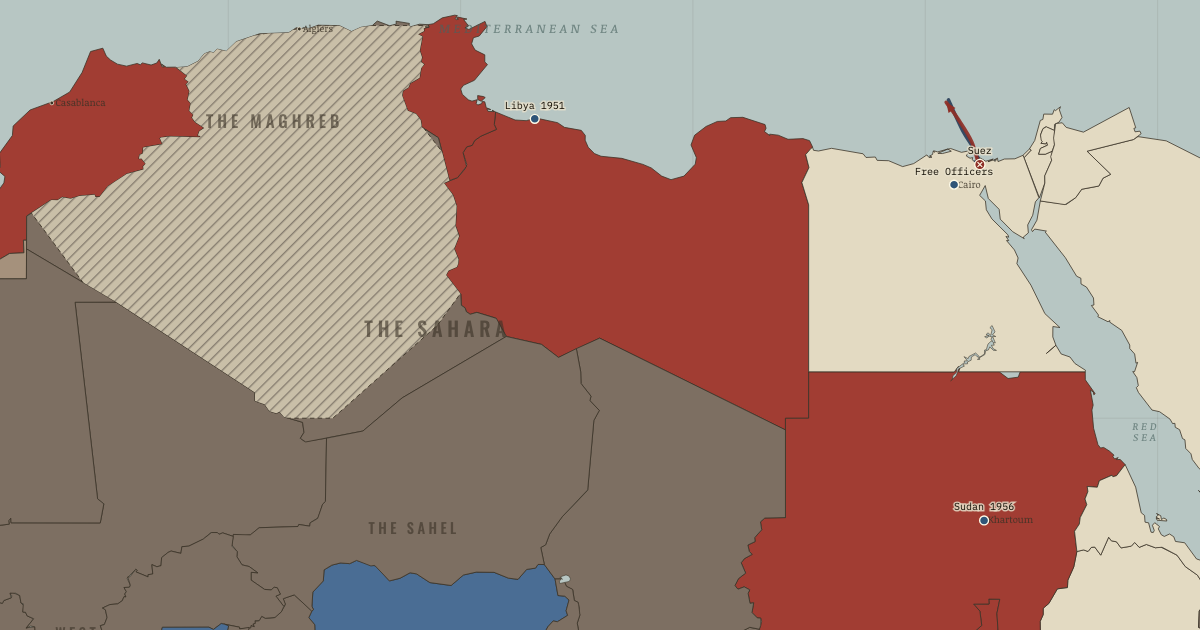
Nasser nationalized the Suez Canal in July 1956 to fund the Aswan Dam after Washington withdrew its loan, and to assert that Egypt, rather than London or Paris, owned the ground beneath Egypt. For Britain and France the canal meant more than a waterway; it was a route to their remaining possessions and a symbol of great-power standing. Their secret plan with Israel recaptured the canal zone quickly, but the operation depended on money and oil that only the United States could guarantee. When Eisenhower opposed the invasion and let sterling come under pressure, Britain found it could not sustain the campaign and folded within days.
The short answer
- Suez: the canal as a symbol of who rules. Nasser nationalized the canal to fund the Aswan Dam after Washington pulled its loan. And to assert that Egypt, not London and Paris, owned the ground under Egypt. For Britain and France the canal was empire itself: prestige, oil, the road to Asia. The collision was not really about a waterway. It was about whether Europe could still command the postcolonial world by force.
- The dollar veto. The invasion was a military success and a total political defeat. Eisenhower, furious at being deceived and fearful of driving Arab states toward Moscow, refused to support the pound as it came under speculative attack and blocked emergency oil. Sterling would have collapsed. Britain folded in days. It was a demonstration that the age of independent European action was over. The West now had one leader, and it was not in Europe.
- France chooses Algeria. Paris granted Tunisia and Morocco independence in 1956 with relatively little struggle for a hard-headed reason: they were protectorates, not settled French soil, and letting them go freed troops and legitimacy for the one place France would not yield. Algeria, constitutionally three French départements with a million pieds-noirs. Triage: sacrifice the flanks to hold the centre.
- Nasser and the power of the example. Nasser’s survival. Defying three armies and winning by losing. Made him the hero of the Arab and African world overnight and the model for a militant, non-aligned nationalism. Radio Cairo’s “Voice of the Arabs” beamed the lesson across the continent: the empires could be faced down. Egypt became a training ground and megaphone for liberation movements from Algeria to Angola.
THE TURNING POINT
Suez, November 1956. The military plan works flawlessly and the political result is catastrophe: within a week the invaders are forced into a UN-supervised retreat by their own senior partner. Historians treat it as the precise moment the British and French empires ceased to be independent great powers. After Suez, every colonial calculation in London and Paris is made in the knowledge that Washington can end the game. And the pace of withdrawal accelerates everywhere.
What it changed
Empire loses its nerve. Suez broke something psychological. Harold Macmillan, Chancellor during the crisis, became the Prime Minister who three years later told South Africa’s parliament that “the wind of change is blowing through this continent.” The retreat from Africa that followed was, in part, the lesson of Suez applied: fighting to hold colonies against the tide risked national ruin.
The Maghreb splits three ways. Tunisia and Morocco walked out through open doors in 1956. Algeria was already two years into a war that would last until 1962. The same French empire, the same region, the same year. And two completely different exits, decided entirely by the presence of settlers. Hold that comparison for the next chapter.
Non-alignment is born. Nasser, with Nehru, Tito and Sukarno, made the “Third World” a bloc that refused both Cold War camps and auctioned its allegiance for aid and arms. Decolonizing Africa would be courted, armed and subverted by both superpowers for thirty years. A fact that turns several later chapters of this atlas into Cold War battlefields.
The full answer, argued
Because the objective was never the canal alone. It was to prove that Europe could still enforce its will in the postcolonial world. Instead the operation proved the opposite in the most public way possible: the two old empires were ordered out by their own ally, powerless before American financial pressure, within days. Every colonized people watching learned that the metropole was a paper tiger dependent on Washington. Every European cabinet learned that holding an empire by force could bankrupt the nation. The measurable defeat. A canal retaken and surrendered. Mattered far less than the lesson, which was that the era of independent European empire had ended. Decolonization’s pace is visibly different before and after 1956.
An interesting fact
Libya owed its independence partly to a single vote cast by the world’s first Black republic. In May 1949 the Bevin–Sforza plan would have parcelled Libya back out to Britain, France and Italy as UN trusteeships; it collapsed in the General Assembly when the clause on Tripolitania fell one vote short of the required two-thirds — and the vote most often credited with sinking it belonged to Haiti’s delegate, Émile Saint-Lôt. Two years later Libya became the first state ever created through the United Nations: a door opened for Africa, fittingly, by an heir of the Haitian Revolution.
This is the study layer of Suez Crisis and North Africa, chapter 2 of The Decolonization of Africa, 1945–1994; the full index of the atlas is here.
Related questions
THE FREE PRINTABLE STUDY GUIDE
Join the Dispatch — a short welcome series, then a letter when a new atlas opens — and the printable study guide for The Decolonization of Africa is yours now, free.
NO TRACKING · YOUR ADDRESS IS USED FOR THE DISPATCH AND NOTHING ELSE · UNSUBSCRIBE ANYTIME