Decolonization of Africa · JUL 1962
What caused the Congo Crisis?
The seminar question: “Was the Congo catastrophe caused mainly by Belgian misrule, by Cold War intervention, or by the Congo’s own divisions — and why does it matter which?”
The Belgian Congo became independent on 30 June 1960 without a single African army officer or senior administrator. The army mutinied, Belgian troops returned, and on 11 July Katanga seceded with Belgian mining backing; Prime Minister Patrice Lumumba was killed in January 1961, and the West later helped install Mobutu.
Chapter 6 is part of membership. WW2 is free — every chapter. Try chapters 1–2 of any 2 other atlases (3 with a free account). Opening a new atlas uses one of them. Membership opens all 21 — Join.
Free printable Decolonization of Africa study guide, sent by email ↓
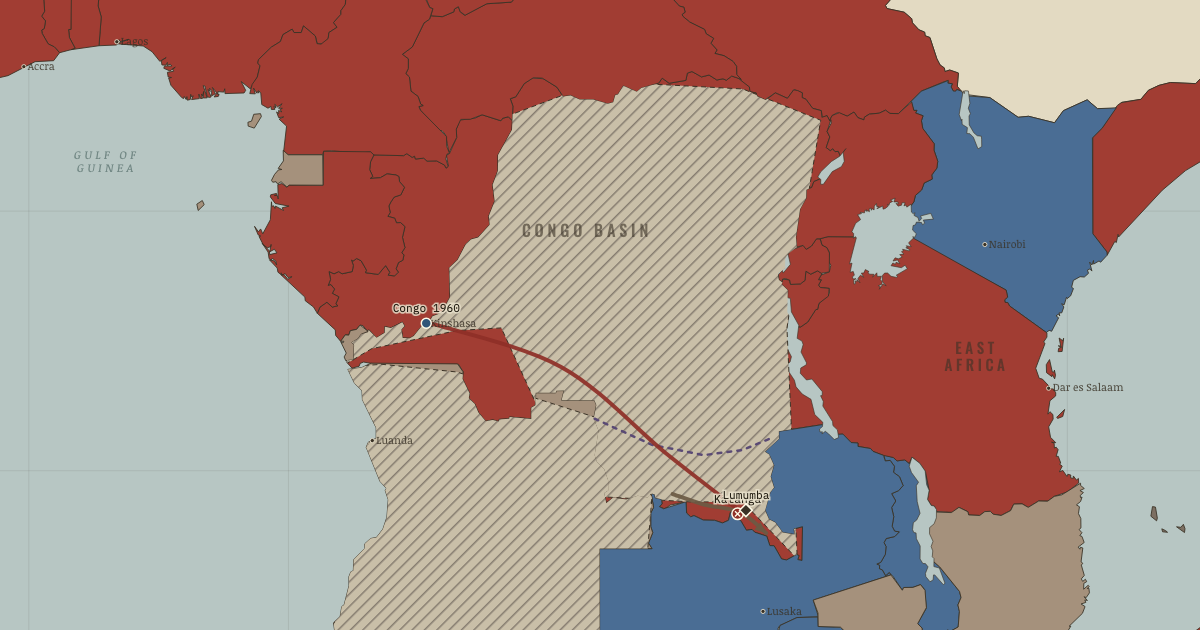
Independence on 30 June 1960 transferred sovereignty without transferring a working state, because Belgium had built none for Congolese hands. The Force Publique, the colonial army, mutinied against the Belgian officers who still commanded it, and Belgium used the disorder as grounds to send its troops back. On 11 July Moïse Tshombe declared Katanga independent, supported by the mining conglomerate Union Minière, by Belgian officers, and by hired white mercenaries. Since Katanga held the copper, cobalt and uranium that made the Congo wealthy, the secession stripped the new nation of most of its revenue at the moment it could least afford the loss.
The short answer
- A colony deliberately left unprepared. Belgium’s policy had been to suppress African political life and education entirely, betting that a contented, uneducated populace would never demand self-rule. When Brussels panicked and granted independence in a rush in 1960, it handed over a state with no trained administrators, officers or politicians and a mutiny-prone colonial army still under Belgian command. The Congo’s collapse was manufactured by the specific way it had been ruled. The extreme case of the whole continent’s under-preparation.
- Katanga: secession to protect a mine. Katanga held the copper, cobalt and uranium that made the Congo rich, and the Belgian conglomerate Union Minière preferred a compliant breakaway state to a nationalist central government that might control its wealth. Tshombe’s secession, armed and financed from Brussels and backed by white mercenaries, was less a nation than a corporate-colonial enclave. Naming the interests. A mining company, not a people. Is essential to understanding it.
- The Cold War descends. When the UN would not reconquer Katanga for him, Lumumba asked Moscow for help. And instantly became, in Western eyes, a Soviet asset to be removed. Decolonization ran head-on into superpower paranoia: a nationalist seeking any ally became a proxy in a global struggle, and his country’s fate was decided in Washington, Brussels and Moscow as much as in Léopoldville. This subordination of African self-determination to the Cold War recurs across the atlas.
- The UN’s impossible mandate. The 20,000-strong ONUC force was sent to keep a peace that did not exist, forbidden at first to take sides or end the secession, caught between a premier it could not save and a breakaway it would not initially fight. Hammarskjöld died pursuing a settlement. It was the UN’s first war and a bruising lesson in the limits of peacekeeping. One that shadowed the organization for decades, and arguably still does.
THE TURNING POINT
Katanga secedes, 11 July 1960. Eleven days after independence, Tshombe declares the mineral-rich south a separate state, with Belgian officers, Union Minière money and white mercenaries. The secession guts the new nation of its wealth, invites in foreign intervention, drives Lumumba toward Moscow and thus toward his death, and turns a fragile independence into a four-year war. It is the moment the Congo’s independence becomes the Congo crisis. And the clearest illustration on this map of how colonial economic interests, dressed as self-determination, could tear a new state apart from within.
What it changed
The murder of Lumumba. The elected premier’s removal and killing, with Western hands on it, martyred him across the Third World and taught a generation of African leaders a bitter lesson about the limits of their sovereignty. His name became shorthand for the ways decolonization was strangled where it threatened Cold War or corporate interests. This is memory, not a scorecard. But it is central to how Africa remembers 1960.
Mobutu’s long shadow. Out of the chaos the West helped install and then sustained Joseph Mobutu, who renamed the country Zaïre and ran it as a personal kleptocracy for thirty-two years, tolerated as an anti-communist bulwark. The crisis thus produced not a functioning state but a durable dictatorship. A pattern (the “friendly strongman” backed against instability) repeated across Cold War Africa.
The cautionary tale. The Congo terrified every actor: African leaders saw how fast a state could dissolve and used it to justify strong central rule and one-party control. The UN learned the perils of peacekeeping. The OAU, founded three years later, made the inviolability of borders and non-interference near-sacred largely to prevent another Katanga. Much of the next chapter’s conservatism is the Congo’s legacy.
The full answer, argued
All three interacted, but they are not equal. The precondition was Belgian misrule: a colony stripped of educated Congolese, trained officers and any political preparation was structurally incapable of surviving the shock of sudden independence. This made collapse likely. The accelerant was foreign intervention driven by economic and Cold War interests: Union Minière’s money behind Katanga’s secession, and the American-Belgian decision to remove and permit the murder of the elected premier, turned a crisis into a catastrophe and imposed thirty years of Mobutu. The Congo’s internal divisions were real but were largely produced and then weaponized by the first two factors. It matters which because the lazy reading. “Africans could not govern themselves”. Inverts the causation: the Congo did not fail because it was independent, it failed because of how it had been ruled and how its independence was then subverted from outside. Getting the causation right is the difference between blaming the victim and understanding the crime.
An interesting fact
From captivity Lumumba wrote a last letter to his wife Pauline: “history will one day have its say… it will not be the history that is taught in Brussels, Paris, Washington or the United Nations… Africa will write its own history.” Smuggled out and published after his murder, the letter became one of the founding texts of postcolonial memory. And in June 2022 — after his daughter Juliana petitioned the Belgian king — Belgium returned to his children the only remains that survive, a single tooth, in a state ceremony sixty-one years late.
This is the study layer of Congo Crisis, chapter 6 of The Decolonization of Africa, 1945–1994; the full index of the atlas is here.
Related questions
THE FREE PRINTABLE STUDY GUIDE
Join the Dispatch — a short welcome series, then a letter when a new atlas opens — and the printable study guide for The Decolonization of Africa is yours now, free.
NO TRACKING · YOUR ADDRESS IS USED FOR THE DISPATCH AND NOTHING ELSE · UNSUBSCRIBE ANYTIME