Decolonization of Africa · JUL 1960
Why did 17 African countries gain independence in 1960?
The seminar question: “Why did seventeen countries become independent in the single year 1960 — and was the speed a triumph or a problem?”
In 1960 seventeen African states became independent, the largest burst of decolonization in history, among them most of French Africa, the Belgian Congo and Nigeria. France’s 1956 loi-cadre had already installed elected African governments, and Guinea’s 1958 rejection of de Gaulle’s offer showed a break could be survived.
Chapter 5 is part of membership. WW2 is free — every chapter. Try chapters 1–2 of any 2 other atlases (3 with a free account). Opening a new atlas uses one of them. Membership opens all 21 — Join.
Free printable Decolonization of Africa study guide, sent by email ↓
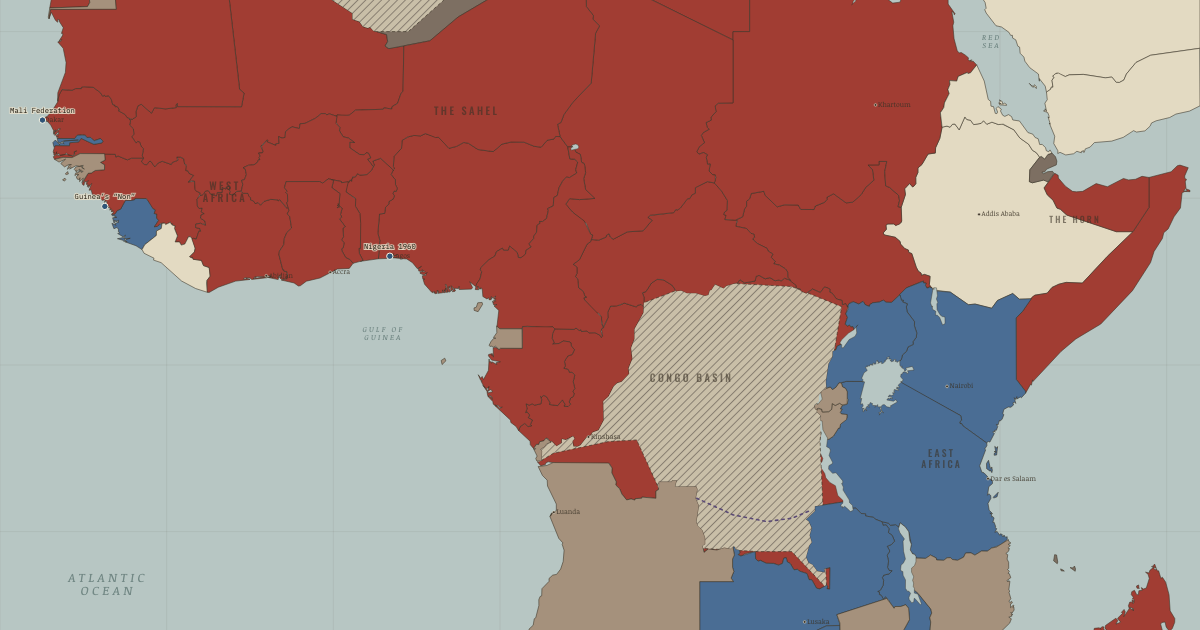
The mechanics of 1960 begin with France’s 1956 framework law, the loi-cadre, which devolved real power to elected territorial assemblies and African executives. Men such as Houphouët-Boigny and Senghor had already governed as ministers, so when full sovereignty arrived it was less a rupture than the final step of a handover mostly complete, and that is why so many territories could change colour at once. The wave then fed on itself. After Ghana, and with the General Assembly increasingly hostile to colonialism, holding out began to look like the aberration rather than the norm, and both superpowers courted the states about to be born.
The short answer
- The loi-cadre alumni. France’s 1956 framework law devolved real power to elected territorial assemblies and African executives. Men like Houphouët-Boigny and Senghor who governed as ministers before independence. When full sovereignty came in 1960, there were experienced African governments ready to receive it. Independence was less a rupture than the last step of a transfer already largely made. That prior groundwork is why so many flips could happen in one year.
- Guinea’s “Non” and the collapse of the Community. In 1958 de Gaulle offered France’s African colonies membership in a French Community. Autonomy without independence. Or, if they voted no, immediate separation. Only Guinea refused, and France retaliated by stripping the country of everything it could carry. But Guinea survived. And its example, plus the manifest hollowness of the Community, led the other territories to demand full independence within two years. De Gaulle, preferring willing partners to sullen ones, let them go.
- The international tipping point. By 1960 the General Assembly was filling with new members who made anti-colonialism a global majority position. That December the UN passed Resolution 1514 declaring colonialism must end. Both superpowers courted the new states. Independence had become the internationally expected outcome, and holding out looked increasingly like the aberration. A reversal of the assumptions of 1945.
- Momentum and the fear of being last. Nothing accelerates a political tide like the sense that it is unstoppable. Once Ghana, Guinea and the Congo had gone, no French or British territory wanted to be the colony still waiting. Nationalist pressure and colonial calculation pushed in the same direction. Decolonization became partly self-propelling. Each independence made the next one easier to imagine and harder to refuse.
THE TURNING POINT
Lagos, 1 October 1960 — the giant rises. Nigeria. The most populous nation in Africa, a federation of three regions and some 250 peoples. Lowers the Union Jack. Its sheer scale makes it the continent’s great test: can a huge, plural, artificially-bordered colony hold together as one democratic federal state? For six years the answer looks like yes. Then the same regional fault lines the federal bargain was built to manage will crack into coup and civil war (Chapter 7). Nigeria’s midnight is the high-water mark of independence’s optimism. And the setup for its hardest lesson.
What it changed
A new majority at the UN. The class of 1960 transformed the United Nations, giving the Afro-Asian bloc a permanent majority in the General Assembly and making decolonization and anti-racism central to world politics. The new states used that platform relentlessly. Against apartheid, against Portuguese colonialism, for non-alignment. Independence was not just a national event. It rewired the international system.
Borders and the coming strain. Seventeen states inherited seventeen sets of colonial borders, enclosing peoples who had never chosen to live together and dividing others across lines. The optimism of 1960 rested on the assumption that these states would cohere. The Congo would test it within days, Nigeria within six years. The Year of Africa handed the continent both its freedom and its hardest structural problem.
Freedom, then the reckoning with what it could not deliver. 1960’s ceremonies promised development, dignity and unity. The economies were still colonial. Single crops, no industry, ports facing Europe. And the honeymoon was short. The coups, one-party states and disappointments of the later 1960s all begin from the gap between what independence promised and what the inherited structures could actually provide.
The full answer, argued
The clustering was mechanical and psychological: France had pre-built African governments through the loi-cadre so the handover was largely complete before the flag changed. The collapse of de Gaulle’s Community after Guinea’s survival converted autonomy into full independence across French Africa within two years. The UN and both superpowers had made independence the expected norm. And momentum made each transfer easier than the last. Whether it was triumph or problem is genuinely debatable, and the honest answer is both. Triumph: an epochal, largely peaceful liberation of a continent. Problem: many states arrived sovereign but structurally unready. Colonial economies, arbitrary borders, shallow institutions, tiny educated classes. And the speed meant almost no time to build the foundations independence needed. The Congo (next chapter) shows the catastrophic end of the spectrum. The enduring debate is whether a slower transition would have built stronger states or simply prolonged colonial rule under a new name.
An interesting fact
Nigeria’s green-white-green was the work of a twenty-three-year-old: Michael Taiwo Akinkunmi, a Nigerian student in England, won the 1959 flag competition against nearly three thousand entries — though the judges deleted the red sun he had drawn on the central band. And when the UN General Assembly declared that December that colonialism must end, not a single state voted against Resolution 1514: the tally was 89 to 0, and the nine abstainers — Britain, France, Portugal, Spain, Belgium, South Africa and the United States among them — could only stand aside in the chamber the Year of Africa had just filled.
This is the study layer of Year of Africa, chapter 5 of The Decolonization of Africa, 1945–1994; the full index of the atlas is here.
Related questions
THE FREE PRINTABLE STUDY GUIDE
Join the Dispatch — a short welcome series, then a letter when a new atlas opens — and the printable study guide for The Decolonization of Africa is yours now, free.
NO TRACKING · YOUR ADDRESS IS USED FOR THE DISPATCH AND NOTHING ELSE · UNSUBSCRIBE ANYTIME