Decolonization of Africa · MAR 1957
Why was Ghana’s model so hard to sustain after 1957?
The seminar question: “Ghana reached independence peacefully and prosperous, the envied model. Why did the model prove so much harder to sustain than to achieve?”
At midnight on 6 March 1957 the Gold Coast became Ghana under Kwame Nkrumah, the first colony south of the Sahara to win its freedom. His Convention People’s Party turned nationalism into a mass movement, and after it won elections by overwhelming margins Britain chose to hand over power rather than fight.
Chapter 3 is part of membership. WW2 is free — every chapter. Try chapters 1–2 of any 2 other atlases (3 with a free account). Opening a new atlas uses one of them. Membership opens all 21 — Join.
Free printable Decolonization of Africa study guide, sent by email ↓
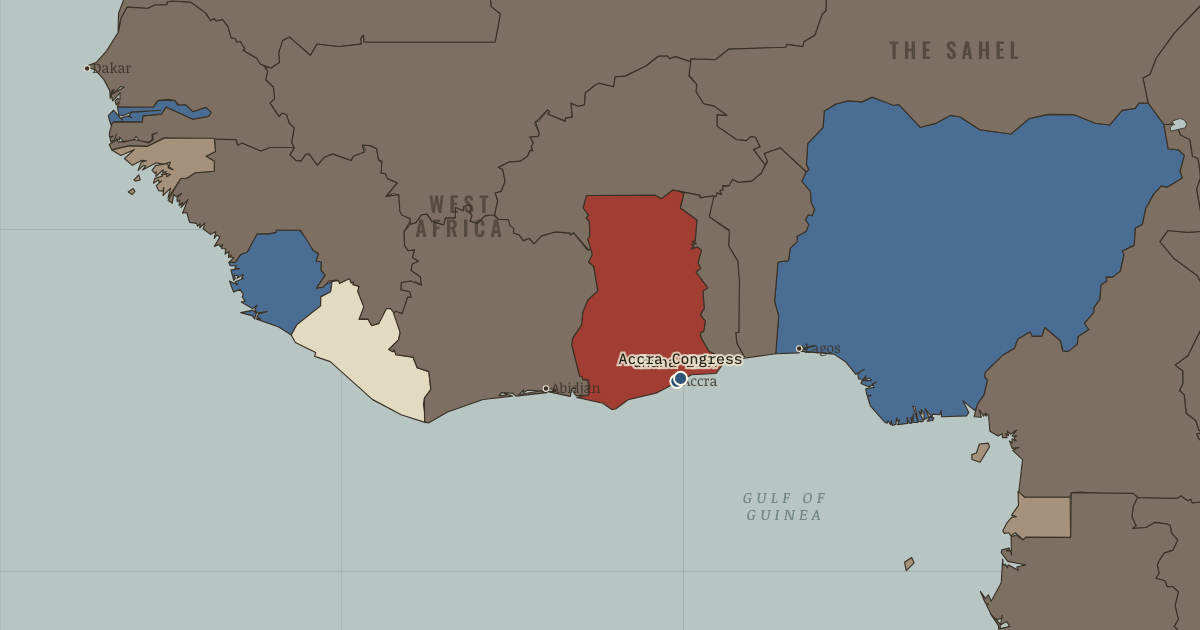
The Gold Coast reached independence first because of how Nkrumah organized, not because of any special favour. Earlier nationalists had worked through small circles of lawyers and respectful constitutional petitions, whereas Nkrumah built a disciplined mass party with local branches, its own newspapers and youth wings, and a talent for public spectacle. Its method, which he called Positive Action, combined strikes, boycotts and non-violent defiance on Gandhi’s pattern, and it made the colony expensive to govern while proving at the ballot box that the party spoke for the country. When Britain jailed him in 1950, his party’s landslide the following year forced the governor to release him to form a government.
The short answer
- The invention of the mass party. Nkrumah’s decisive innovation was organizational. Earlier nationalists (the lawyer-led UGCC he broke from) petitioned politely. Nkrumah built a disciplined mass movement with branches, newspapers, youth wings and a genius for spectacle. It could mobilize hundreds of thousands and make the colony ungovernable without violence. This machine, copied across the continent, is why independence movements suddenly had irresistible weight.
- “Positive Action” and prison as credential. Borrowing from Gandhi, Nkrumah met colonial power with strikes, boycotts and calculated civil disobedience. Costly to suppress, impossible to answer with reform alone. His 1950 imprisonment made him a martyr and his 1951 landslide made him unavoidable. Britain freed him to govern because the alternative was permanent unrest. Jail became a qualification, not a disqualification. A pattern from Kenyatta to Mandela.
- Why Britain conceded the model. The Gold Coast was prosperous, literate and relatively small, with few white settlers to defend. The cheapest possible place to prove that “orderly” decolonization could work. After the humiliation of Suez, Macmillan’s Britain judged that granting independence to a friendly Ghana, tied to the Commonwealth and sterling, protected more interests than a war would. Ghana was a controlled experiment the empire chose to pass.
- Cocoa: an economy that could pay. The Gold Coast was the world’s leading cocoa producer, which gave the new state real revenue and made independence appear self-financing. But it also chained Ghana to one crop at a price set in London and New York. When cocoa prices later collapsed, so did the model’s economic promise. The dependency the colony was born with outlived the flag.
THE TURNING POINT
Accra, midnight, 6 March 1957. The Union Jack comes down, the new flag rises, and Nkrumah declares Ghana free. “forever.” The moment is engineered as a continental broadcast: he immediately reframes it as a down-payment on the liberation of all Africa, funds movements across the continent, and hosts the pan-African conferences that follow. One small colony’s midnight becomes the proof of concept and the rallying cry for every colony still waiting. After Accra, the question everywhere is no longer whether, but when.
What it changed
The template goes continental. Ghana’s formula. Mass party, jailed leader, negotiated handover, midnight flag. Was studied and copied from Lagos to Nairobi to Lusaka. Nkrumah made Accra the headquarters of African liberation, bankrolling the 1958 All-African Peoples’ Conference (the marker) where a young Lumumba and others learned the trade. The door, once open, could not be closed.
And so do the warning signs. Within a few years Nkrumah had banned opposition, jailed rivals under a Preventive Detention Act, and declared a one-party state with himself as “Osagyefo,” redeemer. When cocoa prices fell, the economy foundered. In 1966 the army overthrew him (Chapter 7). Ghana pioneered both the triumph and the disappointment. A warning printed in the same type as the model.
Pan-Africanism versus the nation-state. Nkrumah wanted a United States of Africa and argued that small separate states would stay economically dependent. “neo-colonial.” Most other leaders, jealous of their new sovereignty, preferred the nation-state and the borders they had inherited. That argument, joined here, is settled against Nkrumah at the OAU’s founding. And it is worth asking who was right.
The full answer, argued
Independence removed the colonizer but not the structures colonialism left: an economy pinned to a single export at prices set abroad, a state apparatus built to extract rather than develop, borders enclosing peoples with no shared history, and institutions with shallow roots. Nkrumah’s mass party was superb for winning power and poor for the patient, pluralist work of governing. Facing real economic shocks (collapsing cocoa prices) and real opposition, it slid toward one-party rule and cult, then a coup. The deeper lesson, visible right across this atlas, is that political independence is the easier half. The flag can be won in a decade, but building states, economies and institutions capable of delivering on independence’s promise is the work of generations, and colonialism deliberately left almost none of the foundations.
An interesting fact
Ghana’s flag — red, gold, green, one black star — was the work of Theodosia Okoh, a teacher and artist, and the star is a deliberate quotation: it honours the Black Star Line, the shipping company Marcus Garvey founded in 1919 to reconnect Africa with its diaspora, and it still names the national football team, the Black Stars. Among the guests at the midnight ceremony stood both Richard Nixon and Martin Luther King Jr., who flew home to preach that “Ghana tells us that the forces of the universe are on the side of justice.”
This is the study layer of Nkrumah and Ghana’s independence, chapter 3 of The Decolonization of Africa, 1945–1994; the full index of the atlas is here.
Related questions
THE FREE PRINTABLE STUDY GUIDE
Join the Dispatch — a short welcome series, then a letter when a new atlas opens — and the printable study guide for The Decolonization of Africa is yours now, free.
NO TRACKING · YOUR ADDRESS IS USED FOR THE DISPATCH AND NOTHING ELSE · UNSUBSCRIBE ANYTIME