American Civil War · APR 1865
Were Grant’s terms at Appomattox too soft a peace?
The seminar question: “Grant’s terms at Appomattox are universally praised — and Reconstruction failed anyway. Was the “soft peace” a mistake?”
In early 1865 Sherman moved north through the Carolinas while Grant extended the Petersburg lines. After the Union victory at Five Forks on 1 April, Petersburg and Richmond were abandoned, and Lee surrendered at Appomattox on 9 April 1865. Lincoln was assassinated five days later.
Chapter 11 is part of membership. WW2 is free — every chapter. Try chapters 1–2 of any 2 other atlases (3 with a free account). Opening a new atlas uses one of them. Membership opens all 21 — Join.
Free printable American Civil War study guide, sent by email ↓
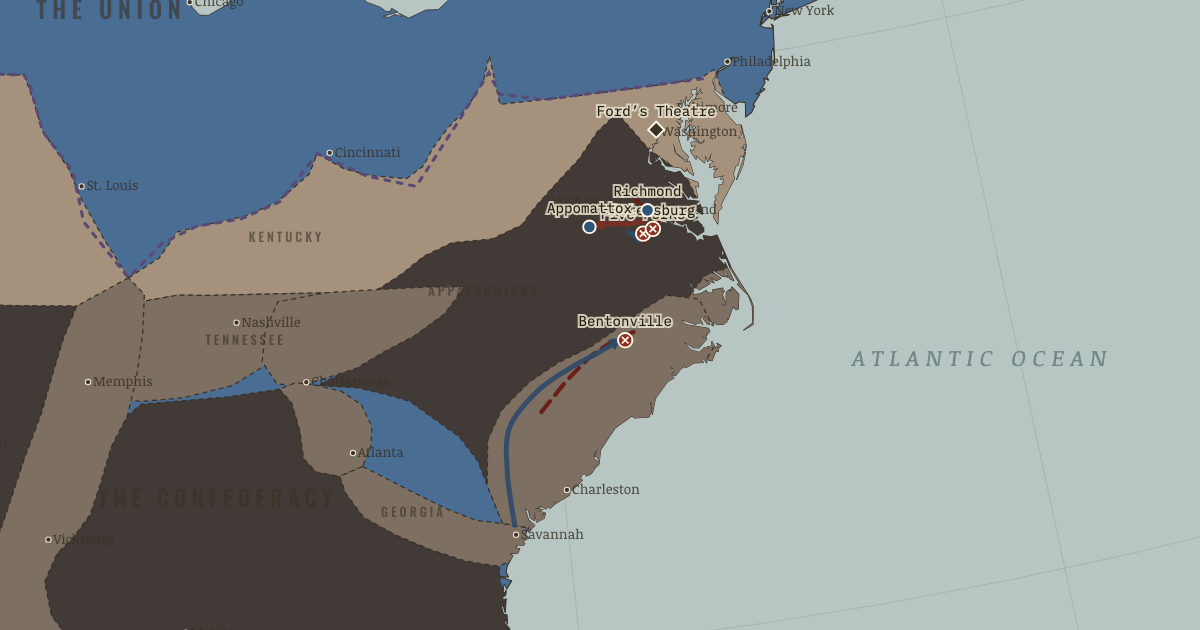
Petersburg was a struggle over supply more than a siege of fortifications, and reading it that way explains its sudden end. Grant kept extending his lines west to cut the railroads feeding Richmond, and Lee had too few men to cover each additional mile while desertion and hunger thinned his ranks. Sherman’s advance north through the Carolinas increased the pressure by threatening to join Grant. After the Union victory at Five Forks on 1 April, Petersburg and Richmond could no longer be supplied and were abandoned.
The short answer
- Why the end came fast. Four years of siege logic collapsed in a fortnight because Petersburg was never a siege of walls but of railroads: when the Southside line fell at Five Forks, Richmond became unsupplyable overnight. Systems under sustained pressure fail suddenly, not gradually. The tide chart on your timeline is flat, flat, flat, then vertical. Remember that shape. It is how attrition always looks from inside.
- The terms as war aims achieved. Grant’s generosity was policy, set in tone by Lincoln at City Point in March: “Let them up easy.” The Union’s objects. Union, and slavery’s death. Were secured by the Amendment and the armies. Humiliating the defeated would purchase nothing but guerrilla war. Paroling 28,000 men to their farms, horses included, was the fastest demobilization of an insurgency ever bought with rations. Note what was NOT settled at Appomattox: everything about the freedpeople’s future. Chapter 12 inherits that silence.
- Why no guerrilla war?. It was seriously proposed. Davis wanted the war continued from the hills. Lee refused, publicly: partisan war would “bring on a state of affairs it would take the country years to recover from.” His surrender, and Johnston’s against Davis’s orders, mattered as much as any battle they fought. The war ended because the men with the guns and the prestige chose that it should. Fort Pillow’s Forrest, of all men, told his troopers to go home and “be good citizens.” Endings are decisions, not just outcomes.
THE TURNING POINT
Appomattox Court House, 9 April 1865. Not the largest surrender (Johnston’s was), but the decisive one: the Confederacy’s legend-army and its indispensable general accepting that the contest was closed. The scene’s restraint. No prisoners marched through Northern cities, no trials of soldiers, a salute answered. Set the template that let the armies dissolve peacefully. Whether that same gentleness, extended by lesser men to the war’s political architects, also let the defeated cause rewrite the peace is Chapter 13’s question. Both truths begin in McLean’s parlor.
What it changed
Assassination changes the peace. Lincoln dies at the exact hinge between war powers and reconstruction, replaced by Andrew Johnson. A Unionist Democrat with a white-supremacist’s view of the freedpeople and a pardoner’s pen. The counterfactual is unknowable, but the actual is documented: presidential protection for the old order, two years before Congress wrests the peace back. The bullet at Ford’s Theatre is among the war’s most consequential shots.
The armies vanish. A million Union soldiers muster out within a year. The Grand Review in Washington in May (two days of marching, the USCT regiments conspicuously absent) and then, simply, home. The republic that many feared would be militarized by victory demobilized instead. Keep this in view when comparing civil wars elsewhere. It is rarer than it looks.
What the map settles. Scrub to the final snapshot: no charcoal, no dashed 1860 line, the Union whole. Secession is dead as a constitutional argument (Texas v. White will bury it in law, 1869), and slavery is abolished by the Thirteenth Amendment in December. What the map cannot show. Who rules the courthouse, who votes, whose labor on whose land. Is exactly what remains unsettled.
The full answer, argued
Distinguish two peaces. The MILITARY soft peace. Paroles, horses, no treason trials of soldiers. Succeeded completely at its object: no insurgency, armies home by summer, a united army of veterans who largely accepted the verdict of arms. The POLITICAL soft peace. Johnson’s wholesale pardons, restored plantations (Field Order 15 revoked), ex-Confederates in Congress by December 1865. Is a separate set of decisions made by different men, and it is where the betrayal of the freedpeople begins. The error is fusing them into one “leniency.” The harder question underneath: could any peace have secured Black freedom without a long federal occupation the Northern electorate was never going to sustain? Answer that honestly and you have the tragedy of Chapter 12 in advance.
An interesting fact
The surrender terms Lee signed were inked in a fine clerk’s hand by Lieutenant Colonel Ely S. Parker — Donehogawa, a sachem of the Tonawanda Seneca, a trained engineer once refused admission to the New York bar because, as an Indian, he was not a citizen. By Parker’s own later account, Lee noticed him at the table and said, “I am glad to see one real American here,” to which Parker replied, “We are all Americans” — the exchange rests solely on Parker’s telling, and historians pass it on with that caveat attached. Grant made him the first Native Commissioner of Indian Affairs in 1869; citizenship for his people at large waited until 1924.
This is the study layer of Appomattox and the end of the war, chapter 11 of The American Civil War, 1840–1877; the full index of the atlas is here.
Related questions
THE FREE PRINTABLE STUDY GUIDE
Join the Dispatch — a short welcome series, then a letter when a new atlas opens — and the printable study guide for The American Civil War is yours now, free.
NO TRACKING · YOUR ADDRESS IS USED FOR THE DISPATCH AND NOTHING ELSE · UNSUBSCRIBE ANYTIME