Haiti and Kenya independence · 1807
How did Haiti’s founders define who was Haitian?
The seminar question: “How did Haiti’s founders define who belonged to the nation, and why?”
On 1 January 1804 at Gonaïves, Jean-Jacques Dessalines and his generals declared independence and named the country Haiti, from the Taíno Ayiti. In early 1804 Dessalines ordered the killing of most remaining French, perhaps 3,000 to 5,000 people, and his 1805 constitution declared that all Haitians would be known as Black.
Chapter 5 is part of membership. WW2 is free — every chapter. Try chapters 1–2 of any 2 other atlases (3 with a free account). Opening a new atlas uses one of them. Membership opens all 21 — Join.
Free printable Haiti and Kenya independence study guide, sent by email ↓
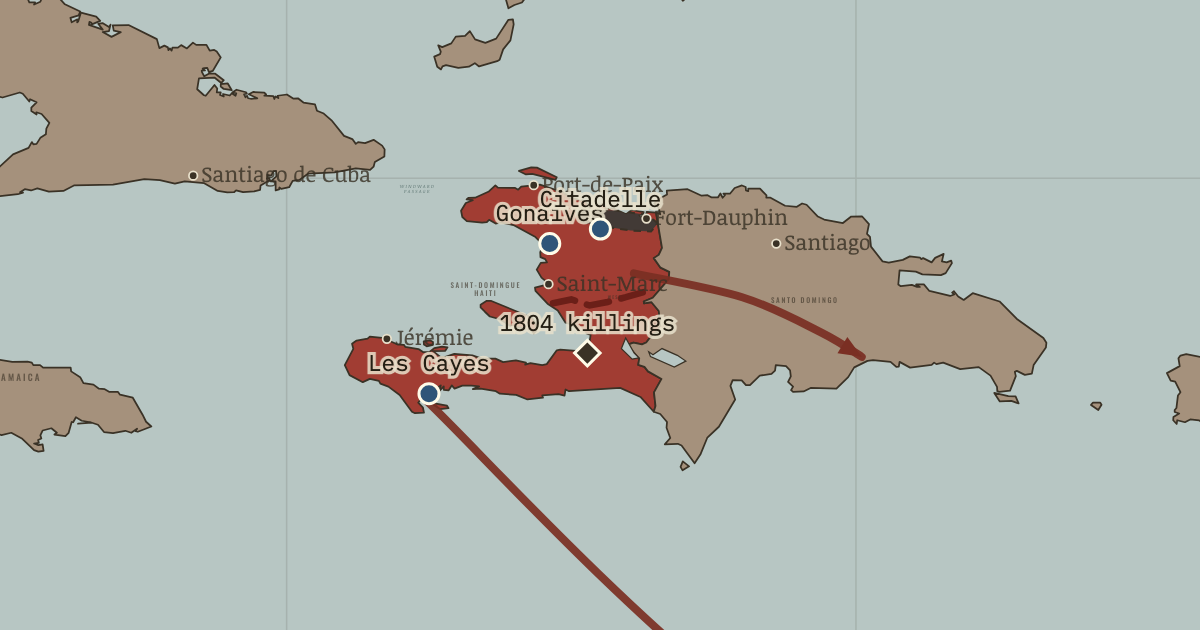
The Declaration of Independence defined Haiti against France, and that definition gave the new state its first identity. Drafted by Dessalines’ secretary, Louis Boisrond-Tonnerre, and read at Gonaïves on 1 January 1804, it called on citizens to swear “to the whole world, to posterity, to ourselves” that they would renounce France for ever. Its authors chose the name Haiti to claim the land for those who now lived on it and to erase the colonial name. Dessalines became governor-general for life and in October 1804 had himself crowned emperor, two months before Napoleon’s coronation in Paris. The constitution of 1805 abolished slavery for ever, banned white people from owning property and declared that all Haitians would be known by the general name of Black, with exceptions for naturalised Polish and German soldiers and white women. Citizenship had been defined by the experience of slavery and the war against it.
The short answer
- Victory without recognition. Vertières drove the French army out, but France did not accept defeat, kept a garrison in Santo Domingo and refused to recognise Haiti. Haiti’s leaders therefore built their state for permanent war: a large army, fortresses in the mountains and laws designed to keep French colonists from returning. The fear of reconquest shaped the declaration, the constitution and the killings of 1804 alike.
- A war that drew the line by colour. The war of 1802–03, with the French army’s massacres, drownings and use of attack dogs under Rochambeau, had turned a conflict over freedom into one fought along lines of race. When the French restored slavery in Guadeloupe, every person of African descent in Saint-Domingue had reason to see the war as a struggle for survival. The new state’s definition of citizens as Black and its ban on white landowners grew directly from that experience.
- The land question left open. Toussaint had kept the plantations working by force, and the cultivators had resisted. Independence reopened the question of who would own the land: the state, the generals who had seized estates, or the former slaves who wanted family plots. Dessalines’ attempt to check land titles alarmed powerful officers, and his successors chose opposite solutions in the north and the south.
- Rivalries among the generals. The army that won independence was led by men of different backgrounds, from former slaves like Dessalines and Christophe to free men of colour like Pétion, with memories of the War of Knives between them. Dessalines’ autocratic rule united his rivals against him. His assassination by his own officers showed that no institution yet existed to settle disputes among the victors, and the country split along the old regional lines.
THE TURNING POINT
Gonaïves, 1 January 1804. The declaration at Gonaïves is the hinge because it created a nation where there had been a colony and fixed the terms of its identity. By renouncing France for ever and taking the Taíno name, the generals claimed the land for those who had been enslaved on it and placed Haiti outside every European empire. No state of formerly enslaved people had existed in the Americas before. The choice of complete separation, made in fear of reconquest, explains much of what followed: the killings of 1804, the constitution of 1805 and France’s determination to make Haiti pay for recognition.
What it changed
A nation without recognition. No major power was willing to recognise Haiti. France refused, the United States banned trade in 1806 under pressure from slaveholding states, and Britain traded quietly without formal ties. Haiti’s isolation left it vulnerable to French threats and short of credit, and it set the stage for the price France would demand in 1825, the subject of the next chapter.
The island reunited, then the east. The union of the whole island meant opposite things to its two peoples: after reuniting Haiti in 1820, Boyer marched into Santo Domingo in February 1822, abolished slavery in the east and governed the whole island until 1844. For Haitians the union protected their independence; for many Dominicans it was an occupation, and their independence in 1844 was won against Haiti.
A beacon and a warning to the Americas. Haiti’s example inspired enslaved people from Jamaica to Virginia and frightened every slaveholding government. Pétion’s aid to Bolívar tied the abolition of slavery in South America to Haitian support, yet the new Spanish American republics excluded Haiti from their diplomacy. Slaveholders from Virginia to Cuba tightened their laws in response. The double reputation, beacon of freedom and symbol of danger, followed Haiti for two centuries.
The full answer, argued
They defined belonging by the experience of slavery and the war against it. The declaration of 1804 renounced France and reclaimed the Taíno name; the constitution of 1805 barred white landowners and named all citizens Black, while naturalising the Polish and German soldiers and white women who had sided with Haiti. The 1816 constitution went further and offered citizenship to any African or Indigenous American who came. These choices answered real dangers: France refused recognition, held Santo Domingo and had just tried to restore slavery. Historians disagree about the costs, from the killings of 1804 to the isolation that followed, and about whether the definition was racial or political; Fischer stresses its political openness. A strong answer explains the definition as a security policy and an assertion of dignity at once. The transferable lesson is that new nations often define themselves against the power they escaped, and that definition outlasts the danger that produced it.
An interesting fact
For two centuries historians knew no printed copy of Haiti’s Declaration of Independence. In 2010 Julia Gaffield, then a doctoral student at Duke University, found an eight-page pamphlet printed by the government press in Port-au-Prince in 1804 among Jamaica’s colonial papers at the UK National Archives in Kew. The Governor of Jamaica had sent it to London in March 1804 with a report on the new state. She later found a one-page printed version in British Admiralty records. Haiti’s founding document had survived because its neighbours were watching it so closely.
This is the study layer of Dessalines and the birth of Haiti, chapter 5 of Two Roads to Independence: Haiti 1789–1838 and Kenya 1895–1978; the full index of the atlas is here.
Related questions
THE FREE PRINTABLE STUDY GUIDE
Join the Dispatch — a short welcome series, then a letter when a new atlas opens — and the printable study guide for Two Roads to Independence is yours now, free.
NO TRACKING · YOUR ADDRESS IS USED FOR THE DISPATCH AND NOTHING ELSE · UNSUBSCRIBE ANYTIME