Haiti and Kenya independence · 1789
Was Saint-Domingue’s wealth the main cause of revolution?
The seminar question: “Was Saint-Domingue’s wealth the main reason it erupted into revolution?”
In 1789 Saint-Domingue, the western third of Hispaniola and today Haiti, produced roughly two-fifths of the sugar and three-fifths of the coffee consumed in Europe. That wealth was made by about half a million enslaved Africans and their children, who outnumbered the free by about eight to one, under the Code Noir of 1685.
WW2 is free — every chapter. Try chapters 1–2 of any 2 other atlases (3 with a free account). Opening a new atlas uses one of them. Membership opens all 21 — Join.
Free printable Haiti and Kenya independence study guide, sent by email ↓
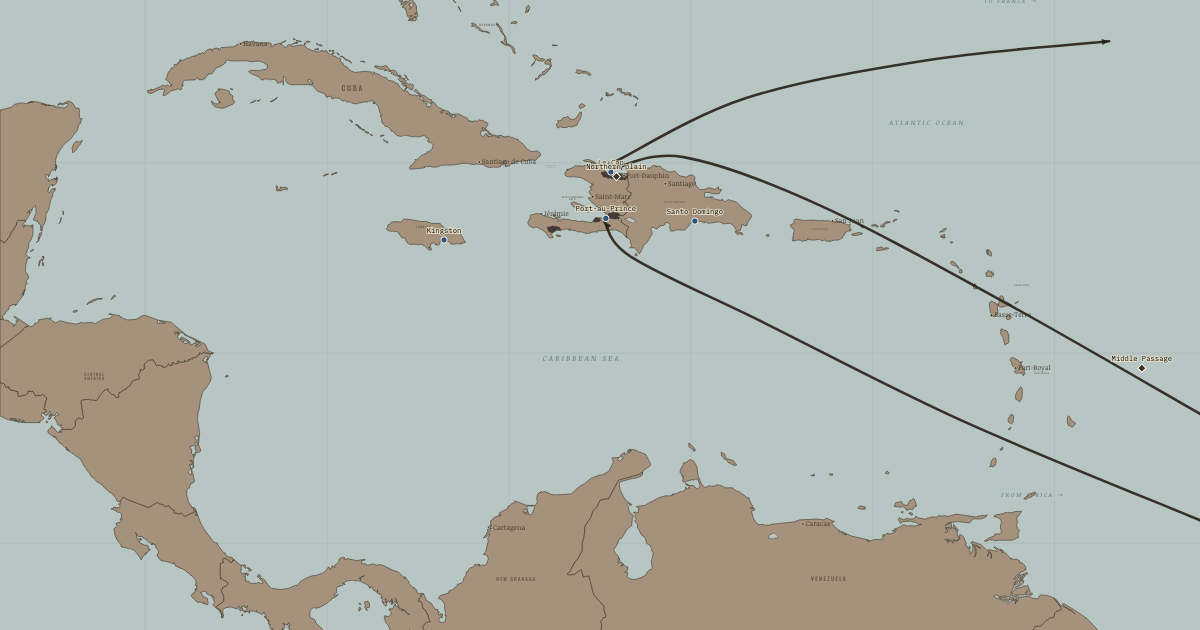
Saint-Domingue’s wealth bound France, Africa and the Americas into a single system, and the arrows on the map show its working parts. Ships from Nantes, Bordeaux and Le Havre carried French goods to the African coast, bought captives there and landed nearly 30,000 people a year in the colony during the late 1780s, most of them from West Central Africa, the region of the Kongo kingdom, and from the Bight of Benin, the stretch of coast that is today Togo, Benin and south-western Nigeria. The colony’s 800 or so sugar estates and more than 3,000 coffee farms sent their produce back to French ports, to be refined and re-exported across Europe. Cap-Français, the main port, known to everyone as Le Cap, had a theatre, newspapers and a scientific society. The colony looked like a model of modern prosperity, and its prosperity depended on the most brutal labour system of the age.
The short answer
- Sugar demanded an unending supply of labour. Sugar was the most profitable crop of the eighteenth century and the most demanding of labour, since cane had to be cut and milled within hours to avoid spoiling. Saint-Domingue’s planters expanded production rapidly after the 1760s, adding coffee in the mountains, and every new estate needed hundreds of workers. Because the work killed faster than families could grow, the colony’s wealth depended on buying ever more Africans. Prosperity and the slave trade grew together.
- Death kept the plantations African. Deaths outnumbered births on the sugar estates, from overwork, poor food and disease, so the enslaved population could only be maintained by new purchases. The result was a workforce in which most adults had been born free in Africa, many of them former soldiers, and fewer had grown up knowing only slavery. Planters believed terror could control them. In fact the brutality that made the system profitable also created a majority with memories of freedom and the skills to fight for it.
- A free society divided by colour. Free people of colour were nearly as numerous as whites by 1789, and many were prosperous planters, yet laws passed since the 1760s barred them from many offices and professions and even regulated their clothing. White colonists, rich and poor, defended these laws because racial status was the foundation of their own privileges. That quarrel between free people meant that any crisis in France would divide the colony’s masters at the very moment they needed unity.
- Colonists who resented their mother country. France governed Saint-Domingue through the exclusif, a law obliging the colony to trade mainly with French merchants and ships, much like a company town forced to buy from the company store. Wealthy planters resented it and dreamed of governing themselves, as Britain’s North American colonies had recently done. Their hope for autonomy would lead them to challenge royal officials in 1789, and that challenge to authority, begun by the rich, would be taken up by everyone beneath them.
THE TURNING POINT
Cap-Français, autumn 1789. News from Paris reached Le Cap in the autumn of 1789, and it is the hinge of this chapter because it split the colony’s masters. The Estates-General, the king’s long-unused assembly of clergy, nobles and commoners, had declared itself a National Assembly, a parliament speaking for the nation; Parisians had stormed the Bastille; and the Assembly had issued a Declaration of the Rights of Man. Wealthy planters saw a chance to win self-government and sent deputies to the new National Assembly; poorer whites formed militias and demanded a share of power; free people of colour, led in Paris by Julien Raimond and Vincent Ogé, claimed the equal rights the Declaration seemed to promise. Each group appealed to France against the others. None of them imagined that the enslaved majority was listening, and that oversight would decide what came next.
What it changed
The colonists demand power. Planters elected colonial assemblies, the most radical meeting at Saint-Marc in 1790, and defied the royal governor in the name of colonial autonomy. They insisted that slavery and race were matters for colonists alone. Their revolt against Paris showed everyone else in the colony that authority could be challenged, and it invited poorer whites and free people of colour to press claims of their own, the lesson the next chapter follows.
Free people of colour claim equality. In Paris, free men of colour lobbied the National Assembly for the rights of citizens, while in the colony white militias answered them with violence. When Vincent Ogé took up arms to enforce those rights in October 1790, his defeat and public execution turned a legal claim into a war. The free people of colour would become a decisive force in every later phase of the revolution.
An African-born majority with its own aims. The enslaved watched the quarrels of their masters and drew their own conclusions. Their aims were shaped by African experience and by life on the estates: an end to the whip, free time to work their own plots, and for many the right to land. When they rose in August 1791 they acted on aims of their own, and that independence of purpose would define Haiti.
Plantation land, then settler land. The charcoal sugar plains of this map have a counterpart in the second case: Kenya’s White Highlands, where European settlers held the best land and African labour worked it. In both colonies the struggle for independence would turn on who owned the land, and in both the answer after independence would disappoint many of those who had fought for it.
The full answer, argued
Wealth explains the conditions: the sugar boom drove the massive purchases of Africans, created a mainly African-born workforce with military experience, and concentrated hundreds of thousands of people on the plains around Le Cap. Yet Jamaica was also rich, also run on sugar and slavery, and saw no successful revolution, so wealth alone cannot be the answer. The trigger came from outside, in the French Revolution, which divided planters, poor whites and free people of colour and weakened the forces that kept the enslaved in check. Historians such as Fick and Thornton add a third element, the political ideas and organisation of the enslaved themselves. A strong answer treats wealth as the necessary condition, the crisis among the free as the opening and the agency of the enslaved, their own capacity to plan and act, as the force that used it. The transferable lesson is that systems built on coercion are most fragile when their rulers fall out.
An interesting fact
Cap-Français was home to one of the first scientific societies in the Americas, the Cercle des Philadelphes, founded in 1784 and granted royal status in 1789. Its members studied tropical medicine, botany, natural history and the weather, and published their findings in France. Much of their research was aimed at the plantation: better ways to grow and mill sugar, to fight epidemics among soldiers and, in the language of the time, to keep enslaved workers alive long enough to repay their purchase. The historian James McClellan described the colony as a place where Enlightenment science served the slave economy.
This is the study layer of Slavery in colonial Saint-Domingue, chapter 1 of Two Roads to Independence: Haiti 1789–1838 and Kenya 1895–1978; the full index of the atlas is here.
Related questions
THE FREE PRINTABLE STUDY GUIDE
Join the Dispatch — a short welcome series, then a letter when a new atlas opens — and the printable study guide for Two Roads to Independence is yours now, free.
NO TRACKING · YOUR ADDRESS IS USED FOR THE DISPATCH AND NOTHING ELSE · UNSUBSCRIBE ANYTIME