Age of Revolutions · SEP 1812
Why did Napoleon repeat Charles XII’s mistakes in Russia?
The seminar question: “Napoleon had studied Charles XII’s 1709 disaster in Russia and carried the history books on campaign. Why did knowing the precedent not save him?”
About 600,000 troops crossed the Niemen on 24 June 1812, but the Russians retreated instead of fighting at the frontier. Borodino on 7 September cost both sides over 70,000 men without destroying the Russian army; Napoleon waited five weeks in Moscow, and disease, hunger and then cold left fewer than 100,000 effective troops.
Chapter 8 is part of membership. WW2 is free — every chapter. Try chapters 1–2 of any 2 other atlases (3 with a free account). Opening a new atlas uses one of them. Membership opens all 21 — Join.
Free printable Age of Revolutions study guide, sent by email ↓
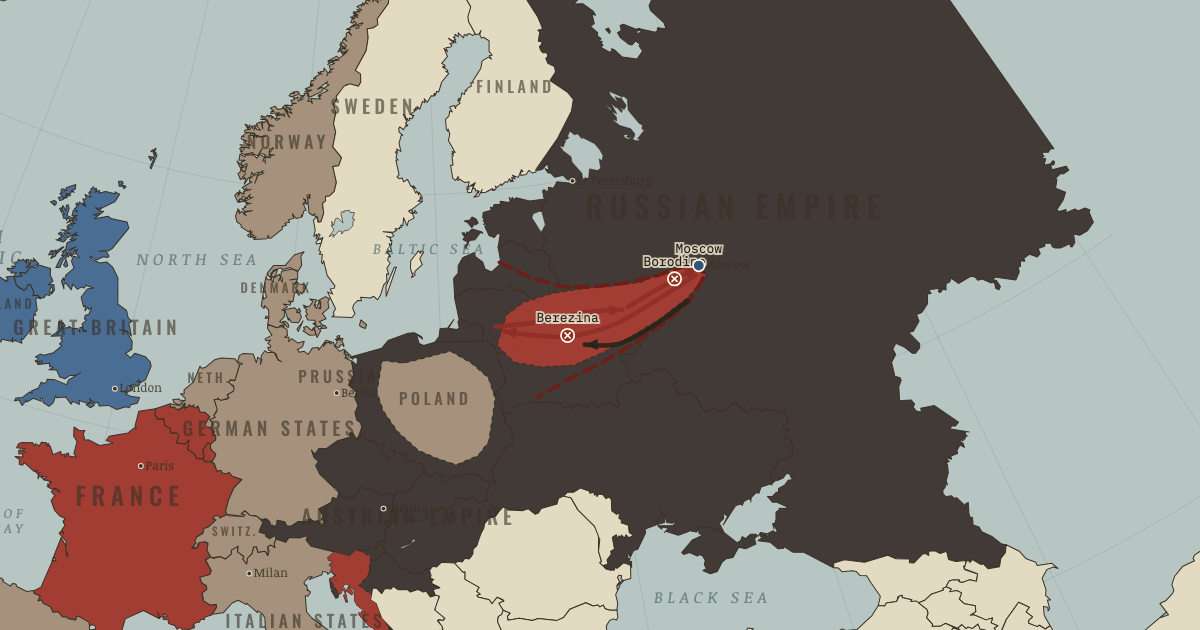
The invasion of Russia was built around a single expectation that failed. About 600,000 troops, many of them from allied or subject states, crossed the Niemen on 24 June 1812 so that Napoleon could trap the Russian armies in a decisive battle near the frontier. The Russians withdrew instead, whether by deliberate design or through the confusion of divided command, and every eastward march after that lengthened French supply lines and thinned the available forage. Typhus, dysentery, heat and desertion removed large numbers of men before the first major battle was even fought.
The short answer
- Logistics against arithmetic. Napoleon’s method — march fast, live off the land, win quickly — was engineered for dense, rich, road-webbed Western Europe. Russia offered sparse forage, sand tracks, and distances that made supply trains mathematically inadequate (the wagons’ draft horses ate their own cargo). The army was dying of ordinary attrition — typhus above all, ~120,000 casualties before Smolensk — while winning every engagement. He had planned a three-week war at Vilna; strategy that cannot survive its own timetable slipping is not strategy but hope.
- Scorched earth and the refused battle. Whether by Barclay’s design or improvisation, retreat denied Napoleon the one thing his system converted into victory: a decisive battle near his supply base. Every league east made the eventual battle less decisive and the return journey more lethal. Compare Chapter 7: Spain denied him a target by dissolving; Russia denied him one by receding. Same lesson, opposite geometry.
- An empire of conscripted allies. Half the invasion force was Prussian, Austrian, German, Italian, Polish — contingents extracted by treaty from recently defeated nations (only the Poles truly believed). Such an army melts under hardship and defects after defeat: the Prussian corps neutralized itself by convention in December, Austria stepped politely aside. Coalition empires fight at the loyalty of their weakest levy.
- Winter was the finisher, not the cause. Name the debate precisely: two-thirds of the losses predate the first hard frost (November). Heat, typhus, dysentery and desertion hollowed the army in summer; winter executed the remainder. “General Winter” was Russian propaganda gladly adopted by Napoleon himself — “the weather” being a more bearable conqueror than “my plan.” Distrust any explanation of disaster that exculpates the planner.
THE TURNING POINT
Moscow, September–October 1812. The battle Napoleon needed never mattered as much as the letter that never came. Possessing the enemy’s ancient capital — the move that had ended every previous war — produced nothing, because Alexander’s throne, unlike Austria’s or Prussia’s, did not depend on any city Napoleon could take; and each of the 35 waiting days converted autumn roads into winter graves. The deepest military lesson in this atlas: victory is not taking things; it is making the enemy’s government prefer peace. If no such preference can be produced, the war has no winning move — and the time spent discovering that is billed in lives.
What it changed
The spell breaks in public. The 29th Bulletin admits catastrophe (while assuring France the Emperor’s health “has never been better”). Prussia defects within weeks, Austria within months; the Sixth Coalition — for once including everyone simultaneously — assembles on Russian bayonets. What Bailén cracked, the Berezina shattered.
The instrument is gone. France can conscript boys (the “Marie-Louises” of 1814 fight superbly), but horses, veteran NCOs and gunners cannot be decreed. At Leipzig the Emperor will command a half-trained army too slow to exploit its own successes — genius with a broken sword.
Russia marches west, twice. The pursuit to Paris (1814) plants the Tsar as arbiter of Europe and marches young Russian officers through constitutional France — they return carrying the comparison that becomes the Decembrist revolt (1825). Autocracy’s victory imports the ideas it defeated; Chapter 11 collects that irony.
The full answer, argued
Napoleon corrected visible features of Charles XII’s failure — he brought more men, supply formations and began in summer. Greater mass also consumed more food and slowed movement. He treated the precedent as a checklist while retaining the same desired mechanism: force Russia into a decisive battle and peace before distance became fatal. Russian retreat denied that mechanism. The lesson was not merely “prepare better for winter”; it was that an enemy able to exchange space for time could make his entire victory condition unavailable.
An interesting fact
The campaign produced what is often called the best statistical chart ever drawn: in 1869 Charles-Joseph Minard, a retired French engineer of eighty-eight, rendered the Grande Armée as a flowing band that leaves the Niemen 422,000 men wide and returns 10,000 — thinning at every river crossing while a temperature line falls away along the bottom of the page. One ribbon of ink carries six variables — strength, position, direction, distance, temperature, time — and an argument. No prose history of 1812 has ever said it faster.
This is the study layer of Napoleon’s invasion of Russia, chapter 8 of The Age of Revolutions, 1775–1848; the full index of the atlas is here.
Related questions
THE FREE PRINTABLE STUDY GUIDE
Join the Dispatch — a short welcome series, then a letter when a new atlas opens — and the printable study guide for The Age of Revolutions is yours now, free.
NO TRACKING · YOUR ADDRESS IS USED FOR THE DISPATCH AND NOTHING ELSE · UNSUBSCRIBE ANYTIME