Ancient Rome · 216 BC
Why did Rome keep fighting after the Battle of Cannae?
The seminar question: “Rome suffered immense losses at Cannae and kept fighting. What allowed it to continue?”
In the Second Punic War (218–201 BC) Hannibal crossed the Alps and destroyed Roman armies at the Trebia, Lake Trasimene and Cannae in 216 BC, aiming to break Rome’s network of Italian allies. Several southern peoples defected, but the central Italian core held, and the Senate refused to negotiate and raised fresh legions.
WW2 is free in full, and chapter 1 of every atlas is free. A free account opens 3 more chapters a day. Starter, at $9 a month, opens all 21 with no daily limit — see the plans.
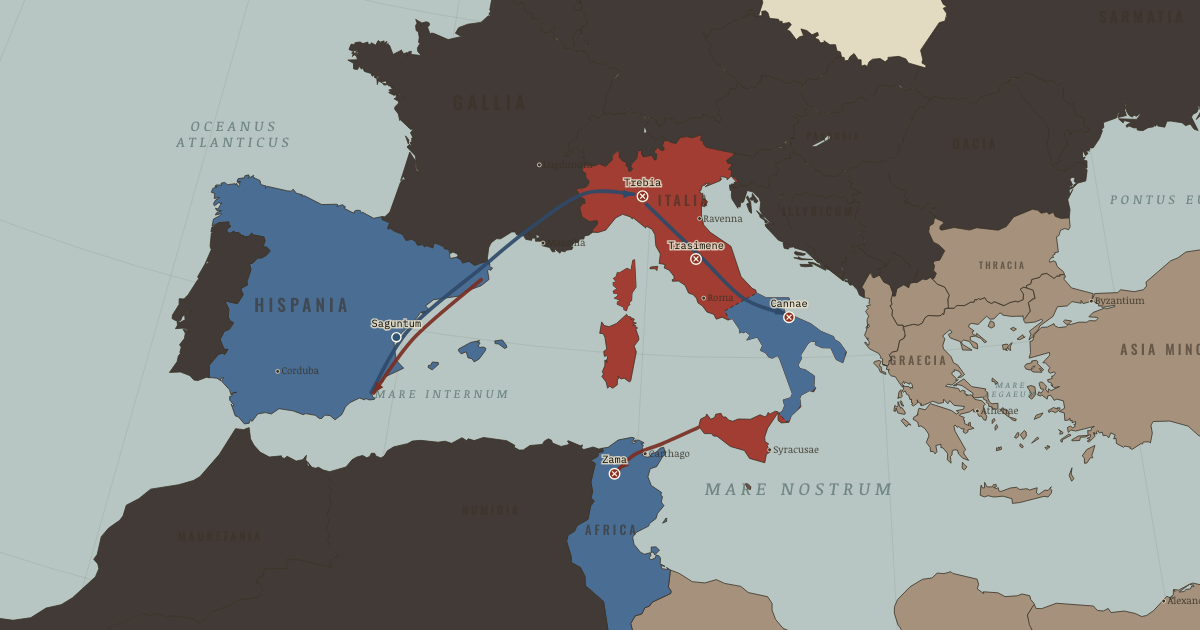
Hannibal began his invasion far from Rome. In 218 BC he led an army from Carthaginian Spain across the Rhône and over the Alps in autumn snow. Most of his men were lost on the journey, and perhaps 26,000 reached Italy. The crossing makes sense as part of a political plan: victories on Italian soil might convince Rome’s allies that Rome could no longer protect them, and persuade them to leave the alliance that furnished its armies.
The short answer
- A treaty written in resentment. Carthage’s defeat brought heavy peace terms in 241 BC. Three years later, while Carthage fought its mutinous mercenaries, Rome took Sardinia. Polybius regarded Roman conduct over Sardinia as a major cause of the later war. In Spain the Barcids built a new base, drawing on silver and men that could support recovery and another contest with Rome.
- Saguntum: the tripwire city. Saguntum was under Roman protection, although the Spanish city lay south of the river used in an agreement defining Carthaginian expansion. Hannibal captured it in 219 BC. Rome demanded that Carthage surrender him; the Carthaginian council stood by him. The rival commitments over Saguntum became the immediate occasion for war.
- Hannibal’s theory of victory. Hannibal’s plan depended on separating Rome from its allies. He defeated legions and freed Italian prisoners without ransom to persuade their communities that they could leave. Some did. Others, particularly in central Italy, had ties of law, citizenship in some communities, intermarriage and shared interests that victories alone could not sever.
- Command by committee, annually. Annual consular elections gave Rome a succession of commanders, but also allowed men such as Varro at Cannae to offer Hannibal the pitched battles he wanted. Rome adapted: Fabius and Marcellus received repeated commands, and Scipio, a private citizen, received an extraordinary proconsular command. These measures helped sustain the war and set precedents for later ambitious commanders.
THE TURNING POINT
Cannae, 2 August 216 BC. The battle at Cannae on 2 August 216 BC destroyed a Roman army. Some ancient estimates put the dead at about 60,000, perhaps an eighth of the adult male citizens and allies within reach; the estimates vary. Rome responded by lowering the property qualification, arming enslaved men and criminals, limiting public mourning to thirty days and refusing to ransom prisoners. Hannibal’s officer Maharbal is said to have told him: “You know how to win a victory; you do not know how to use one.” The remark captures the frustration of victory without a settlement. It does not explain away Rome’s decision to fight on, or the allies who made that possible.
What it changed
The Mediterranean’s center of gravity moves west. With Carthage reduced to a disarmed client, Rome became the dominant naval power in the western Mediterranean. Numidia under Masinissa allied with Rome and put persistent pressure on Carthage; watch the African hinterland change color on the map. Control in Spain also gave Rome access to silver for later wars.
A generation trained by catastrophe. Soldiers and commanders acquired extensive experience during seventeen years of fighting Hannibal. They also gained confidence in Rome’s capacity to prevail after catastrophe. Within three years of Zama, Rome was fighting Macedon: the Hellenistic east was meeting the winner of the western struggle.
Italy’s countryside begins to change. Armies living off Italy devastated farms and smallholders. War captives were enslaved, and wealthy landowners acquired estates. Historians from Appian onward have connected these developments to the Republic’s later social crisis. Their timing and extent remain debated, but the pressures began before the crisis became visible on the map.
The third war: a memorial, not a chapter. Carthage recovered commercially, and Cato repeatedly urged its destruction: “Carthage must be destroyed.” Roughly fifty years after the peace, Rome went to war again in 149 BC. The city fell in 146 after a three-year siege; its people were killed or enslaved and its site cursed. The ◆ marker records the destruction of a city that had revived in trade but was militarily weak.
The full answer, argued
Rome could call on the large alliance described in the previous chapter. Polybius estimated more than 700,000 citizens and allies, a figure historians debate. Even losses that may have approached 100,000 over three years could be replaced, though the human cost was terrible. Annual magistracies supplied new commanders, and the Senate refused a settlement after Cannae. Southern communities defected, but many central allies remained connected to Rome by law, marriage and shared interests. Hannibal had destroyed armies without breaking the coalition that raised replacements.
An interesting fact
Hannibal returned to public life after Zama. As suffete, or chief magistrate, elected in 196 BC, he reformed Carthage’s finances and challenged embezzlement by oligarchs. Ancient accounts connect the reforms with the city’s ability to meet its fifty-year indemnity. Within five years Carthage offered early payment; Rome refused. Hannibal went into exile and took poison in Bithynia around 183 BC rather than be handed over to Rome. Livy placed the death of his opponent Scipio Africanus in the same year, after Scipio’s withdrawal into self-imposed exile from Roman politics. Ancient historians noticed the symmetry.
This is the study layer of Second Punic War, chapter 2 of The Rise and Fall of Rome, 264 BC – AD 476; the full index of the atlas is here.
Related questions
THE FREE PRINTABLE STUDY GUIDE
Get the printable study guide for Rome free. I’ll send you a few short letters, then one when a new atlas opens. That’s all. — Paul
NO TRACKING · YOUR ADDRESS IS USED FOR THE DISPATCH AND NOTHING ELSE · UNSUBSCRIBE ANYTIME