Russian Revolution · OCT 1920
Was Warsaw 1920 won by Piłsudski or lost by Tukhachevsky?
The seminar question: “The Miracle on the Vistula — Piłsudski’s genius or Tukhachevsky’s blunder? And what did stopping the Red Army at Warsaw decide?”
In 1920 Piłsudski took Kiev, but Tukhachevsky’s Red Army drove him back and advanced on Warsaw until a Polish counterstroke, the Miracle on the Vistula, routed it in August. The Peace of Riga fixed a border that held until 1939, and in November the Reds stormed Perekop against Wrangel’s last White army in the Crimea.
Chapter 12 is part of membership. WW2 is free — every chapter. Try chapters 1–2 of any 2 other atlases (3 with a free account). Opening a new atlas uses one of them. Membership opens all 21 — Join.
Free printable Russian Revolution study guide, sent by email ↓
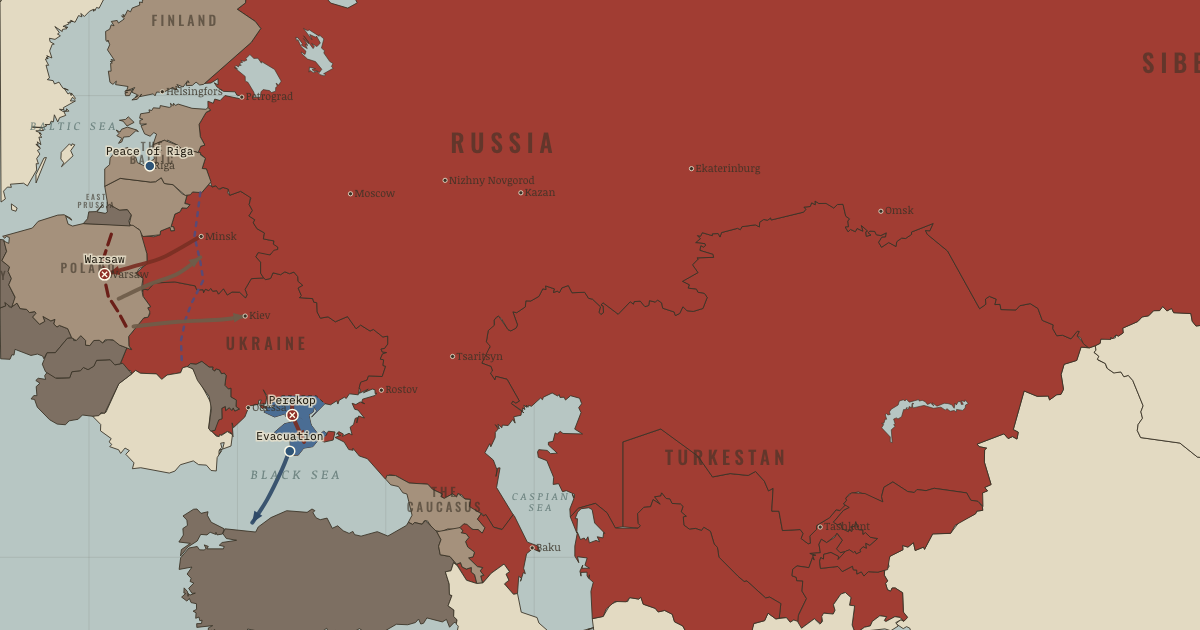
The Polish-Soviet war of 1920 mixed a border conflict with two much larger political projects. Piłsudski hoped to build a federation of nations between Poland and Russia, and took Kiev in May toward that end, while the Bolshevik leaders came to see a march west as the road to revolution in a Germany they still believed was ripe for it. The Red counteroffensive drove hundreds of kilometers toward Warsaw, but each advance stretched its supply lines thinner, and Tukhachevsky’s northern armies lost contact with the south-western front, leaving a gap between them. The dream of carrying the revolution into central Europe on bayonets was about to meet its limit.
The short answer
- Two enemies the Reds could not fight at once. Wrangel survived as long as he did precisely because the Polish war pinned the Red Army in the west. A last illustration of the whole war’s logic of interior lines and one-front-at-a-time. Only when Poland made peace could Moscow turn its full weight south. The Whites’ last hope was always that their enemies would have to divide their attention. In 1920 they briefly did.
- The gamble to export revolution. Tukhachevsky’s drive on Warsaw was not just border-fixing. It was an attempt to punch through Poland to a Germany the Bolsheviks still believed was ripe for revolution. The overreach. Political and logistical. Turned a defensible victory into a catastrophic defeat, and taught the regime that world revolution would not be delivered by the Red Army’s bayonets.
- Piłsudski’s counterstroke and Tukhachevsky’s overextension. The “Miracle” was made of concrete mistakes and one bold plan: the Reds outran supply and coordination and left a flank open. Piłsudski, reading intercepted Soviet radio, gathered a strike force and hit the gap. Warsaw is a textbook case of an overextended offensive shattered by a counter-attack at its weakest joint.
THE TURNING POINT
The Miracle on the Vistula, August 1920. The battle that stopped the revolution at Europe’s door. Tukhachevsky’s exhausted, overextended armies were split by Piłsudski’s flank counterstroke and routed within a week. The Red Army’s worst defeat of the whole period. Its consequences ripple for decades: Poland’s eastern border was fixed until 1939 (making the borderlands the fuse of the next war), the Bolshevik hope of carrying revolution into Germany was abandoned for “socialism in one country,” and the myth of the invincible Red Army was punctured. Sometimes the most important battles are the ones that mark a limit. Here, the western edge of what the revolution could conquer.
What it changed
A border drawn to 1939. The Peace of Riga split the contested borderlands between Poland and Soviet Russia and held for eighteen years. Until, in September 1939, two dictators erased Poland along a line not far from Tukhachevsky’s furthest advance. The war you may have studied in the War Room begins where this one ends.
Revolution contained, not exported. Warsaw ended the Bolshevik bid to spread the revolution by force into central Europe. The failure pushed the regime, over the next few years, toward consolidating what it had. The road to Stalin’s “socialism in one country.”
The White emigration. Wrangel’s evacuation was the last of several: perhaps 1.5 million Russians went into exile. Officers, aristocrats, professionals, whole institutions. The civil war ended not only in Red victory but in the permanent removal of a large slice of educated Russia, a loss the Soviet state would feel for decades.
The full answer, argued
Both, as usual, but weighted toward Red overreach. Piłsudski’s counterstroke was genuinely bold and well-informed (Polish codebreakers were reading Soviet radio), but it succeeded because Tukhachevsky handed him the opening. Armies outrunning their supply, a fatal gap between fronts, and a political fantasy that Polish workers would welcome the invaders. What it decided is large: it fixed the eastern border of Europe for a generation and, in doing so, created the Poland and the borderland that Hitler and Stalin would carve up in 1939, making Warsaw 1920 one of the hidden hinges of the twentieth century. It also killed, for the Bolsheviks, the dream of exporting revolution by the sword. Turning them inward toward building socialism in the one country they held. A battle that looks like a footnote to the civil war set the terms of the wars to come.
An interesting fact
Among the French officers advising the Polish army in 1920 was a young captain named Charles de Gaulle — a veteran of Verdun and of German prison camps, decorated with Poland’s Virtuti Militari for the campaign. What he watched on the Vistula was a war of movement, cavalry and deep thrusts that looked nothing like the trenches that had formed him, and biographers have traced his later doctrine of mechanized warfare partly to that summer. The battle that stopped the Red Army also helped school the man who would one day lead Free France.
This is the study layer of Polish–Soviet War, chapter 12 of The Russian Revolution, 1855–1924; the full index of the atlas is here.
Related questions
THE FREE PRINTABLE STUDY GUIDE
Join the Dispatch — a short welcome series, then a letter when a new atlas opens — and the printable study guide for The Russian Revolution is yours now, free.
NO TRACKING · YOUR ADDRESS IS USED FOR THE DISPATCH AND NOTHING ELSE · UNSUBSCRIBE ANYTIME