American Civil War · JUL 1861
Why did Europe expect the Confederacy to win in 1861?
The seminar question: “The Union had great advantages on paper. Why might European observers nevertheless have expected the Confederacy to win?”
At Bull Run on 21 July 1861 untrained Union volunteers advancing on Richmond were routed, ending Northern hopes of a short war. The Union held large advantages in population, industry, railroads, finance and naval power, but the Confederacy needed only to survive until Northern voters tired of the cost.
Chapter 4 is included with every paid plan. WW2 is free in full, and chapter 1 of every atlas is free. A free account opens 3 more chapters a day. Starter, at $9 a month, opens all 21 with no daily limit — see the plans.
Free printable American Civil War study guide, sent by email ↓
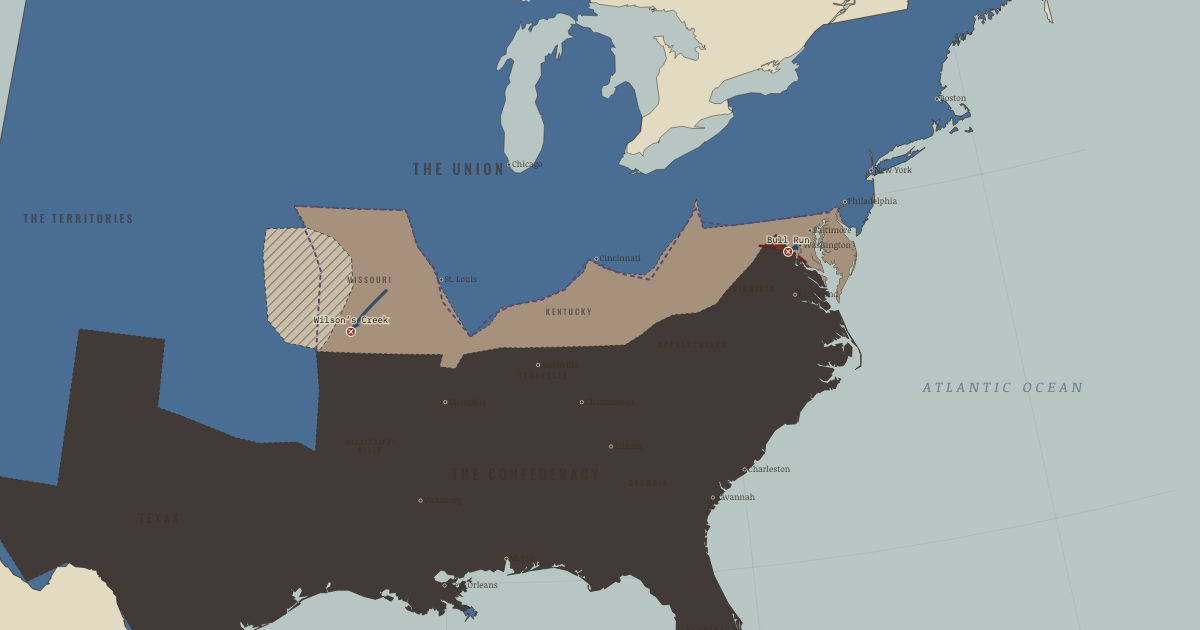
The road to Richmond seemed to offer a quick way to restore the Union. In July 1861 inexperienced Union volunteers advanced toward the Confederate capital and met an equally inexperienced enemy at Bull Run. Confederate reinforcements arrived by railroad; the Union line broke, and the retreat became disorderly. The battle changed little territory. It changed what Lincoln’s government had to prepare for.
The short answer
- Ninety-day thinking. Expectations of a quick war rested on comforting views of the enemy. Some Northerners believed secession was a planter conspiracy that would collapse at its first defeat; some Southerners thought a battlefield humiliation would bring the commercial North to terms. Bull Run frustrated the first hope and appeared to support the second. Yet a single victory could not establish how long Northern voters would accept the costs of fighting.
- Asymmetry of objectives. Independence required the Confederacy to survive the Union’s effort, not conquer the North. Confederate leaders could defend, give ground to gain time and try to exhaust Northern political will, while looking to cotton and European interests for help. The Union’s task demanded armies and supplies across a vast region and along hostile rivers and railroads. Its blockade, river campaigns and later marches addressed that unequal problem.
- Armies before soldiers. The regular United States army numbered about 16,000 at the start, many stationed in the West. Neither side possessed the mass army the war would require. They assembled volunteers under elected officers and political generals, often for short terms, and troops and commanders learned their work at Bull Run. Grant, Sherman and Lee began a four-year development as commanders, much of it initially in obscurity.
THE TURNING POINT
Bull Run, 21 July 1861. The outcome at Bull Run on 21 July 1861 had effects beyond the field. Defeat shook Northern complacency; victory gave Confederates confidence and time, without proving that the North would stop. Lincoln called for half a million long-service men, McClellan began building the army, and the blockade tightened. The Union was preparing for a longer effort.
What it changed
McClellan builds the weapon. McClellan spent the autumn turning volunteers into the Army of the Potomac, drilling and equipping them. The soldiers became devoted to the young general who built their army. That achievement gave the Union an instrument for future campaigns; his later reluctance to risk it would become a central difficulty in the East in 1862.
The West organizes. The war’s western routes were taking shape while the eastern armies settled in. Wilson’s Creek, reached by the arrow, formed part of the struggle through which the Union held Missouri. Confederate troops entered Kentucky first and ended its neutrality; Grant occupied the river junctions at Cairo and Paducah. Holding those positions gave Union forces access toward the Confederate interior.
Cotton diplomacy fails its first test. Confederate supporters withheld cotton, expecting British mills to press for recognition when supplies ran short. But British warehouses still held cotton from bumper crops, Egypt and India could grow more, and Britain needed Northern wheat as well. The first test of “King Cotton” diplomacy showed why dependence on Southern fiber did not automatically translate into diplomatic recognition.
The full answer, argued
A defender could draw encouragement from the American Revolution and Spanish resistance to Napoleon. In each, a stronger invader faced opponents who could succeed by holding out. Distance, disease and the expense of occupation could consume an attacker’s material advantage. European observers had good reason to take those obstacles seriously. The Union, however, had rivers and railroads that could carry it into the Southern interior. Enslaved people could escape to Union lines and later fight against the Confederacy. Northern voters also sustained the war effort through the elections of 1862 and 1864, showing a durability that aristocratic Europeans had doubted democracies possessed. Resources mattered because the Union could bring them to bear and maintain support despite the cost.
An interesting fact
Wilmer McLean moved away from Bull Run after his farm served as a Confederate headquarters and a shell crashed into his kitchen during the first fighting. He chose Appomattox Court House, a quiet crossroads village in southside Virginia, hoping to put his family beyond the armies’ reach. In April 1865 Grant and Lee met in his front parlor to arrange surrender. His later description, “the war began in my front yard and ended in my front parlor,” was a mild exaggeration. Within an hour of the signing Union officers had carried away his furniture as relics; some paid and some did not.
This is the study layer of First Battle of Bull Run, chapter 4 of The American Civil War, 1840–1877; the full index of the atlas is here.
Related questions
THE FREE PRINTABLE STUDY GUIDE
Get the printable study guide for The American Civil War free. I’ll send you a few short letters, then one when a new atlas opens. That’s all. — Paul
NO TRACKING · YOUR ADDRESS IS USED FOR THE DISPATCH AND NOTHING ELSE · UNSUBSCRIBE ANYTIME