American Civil War · JUL 1848
Was the Mexican–American War fought for slavery?
The seminar question: “Was the Mexican War a war for slavery?”
In the 1840s the belief in Manifest Destiny drove American expansion: Texas joined the United States in 1845 and Oregon was split with Britain in 1846. When Mexico refused to sell California, President Polk sent troops into disputed land, and the Wilmot Proviso of 1846 tied the conquest to the question of slavery.
WW2 is free — every chapter. Try chapters 1–2 of any 2 other atlases (3 with a free account). Opening a new atlas uses one of them. Membership opens all 21 — Join.
Free printable American Civil War study guide, sent by email ↓
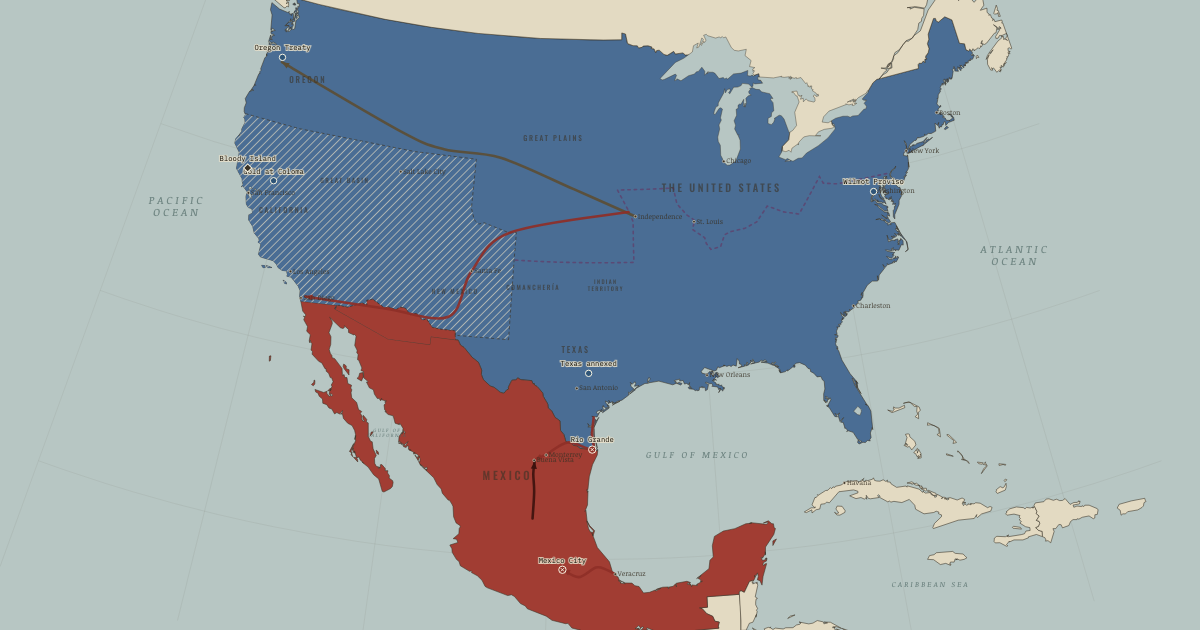
Expansion in the 1840s was a political programme as much as a migration, and President James K. Polk pursued it to the point of war. Its champions called it Manifest Destiny, the belief that Providence, meaning God’s plan, intended the United States to span the continent, much as some nations today claim a historic mission, and it carried a racial confidence that white Americans should rule. Texas, a slaveholding republic since it broke from Mexico in 1836, joined in 1845 by joint resolution, a simple vote of both houses like an ordinary law, after the Senate rejected an annexation treaty. Oregon was split with Britain at the 49th parallel, today’s Canadian border, and its map hatching vanishes in June 1846. When Mexico refused to sell California, Polk sent General Zachary Taylor into the hatched strip between the Nueces River and the Rio Grande, and a skirmish there in April 1846 let him present a war of choice as a war of defence.
The short answer
- Land hunger and an ideology of destiny. Americans were moving west faster than their government could follow, so Washington came under pressure to secure land its citizens had already entered. Thousands took the Oregon Trail in the 1840s, the brown arrow on the map. Expansionists dressed this movement in the language of Manifest Destiny, the belief that Providence had given the continent to the United States. The idea joined real hopes, such as Pacific ports for the China trade, to a racial conviction that Mexicans and Native peoples should give way.
- Polk’s determination to have California. The most direct cause was a president who wanted California badly enough to take it. Polk entered office in 1845 with a short list of goals, and California, with its harbours at San Francisco and San Diego, stood near the top. He first tried to buy it, sending John Slidell to Mexico City authorised to offer up to $25 million by most accounts, and the Mexican government refused to receive him. Polk then moved Taylor’s army to the Rio Grande, into land that Mexico held and Texas claimed, which turned a diplomatic refusal into an armed standoff.
- A Mexican state at its weakest. Mexico in 1846 was in no condition to fight a long war. Its treasury was empty, its army was led by generals who also made and unmade governments, and its northern states had been devastated by Comanche and Kiowa raids. Mexican leaders could not sell territory without being overthrown, as Herrera discovered when Paredes toppled him for being willing to talk. Weakness made war more likely, because it left Mexico able neither to deter Polk nor to bargain with him.
- Texas and the politics of slavery. Texas joined the Union as a slave state, and its annexation was argued in the language of slavery from the start. In 1844 Secretary of State Calhoun told the British minister that annexation would protect slavery from British abolitionism, and the Senate rejected the treaty that June partly for that reason. When annexation passed by joint resolution in 1845, Northern opponents saw the “slave power,” the slaveholders’ supposed grip on the federal government, enlarging itself. The war inherited that suspicion, which is why Northern congressmen moved at once to keep slavery out of its conquests.
THE TURNING POINT
The Wilmot Proviso, 8 August 1846. The hinge of the decade came on the night a first-term Pennsylvania congressman added one sentence to a bill giving Polk $2 million to make peace. David Wilmot proposed that slavery should never exist in any territory taken from Mexico, and the House approved it 83 to 64, with Northern Democrats and Whigs together on one side and Southerners of both parties on the other. That vote revealed that slavery could now split the national parties, which had held the Union together by making Northerners and Southerners cooperate. The Senate never passed it, yet its question shaped every crisis that followed, in 1850, 1854 and 1860. An amendment that failed did more to divide the country than most laws that passed.
What it changed
Free soil becomes a party. The proviso gave Northerners who opposed slavery’s spread a cause, free soil, meaning western land kept for free labour, that did not require them to attack slavery where it already existed. In 1848 the Free Soil Party ran former president Martin Van Buren on that platform and won about ten percent of the popular vote. Its slogan, “Free Soil, Free Speech, Free Labor, and Free Men,” and many of its leaders passed into the Republican Party in the 1850s. Lincoln’s platform of 1860 was, in effect, the Wilmot Proviso grown up.
The Fugitive Slave Act radicalizes the North. The South’s main gain in 1850 became the North’s main grievance. The new law denied accused fugitives a jury trial and paid federal commissioners $10 when they sent a person south and $5 when they set one free. Crowds in Boston and other cities tried to rescue captured people, and Harriet Beecher Stowe wrote Uncle Tom’s Cabin in response. A law meant to reassure the South taught many Northerners that slavery reached into their own towns.
Popular sovereignty carries the quarrel to Kansas. Letting settlers decide sounded like a democratic way out, and in 1854 Stephen Douglas applied it to Kansas and Nebraska, repealing the line of 36°30′ that the Missouri Compromise of 1820 had drawn between slave and free territory. On the continental map the hatch spreads across the plains in the snapshot of June 1854. Settlers then fought over the decision, and Kansas became a small civil war. The method of 1850 moved the conflict from Congress to the frontier, where no one could arbitrate it.
Mexico trains the generals of 1861. The Mexican War was the school where the commanders of 1861 learned their trade, since Grant, Lee, Jackson, Longstreet, McClellan and Jefferson Davis all served in it. Grant wrote later that the Southern rebellion “was largely the outgrowth of the Mexican war,” and he judged the Civil War the nation’s punishment for that conquest. The war that reopened the slavery question also trained the men who would fight over it, each knowing the others’ habits.
The full answer, argued
The case for yes begins with Texas, which entered as a slave state after Calhoun had defended annexation as protection for slavery, and it gains force from Southern enthusiasm for the war. The case for no rests on Polk’s aims, which centred on California’s harbours, on the Northern Democrats who backed the war, and on the Southern Whigs who opposed it for fear of what new land would do to the Union. Geography weakened the slavery motive too, since few planters expected cotton to grow in most of the Mexican Cession, the land Mexico gave up in 1848. The stronger verdict separates motive from consequence. The war was fought chiefly for land and ports, yet once won it forced the question of slavery’s expansion onto every vote that followed, so slavery decided what the war meant even where it did not decide why it began. The same distinction serves for many wars, whose causes and consequences often turn out to be different things.
An interesting fact
The treaty that ended the war was signed by a man who had been fired. Polk recalled his envoy Nicholas Trist in October 1847, but Trist received the order in mid-November and chose to stay, explaining himself in a letter of some sixty-five pages because he judged that Mexico’s moderate government might fall before a replacement arrived. He signed at Guadalupe Hidalgo on 2 February 1848. Polk, furious, sent the treaty to the Senate anyway, since it gave him almost everything he wanted. Trist was dismissed and left unpaid until 1871, when Congress, pressed by Senator Charles Sumner, finally paid his salary and expenses.
This is the study layer of Mexican–American War, chapter 1 of The American Civil War, 1840–1877; the full index of the atlas is here.
Related questions
THE FREE PRINTABLE STUDY GUIDE
Join the Dispatch — a short welcome series, then a letter when a new atlas opens — and the printable study guide for The American Civil War is yours now, free.
NO TRACKING · YOUR ADDRESS IS USED FOR THE DISPATCH AND NOTHING ELSE · UNSUBSCRIBE ANYTIME