Chinese Revolution · 1938
Was Chiang right to fight Japan in 1937?
The seminar question: “Was Chiang right to fight in 1937 — six years after Manchuria, arguably years before he was ready?”
A clash at Marco Polo Bridge in July 1937 escalated into full war between China and Japan. Chiang fought a three-month battle at Shanghai that destroyed many of his best divisions, Japanese forces committed mass murder and mass rape after Nanjing fell, and the government moved inland but lost Wuhan in 1938.
Chapter 8 is part of membership. WW2 is free — every chapter. Try chapters 1–2 of any 2 other atlases (3 with a free account). Opening a new atlas uses one of them. Membership opens all 21 — Join.
Free printable Chinese Revolution study guide, sent by email ↓
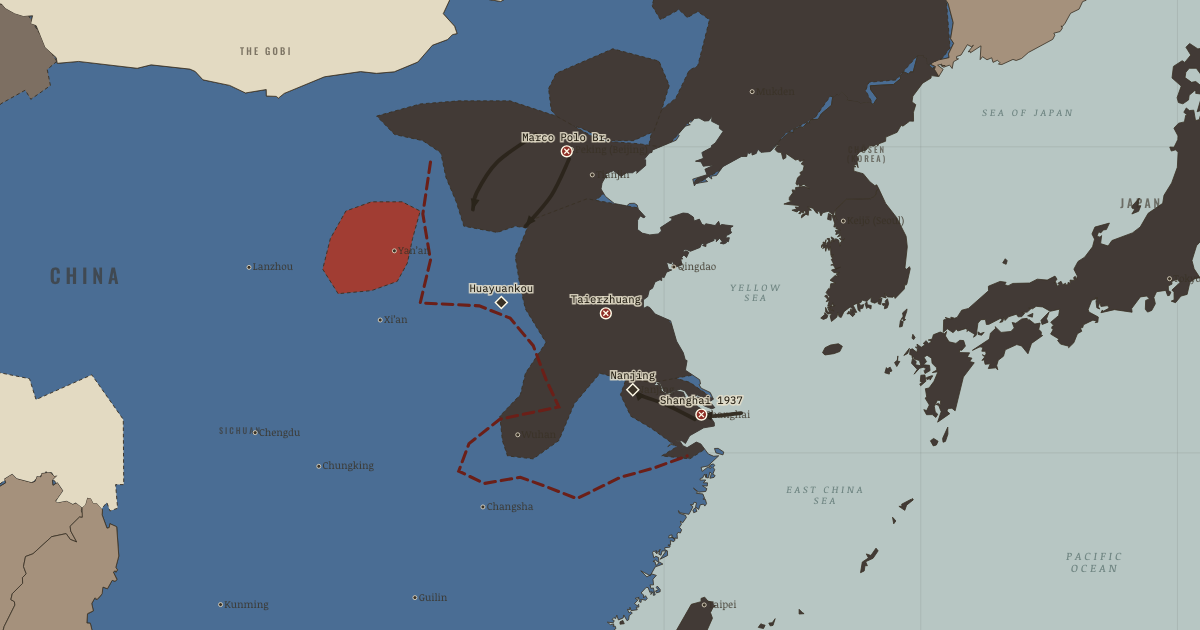
“Space for time” meant surrendering territory in order to preserve enough forces and government to keep the war going. It began with an incident far too small for the war it started. During a night exercise a Japanese soldier went missing at roll call, and shots were exchanged in the dark at a stone bridge southwest of Peking (the ✕ at Marco Polo Bridge, 7 July 1937). Local commanders nearly settled it, as they had settled a dozen such incidents since 1931, but this time Tokyo reinforced. Chiang also refused to back down, because his currency was reformed, his German-trained divisions were ready enough, and his legitimacy had been mortgaged at Xi’an to resistance. Two charcoal arrows drove south from the Peking–Tianjin plain along the railways into Hebei and Shanxi, Japan’s war of lines, fast and mechanized and unstoppable in the open north. The other two arrows belong to the war Chiang chose. In August he attacked the Japanese garrison in Shanghai (the ✕ there), deliberately pulling the main war onto the Yangtze axis. There rivers, cities and mud favored the defender, and the world, watching from the International Settlement’s rooftops, could not ignore it. Three months of house-by-house fighting consumed his best divisions, with casualties approaching a quarter-million, including the irreplaceable junior officers Whampoa had spent a decade making.
The short answer
- Tokyo’s escalation machine. Japan in 1937 had no plan to conquer China — it had a government too weak to refuse its field armies’ faits accomplis, a doctrine (“one decisive blow will make Chiang submit”) renewed after each blow failed, and a domestic politics in which assassination had already priced moderation (the coups and murders of 1932–36). Each escalation was locally rational and cumulatively ruinous: the classic pattern of a state whose army audits itself.
- Why Chiang chose 1937. Six years of trading space for time (Manchuria, Jehol, the Tanggu line — the dashed concession still visible on your 1933–35 maps) had bought real assets: the fabi, German-trained divisions, arsenals, roads. But Xi’an had spent his last credit for delay, and the north was being nibbled into a second Manchukuo. He fought when the alternative was presiding over erosion. He chose Shanghai to make the war expensive, visible and long. Argued strategy, paid for in his best army.
- Two wars in one country. Japan’s army was built to destroy armies quickly and could. China’s strategy was to refuse the decision — trade cities for time, stretch the enemy across a continent, and wait for the world war Chiang was certain was coming. “Space for time” was announced doctrine, not improvisation. The map is the argument: by December 1938 Japan has taken every great city of eastern China and won nothing decisive.
- A soldiery prepared for atrocity. Nanjing was not an aberration of discipline but a product of it: an army trained in systematic brutalization of its own ranks, indoctrinated in contempt for Chinese combatants and civilians alike, permitted — at command levels whose responsibility the Tokyo tribunal later traced — to treat a fallen capital as spoils. Naming the mechanism matters, because “chaos” is the alibi. The pattern (Nanjing 1937, and after) was policy tolerated into recurrence.
THE TURNING POINT
Marco Polo Bridge, 7 July 1937. The incident was trivial and the hinge is real: this is where both governments stopped being able to climb down — Tokyo because its army would not be overruled twice, Chiang because Xi’an had made further concession politically fatal. Every earlier incident since 1931 had been absorbed. This one compounded into eight years of war that killed tens of millions and decided, among much else, who would rule China. When you assess “accidental” wars, look for the accident that fell on ground where neither side could afford to let it lie.
What it changed
The government of the interior. The retreat to Chungking is a state amputating its own richest limb to survive: customs revenue, industry and the tax base of the Yangtze delta are gone. What remains is a poor, agrarian Free China financing a total war — the fiscal wound (inflation, conscription, requisition) that Chapter 9 shows festering into political decay.
The Communists’ war opens behind the lines. The Japanese tide holds cities and railways. The countryside between them becomes politically vacant. Eighth Route Army columns walk into the vacancy within months — the mechanism (occupation displaces the old elite, resistance organizes the villages) that Chalmers Johnson would later put at the center of the whole era’s explanation.
The world takes note and takes years. The Panay sinking, the newsreels of Shanghai and the reporting of Nanjing turn American opinion. Policy follows at glacial speed: loans, then the 1940–41 embargoes on scrap and oil that put Tokyo to its Pearl Harbor choice. China’s strategy of holding until the world arrives is vindicated slowly, at Chinese expense.
The full answer, argued
Put the alternatives on the table honestly. Fighting in 1931 meant fighting without a currency, without the German divisions, with warlord armies he did not command — probably a faster version of 1937’s defeats without 1937’s endurance. Conceding in 1937 meant the north absorbed as a second Manchukuo, his nationalist legitimacy — the only kind he had left after Xi’an — liquidated, and a war postponed to terms likelier worse. Fighting in 1937 meant what the map shows: the coast lost, the best army spent in Shanghai’s rubble, the government exiled to the interior. Yet it also the one outcome Japan could not manufacture: a China still in the war when the world war arrived, seated (because it endured) among the eventual victors. Hans van de Ven and Rana Mitter have pushed hard against the old portrait of Nationalist incompetence: the strategy was coherent and partly worked. Its costs simply landed on a society already at the margin. The transferable discipline: judge 1937 against 1931 and 1941, not against an unavailable peace.
An interesting fact
China moved its civilization out of the war’s path. Beginning in 1933, the Palace Museum crated the imperial collections of the Forbidden City — porcelains, paintings, bronzes, the archives of dynasties — and from 1937 shipped nearly twenty thousand crates up-country by rail, truck, sampan and porters’ poles, storing them in caves and temples in Sichuan and Guizhou for eight years. Astonishingly little was lost or broken across ten thousand kilometers of wartime evacuation. The collection’s later itinerary belongs to Chapter 12: a portion of the crates, never unpacked, sailed for Taiwan in 1948–49 — which is why there are two Palace Museums today, one in Beijing and one in Taipei.
This is the study layer of Second Sino-Japanese War (1937–38), chapter 8 of China in Revolution, 1911–1949; the full index of the atlas is here.
Related questions
THE FREE PRINTABLE STUDY GUIDE
Join the Dispatch — a short welcome series, then a letter when a new atlas opens — and the printable study guide for China in Revolution is yours now, free.
NO TRACKING · YOUR ADDRESS IS USED FOR THE DISPATCH AND NOTHING ELSE · UNSUBSCRIBE ANYTIME