Road to WW2 · 1940
Was the fall of France a defeat or a national collapse?
The seminar question: “Was France’s fall a military defeat or a national collapse, and why does the distinction matter?”
The Soviet Union attacked Finland in November 1939, and Germany took Denmark and Norway before striking west on 10 May 1940. German armour crossed the Ardennes, broke through at Sedan and reached the Channel. Dunkirk saved 338,000 troops, but France accepted an armistice and the Vichy regime chose collaboration.
Chapter 9 is included with every paid plan. WW2 is free in full, and chapter 1 of every atlas is free. A free account opens 3 more chapters a day. Starter, at $9 a month, opens all 21 with no daily limit — see the plans.
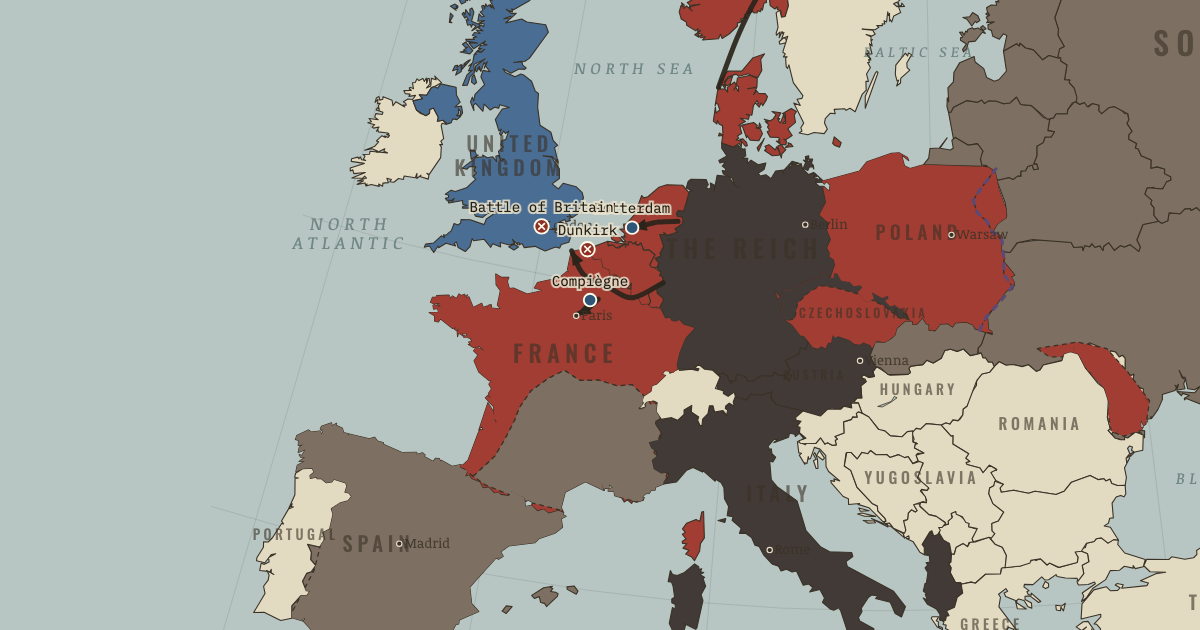
The war in the west began with a lesson that different governments would interpret in different ways. The Soviet Union attacked Finland in November 1939 and suffered heavy losses before Finland ceded territory in March. Finland remained independent, while the Red Army’s reputation suffered. Germany then occupied Denmark and Norway, protecting its northern flank and the route by which Swedish iron reached it.
The short answer
- A risky attack through the Ardennes. The Allies had prepared to meet a German advance through Belgium under the Dyle-Breda plan; an earlier German plan had envisaged just such an attack. In January 1940 a courier plane carrying those plans crashed in Belgium. Their exposure helped open the way for Manstein’s alternative, concentrating armor in the Ardennes, where the Allies did not expect a major armored attack. The gamble needed circumstances to favor it. A French reconnaissance report of columns in the region was discounted, and second-line reservists held Sedan. France had many tanks, some better armored than Germany’s, but assigned many to infantry support and expected a continuous front. Germany concentrated armored formations to exploit a breach. The outcome turned on deployment and command as well as equipment.
- The uses of the Phoney War. During the Phoney War the Allies expected time to bring advantages: the blockade would tighten, rearmament mature, and imperial resources become available. British aircraft production did overtake Germany’s in 1940. Germany, however, also had time to absorb the lessons of Poland and choose when to strike. Inactivity brought boredom and defeatism to French forces. Belgium’s neutrality limited joint planning, so Allied armies would enter a country whose roads and defenses they had not been free to prepare together beforehand. The pause gave both sides opportunities, but not the same ones.
- The limits of neutrality. After the First World War and the League’s failures, several small northwestern European states sought security in neutrality. Belgium had formally adopted it in 1936 (Ch. 5). Yet Germany found their territory useful for its military purposes and invaded six countries in six weeks in April and May 1940. Their legal status did not deter it. Switzerland, Sweden, and the countries of Iberia remained outside the fighting; geography and great-power calculations helped determine where neutrality survived. The map’s change from parchment to red shows the limits of a declaration when an invader has other plans.
- Vichy: defeat and decisions. The pressure to seek an armistice was overwhelming. What should France’s government do after it? In July 1940 a parliamentary majority gave Pétain full powers. His regime sought a favorable place in Hitler’s Europe and spoke of “collaboration” at Montoire in October. In the initially unoccupied grey-tan southern zone, Vichy governed and policed its own territory and enacted antisemitic legislation, including measures ahead of German demands. French responses had already begun to diverge: after the armistice request, de Gaulle appealed from London on 18 June.
THE TURNING POINT
Compiègne, 22 June 1940. France signed the armistice on 22 June in the Compiègne railway carriage where Germany had accepted the 1918 armistice. The deliberate symbolism accompanied a change in strategic calculations around the world. Britain had counted on the French army; eleven days later it attacked the French fleet at Mers-el-Kébir. The United States passed the Two-Ocean Navy Act in July and introduced its first peacetime draft in September. Japan saw opportunities in exposed European colonies in Asia (Ch. 10), and victory strengthened Hitler’s confidence before his eastern campaign (Ch. 11). Historians debate how seriously Britain considered terms that summer. The War Cabinet discussed them for three days in late May and chose Churchill’s course of continued resistance.
What it changed
War spreads in the Mediterranean. Mussolini declared war on 10 June, saying he needed “a few thousand dead for the peace table.” Italy then invaded Egypt from Libya in September and Greece from Albania in October. Both campaigns went badly, and Germany intervened. As Chapter 11 follows, the Mediterranean and Balkan campaigns affected the timetable and circumstances of the coming attack on the Soviet Union.
The United States moves closer to war. With France defeated, Americans could less readily assume that Europe’s democracies could contain Germany without substantial US help. Destroyers-for-bases came in September 1940, as did the first US peacetime conscription; Lend-Lease followed in March 1941. The United States remained outside the war for the time being, while Roosevelt called on it to become the “arsenal of democracy.”
European colonies become vulnerable. European possessions in Asia now had vulnerable rulers: the Netherlands was occupied, France had a client regime, and Britain was fighting for survival. Within three months Japanese forces entered northern Indochina and Japan signed the Tripartite Pact. Events in the European and Pacific theaters were becoming more closely connected.
The full answer, argued
Vichy described defeat as a judgment on the divided, “decadent” Third Republic, an account that helped justify ending it. Historians including Ernest May and Julian Jackson have challenged that interpretation. France fielded more tanks than Germany, and its soldiers fought hard: estimates of French military deaths in six weeks range from 50,000 to 90,000, a rate comparable to Verdun. The campaign had a more specific explanation. German concentration and speed exploited Allied decisions at Sedan, with an outcome that was not inevitable. Politics and morale mattered, but an appeal to national character cannot explain where armies were placed or how they were commanded. The distinction matters for justice too, because Vichy used its account of collapse to excuse its own choices after defeat.
An interesting fact
Hitler made the Compiègne carriage a trophy: he had the memorial site dynamited and the carriage taken to Berlin, where crowds queued to see it. SS troops destroyed it in 1945, by most accounts burning it near Crawinkel in Thuringia. After the war France rebuilt the memorial clearing with a carriage from the same series and displayed surviving fittings from the original nearby.
This is the study layer of Phoney War and the fall of France, chapter 9 of The Road to War, 1931–1941; the full index of the atlas is here.
Related questions
THE FREE PRINTABLE STUDY GUIDE
Get the printable study guide for The Road to War free. I’ll send you a few short letters, then one when a new atlas opens. That’s all. — Paul
NO TRACKING · YOUR ADDRESS IS USED FOR THE DISPATCH AND NOTHING ELSE · UNSUBSCRIBE ANYTIME