Russian Revolution · JAN 1924
Was one-party dictatorship the inevitable result of 1917?
The seminar question: “Was the Soviet outcome — a one-party dictatorship — the inevitable result of 1917, or a contingent product of the civil war and its aftermath?”
On 30 December 1922 Russia, Ukraine, Belorussia and Transcaucasia formed the USSR, a federation in national form run by one Communist Party, and Lenin died at Gorki in January 1924. The civil war had forged a centralised one-party state with a political police, which also expanded literacy and changed women’s legal position.
Chapter 14 is part of membership. WW2 is free — every chapter. Try chapters 1–2 of any 2 other atlases (3 with a free account). Opening a new atlas uses one of them. Membership opens all 21 — Join.
Free printable Russian Revolution study guide, sent by email ↓
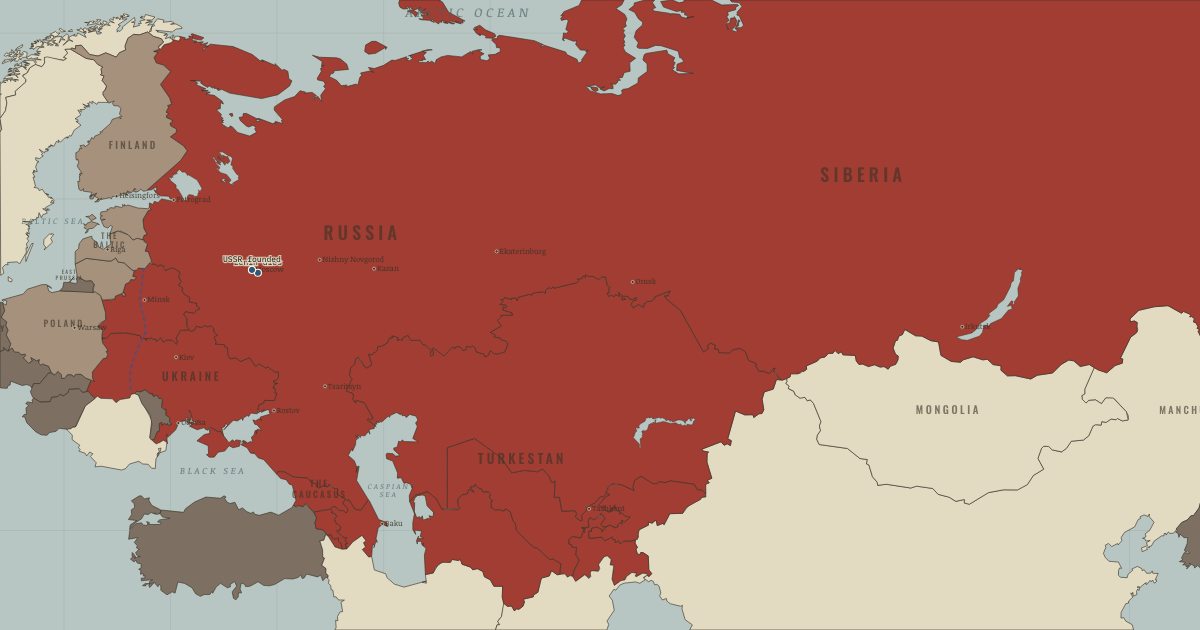
The settled red map should not be mistaken for a simple restoration of the old empire, because the country that emerged in 1922 differed from the one that had fallen. Finland, Poland and the Baltic states remained outside it, and inside the new union the republic borders, official languages and national institutions gave nationality a formal place that tsarist autocracy had always denied. The founding of the USSR at Moscow on 30 December 1922 recognized the force of national identity while withholding any competitive sovereignty, since one command structure controlled security, the major appointments and policy across every republic. This was a durable arrangement precisely because its federal form and its party centralization solved two different problems at once.
The short answer
- The civil war forged the state. The USSR of 1924 was the child of its war, not of 1917’s hopes. Centralization, one-party rule, the security police, the militarized economy and the siege mentality were all civil-war improvisations that hardened into permanent structures. You cannot understand the Soviet state without seeing that it was made by the way it survived, not by the theory it professed.
- A federation to hold a multinational empire. The Union’s federal form. Sovereign republics on paper, one Party in fact. Was the pragmatic answer to reassembling a hundred nations under Moscow while claiming self-determination. It bound the empire together for seventy years and, when the Party’s grip finally failed in 1991, provided the ready-made lines along which it fell apart.
- A vacuum at the top with no rule to fill it. The revolution never solved succession. When Lenin was disabled, there was no mechanism to choose a leader. Only a struggle among the men around him, decided by control of the Party machine. The 1921 ban on factions meant that struggle would be settled in secret, by apparatus, not by open contest. The door was open for whoever held the levers of appointment.
THE TURNING POINT
Lenin dies at Gorki, 21 January 1924. The revolution’s founder died at fifty-three, his final warnings unheeded and his succession unsettled. Lenin’s death matters less for the man than for what it revealed: a system so personalized that his removal left a vacuum, and so sealed against open politics that the vacuum would be filled by intrigue over the Party apparatus rather than by any vote or principle. The Testament that warned against Stalin was buried. The offices that Stalin controlled were not. In the space between Lenin’s stroke and his funeral, the shape of the next, darker transformation of Russia was already being decided.
What it changed
Stalin’s rise. The man who held the dull administrative offices. General Secretary above all. Controlled who joined the Party, who was promoted, who was posted where. In a state where the Party was everything and its ranks were sealed against dissent, that was the whole game. Within five years of Lenin’s death he had outmaneuvered every rival. Within ten he had launched a second revolution from above.
A second, deadlier transformation to come. NEP’s mixed economy was a truce, not a settlement. The unanswered questions. How to industrialize a peasant country, what to do with the market, how fast to build socialism. Would be answered after 1928 by forced collectivization, planned industrialization and a terror that dwarfed the civil war’s. The revolution’s most lethal phase came not in its war but in its “peace.”
The world the revolution made. The USSR became the century’s great alternative and antagonist: a model for anti-colonial and communist movements worldwide, and the adversary that would shape the Second World War and define the Cold War. Scrub back through this atlas and you have watched a world power born. Open the War Room and you meet it again, seventeen years on, as the state that will absorb the largest invasion in history. Every color change here is a hundred books. Pick one.
The full answer, argued
This is the central debate of the field, and the map lets you weigh it. The “inevitability” school (Richard Pipes is its sharpest voice) argues the dictatorship was present from the first night: a party that dispersed the Constituent Assembly, banned rivals and institutionalized terror was authoritarian by design, and Stalin was Lenin’s logical heir, not his betrayer. The “contingency” school (Sheila Fitzpatrick and others) stresses that the specific, murderous shape of the Soviet state was forged by the civil war’s emergencies. That War Communism, the security police and the sealed Party were improvisations of survival that might have relaxed, and that Stalin’s regime was a distinct and avoidable turn, not a straight line from 1917. Orlando Figes and most current historians hold the middle: the revolution created a framework that was authoritarian but not yet totalitarian, and the war, the isolation, the peasant question and finally the accident of the succession pushed it toward the extreme. The honest answer is that structure made a dictatorship likely and contingency made this dictatorship. And learning to hold both, to see the tram-lines and the switches, is exactly the skill this atlas has been trying to teach.
An interesting fact
Krupskaya publicly asked that her husband be honored with schools, nurseries and libraries rather than statues — “do not raise memorials to him,” she wrote in Pravda days after his death. The Party overrode her: the first mausoleum was a wooden cube hammered together in the January frost, and the embalming — improvised so the endless queues of mourners could keep filing past — was made permanent that spring by a specially created laboratory that maintains the body to this day. The lifelong materialist was turned into an incorruptible relic, the founding exhibit of a cult his own doctrine should have forbidden.
This is the study layer of Legacy of the Russian Revolution, chapter 14 of The Russian Revolution, 1855–1924; the full index of the atlas is here.
Related questions
THE FREE PRINTABLE STUDY GUIDE
Join the Dispatch — a short welcome series, then a letter when a new atlas opens — and the printable study guide for The Russian Revolution is yours now, free.
NO TRACKING · YOUR ADDRESS IS USED FOR THE DISPATCH AND NOTHING ELSE · UNSUBSCRIBE ANYTIME