MAPS OF HISTORY · IB HISTORY · CHINA IN REVOLUTION
IB HISTORY · 1911 – 1949 · 12 CHAPTERS
IB History: China in Revolution — notes, maps and essay questions
Warlords, the long Japanese war, and the final contest between Chiang and Mao: four decades in which the world’s oldest state was broken and remade.
IB notes for this atlas are in preparation. Meanwhile, this page gathers the study notes every one of its 12 chapters already carries: why each episode happened, the moment it turned on, what it changed, and the question historians still argue about. It also shows where the atlas fits the IB course.
WW2 is free — every chapter. Try chapters 1–2 of any 2 other atlases (3 with a free account). Opening a new atlas uses one of them. Membership opens all 21 — Join.
Where it fits the course
The atlas is filed under Paper 2 (Conflict) and Paper 3 for Higher Level (Asia and Oceania, (1910–1949)). Its IB notes, with evidence lists, primary sources and model essay plans, are in preparation. These are the IB History pages for the parts of the course it serves:
- Paper 2 · Conflict
- Paper 3 · Asia and Oceania · HL (1910–1949)
Why it began
Causation questions start at the beginning. These are the causes the atlas’s opening chapters argue, each in a few sentences you can test against your own reading.
Chapter 1: The Fall of the Qing
Defeat as a system, not an event. From the Opium War (1839–42) to the Boxer Protocol (1901), every generation of Qing statesmen lost a war and paid for it in ports, tariffs and legal immunities for foreigners. The humiliations compounded: customs revenue pledged to indemnities could not build a navy. A navy built in the 1880s was sunk by Japan in 1895. By 1911 the dynasty’s core claim — that it could protect the civilization it governed — had been falsified in public, repeatedly, for seventy years.
Reform that armed its own gravediggers. After 1901 the Qing tried everything at once: abolished the ancient examination system (1905), built New Armies on the German model, promised a constitution. Each reform manufactured enemies. The examination’s end orphaned a scholar class and sent students to Japan, where they met revolutionaries. The New Armies gave provinces modern soldiers who owed the throne nothing — Wuchang was a New Army mutiny. States are most fragile mid-reform, when the old legitimacy is dismantled and the new one not yet built.
The railway fuse. In May 1911 the court nationalized the provincial railway companies and pledged the lines to foreign lenders — expropriating the gentry investors of Sichuan and Hunan at a stroke. The Railway Protection movement put respectable provincial elites in the streets months before Wuchang. The troops sent to suppress Sichuan’s protests came from the very Hubei garrisons that then rose. The dynasty’s last act was to teach its natural supporters that Peking was the enemy.
A revolutionary idea already in place. Sun Yat-sen’s alliance had staged and lost ten risings since 1895, and its real work was elsewhere: in student journals, in overseas Chinese remittances, in the New Army cells that turned a police raid into a mutiny. Republicanism in 1911 was thin — few Chinese had voted for anything. But the alternative had simply expired. As one revolutionary put it, the dynasty was not overthrown. It collapsed.
Chapter 2: Yuan Shikai’s Republic
An army with a state attached. The Beiyang Army was built by Yuan in the 1890s–1900s as the Qing’s modern force, and its loyalty was structured like a patronage firm: commanders promoted by Yuan, paid through Yuan, married into Yuan’s network. When the republic put this firm at its center, it inherited the firm’s logic — authority flowed from the paymaster, not the constitution. Every warlord of Chapter 3 is a Beiyang alumnus or a provincial imitator of the model.
A constitution nobody would die for. The 1912 settlement was a bargain among elites, not a mass conviction: 40 million men were nominally enfranchised in the 1912–13 elections, but the electorate that mattered wore uniforms. When Yuan broke the rules — Song’s murder, the dissolved parliament — no institution could impose a cost on him. Only another army could, which is precisely the lesson the provinces learned and applied in 1915–16.
Japan moves into the vacuum. The World War withdrew every European restraint at once: Britain needed Japan’s navy, Russia was drowning, Germany was the enemy. The Twenty-One Demands were opportunism with a timetable. Although the worst clauses failed, Shandong stayed Japanese, and the precedent stood: China’s sovereignty was negotiable whenever the world was busy. The next time the world was busy would be 1931.
The monarchy miscalculation. Yuan’s advisers (including an American constitutional scholar, Frank Goodnow, whose memo on monarchy was quoted well past its intent) told him China needed a throne’s legitimacy. But 1911 had not transferred the Mandate of Heaven — it had abolished it. The provincial risings of 1915–16 were not republican idealism. They were provincial militarism discovering it could veto the center. That discovery, not the monarchy’s failure, is the chapter’s real event.
Chapter by chapter
The atlas has 12 chapters. For each, the causes it explains and the moment it turns on; the title opens the chapter’s free page with the full explanation, a discussion question and the map.
1. The Fall of the Qing
CHAPTER 1 · 1911–1912
Why it happened: Defeat as a system, not an event · Reform that armed its own gravediggers · The railway fuse · A revolutionary idea already in place
The turning point: Wuchang, 10 October 1911.
2. Yuan Shikai’s Republic
CHAPTER 2 · 1912–1916
Why it happened: An army with a state attached · A constitution nobody would die for · Japan moves into the vacuum · The monarchy miscalculation
The turning point: The National Protection War, 25 December 1915.
3. Warlords and May Fourth
CHAPTER 3 · 1916–1925
Why it happened: Armies as capital, war as business · The Peking government as prize · Versailles radicalizes a generation · A cultural crisis under the political one
The turning point: May Fourth, 1919.
4. The United Front Marches North
CHAPTER 4 · 1923–1927
Why it happened: The Soviet package: party, army, mass line · Nationalism with an address · The warlords could not combine · Whampoa as the multiplier
The turning point: Whampoa, June 1924.
5. The Purge and the Nanjing Decade
CHAPTER 5 · 1927–1931
Why it happened: Class war inside the alliance · Stalin’s China policy collides with China · Reunification by contract · The Kwantung Army learns impunity
The turning point: Shanghai, 12 April 1927.
6. The Soviet Republic and the Encirclements
CHAPTER 6 · 1931–1934
Why it happened: Manchuria: an army making foreign policy · Non-resistance as a considered bet · Land revolution as state-building · The Comintern line meets Chinese terrain
The turning point: Guangchang, April 1934.
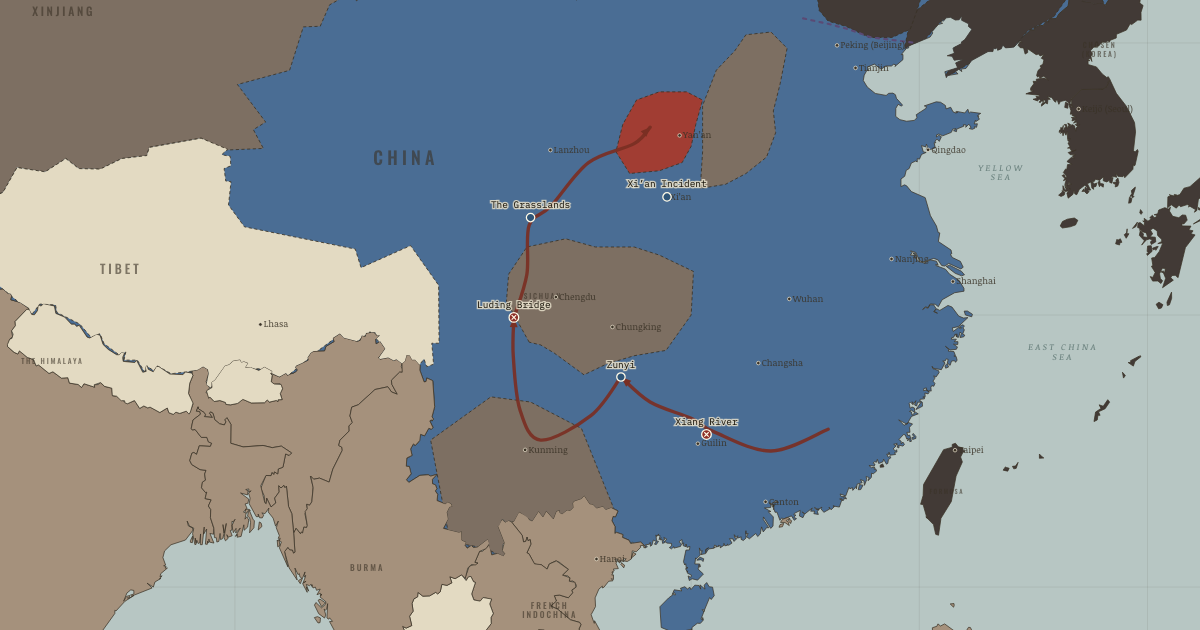
7. The Long March
CHAPTER 7 · 1934–1936
Why it happened: Breakout was forced, direction was chosen · Zunyi: defeat reorganizes power · Warlord geography as corridor · Survival as selection
The turning point: Zunyi, 15–17 January 1935.
8. The Japanese War Begins
CHAPTER 8 · 1937–1938
Why it happened: Tokyo’s escalation machine · Why Chiang chose 1937 · Two wars in one country · A soldiery prepared for atrocity
The turning point: Marco Polo Bridge, 7 July 1937.
9. Stalemate — Two Chinas at War
CHAPTER 9 · 1938–1944
Why it happened: Why the front froze · Two ways to tax a war · Occupation as recruiting agent · The alliance of mutual disappointment
The turning point: Hengyang, June–August 1944.
10. The Failed Peace and Manchuria
CHAPTER 10 · 1945–1947
Why it happened: Manchuria as the decisive prize · Soviet policy: two hands, one direction · Mediation against both parties’ convictions · Victory’s poisoned inheritance
The turning point: August Storm, 9–20 August 1945.
11. The Three Campaigns
CHAPTER 11 · 1948–1949
Why it happened: Operational art, learned the hard way · Logistics with title deeds attached · Command as single point of failure · Defection as arithmetic
The turning point: Jinzhou, October 1948.
12. The People’s Republic
CHAPTER 12 · 1949
Why it happened: The war against Japan as the great reordering · Land as the war-winning policy · Inflation as regime solvent · Two party-states, one succession
The turning point: Tiananmen, 1 October 1949.
Essay questions, argued
Every chapter ends with a discussion question that historians still argue about, with our answer in brief. Use them as essay practice: plan your own answer, then read how we would argue it.
DISCUSSION QUESTION · CHAPTER 1
Was 1911 a revolution at all — or the collapse of a dynasty that revolutionaries happened to be standing near?
The case for collapse is strong: the risings Sun’s movement actually planned all failed. Wuchang succeeded by accident. Power passed not to republicans but to provincial elites and the Beiyang generals — continuity of local power wearing a new flag. But Joseph Esherick and others point out what changed underneath: the monarchy, the cosmology of the Mandate of Heaven, and the Confucian examination elite all ended within a decade, and no one seriously tried to restore them (Yuan’s attempt, Chapter 2, was laughed and fought off the stage in months). A useful formulation: 1911 was a thin political revolution that opened the door to the thick social ones — May Fourth, the party-states, land revolution. This took four more decades to walk through it. Judge revolutions less by the day power changes hands than by what can no longer be said or restored afterward.
The chapter behind it: The Fall of the Qing. Every chapter’s question is on the discussion questions page.
DISCUSSION QUESTION · CHAPTER 5
Was the Nanjing decade a real modernization interrupted — or a façade that Japan merely exposed?
Eastman’s classic indictment (The Abortive Revolution) reads the decade as seeds of destruction: a party that had purged its idealists, government by factional balance, chronic deficits, tax power that stopped at the county town, and “reunification” resting on bought warlords. Revisionists — historians of the Maritime Customs, the fabi reform, the law codes, the universities — answer that no Chinese government since the 1830s had recovered so much sovereignty or built so much administrative machinery so fast, under permanent civil war and Japanese pressure. The honest synthesis is uncomfortable for both: the modernization was real and narrow — brilliant in Shanghai’s orbit, nearly absent in the villages where four-fifths of Chinese lived, which is precisely where the CCP was building its rival state. Judged as a race between two incomplete states rather than against an ideal, Nanjing was losing the countryside years before it lost a single city to Japan. When you evaluate a regime, ask not “did it modernize?” but “whom did its modernization reach?”
The chapter behind it: The Purge and the Nanjing Decade. Every chapter’s question is on the discussion questions page.
DISCUSSION QUESTION · CHAPTER 9
Who fought Japan — the Nationalists, the Communists, or neither as much as each claimed? And why does the answer still matter politically?
Count what can be counted. The Nationalists fought virtually every conventional battle of the war — Shanghai, Wuhan, three Changshas, Ichigo. They took the overwhelming share of military casualties. Twenty-two major engagements to the Communists’ one large offensive (the Hundred Regiments, 1940), after which Yan’an deliberately husbanded its forces. The Communists fought the other war — sabotage, ambush, village defense across an occupied north the Nationalists could not reach. They absorbed brutal reprisal campaigns. Their claim to have been the resistance is inflated, but “they hid for eight years” is propaganda in the other direction. The honest formulation: the Nationalists fought Japan’s army, and were broken by the effort. The Communists fought Japan’s occupation, and were built by it. The answer matters because both regimes founded their legitimacy on this war — Taipei’s and Beijing’s textbooks still disagree. It also matters because van de Ven, Mitter and Yang Kuisong have spent decades correcting both official memories. When a question stays politically alive for eighty years, historiography is part of the history.
The chapter behind it: Stalemate — Two Chinas at War. Every chapter’s question is on the discussion questions page.
DISCUSSION QUESTION · CHAPTER 12
Why did Mao win and Chiang lose — and was Communist victory inevitable once Japan surrendered?
Line up the explanations and make them compete. Chalmers Johnson: the Japanese occupation manufactured peasant nationalism, and the CCP was its only organized vehicle — powerful for north China, weaker for regions the war barely touched where the party also won. Mark Selden and successors: the “Yenan Way” — land policy, taxation, participatory institutions — built support the occupation alone cannot explain. The counter-evidence is how quickly coercion supplemented consent when policy needed it (Chen Yung-fa’s work on the base areas). Lloyd Eastman and the internalists: the Nationalists lost it — inflation, factionalism, command failure — a necessary condition, but collapse alone does not conquer Manchuria in fourteen months. Westad’s archival synthesis adds contingency: Soviet Manchuria policy, Chiang’s 1946 decision to fight there, even timing — remove any one and 1949 looks different, which is the strongest argument against inevitability. A defensible verdict: by 1945 the Nationalists could still have survived as a southern or coastal state under almost any competent strategy. By the end of 1948 nothing could have saved them. Between those dates lie choices, not fate. This is precisely why this era rewards study rather than moral shorthand. For the IB question beneath the question: Mao’s rise fits “conditions, methods, consolidation” only if you let the conditions include an invasion nobody chose and methods include twenty years of institutional learning that his rival’s party, by its 1927 choice of coalition partners, had forbidden itself.
The chapter behind it: The People’s Republic. Every chapter’s question is on the discussion questions page.
What it changed
Consequence questions need the end of the story. The final chapter, The People’s Republic, sets out what the period left behind:
The revolution starts governing. Within three years the new state does what no Chinese government had done in a century: unified currency, suppressed inflation, land reform completed nationwide (with a violence against landlords whose death toll is itself a debated, sobering ledger), and a war fought against the United Nations in Korea to a draw. The capacities this atlas watched being built in base areas scale to a fifth of humanity — in both their competence and their coercion.
Two Chinas institutionalize. The Taipei government keeps China’s UN seat until 1971 and its American alliance beyond that. The strait freezes into the Cold War’s longest unfinished front. Every crisis in it since — 1954, 1958, 1996, and counting — is a footnote to December 1949’s incomplete ending.
The model travels. Peasant war, base areas, united fronts, party-army fusion: the Chinese revolution becomes the twentieth century’s most exported insurgency manual — Vietnam above all, where a French war is already being fought with Mao’s doctrine as Chapter 12 closes. The era you have just scrubbed through is about to be replayed, with variations, across three continents.
Revision tools
The atlas ends with a map quiz that asks you to find places and moments on the map itself (part of membership and of the Exam Sprint). The quick quiz and the discussion questions with our answers are free pages on this site, and the printable study guide gathers every chapter’s notes into one document for revision.
Read next
- Mao’s China after 1949: consolidation, the Great Leap, the Cultural Revolution · THE PEOPLE’S REPUBLIC UNDER MAO
- Japan’s expansion in China, 1931–1941 · THE ROAD TO WAR
Maps of History is independent and is not affiliated with or endorsed by the International Baccalaureate Organization. IB course names describe alignment only; paper, theme and section names follow the new course outline and may change when the final guide is published.
THE DISPATCH
A short welcome series, then a letter when a new atlas opens — and the printable study guide for China in Revolution is yours now, free.
NO TRACKING · YOUR ADDRESS IS USED FOR THE DISPATCH AND NOTHING ELSE · UNSUBSCRIBE ANYTIME