MAPS OF HISTORY · IB HISTORY · THE ROAD TO WAR
IB HISTORY · 1931 – 1941 · 12 CHAPTERS
IB History: The Road to War — notes, maps and essay questions
Manchuria, Abyssinia, the Rhineland, Munich: a decade of tests that went unanswered, traced step by step as the world order gives way.
IB notes for this atlas are in preparation. Meanwhile, this page gathers the study notes every one of its 12 chapters already carries: why each episode happened, the moment it turned on, what it changed, and the question historians still argue about. It also shows where the atlas fits the IB course.
WW2 is free — every chapter. Try chapters 1–2 of any 2 other atlases (3 with a free account). Opening a new atlas uses one of them. Membership opens all 21 — Join.
Where it fits the course
The atlas is filed under Paper 2 (Conflict) and Paper 3 for Higher Level (Europe and Asia and Oceania). Its IB notes, with evidence lists, primary sources and model essay plans, are in preparation. These are the IB History pages for the parts of the course it serves:
Why it began
Causation questions start at the beginning. These are the causes the atlas’s opening chapters argue, each in a few sentences you can test against your own reading.
Chapter 1: The World the Slump Made
The Depression discredited the open world. World trade fell by roughly two-thirds in value between 1929 and 1933, and every industrial country retreated behind tariffs — America’s Smoot–Hawley (1930), Britain’s imperial preference (1932). For have-not powers without empires to retreat into, autarky became a strategic argument: if the world is closing into blocs, seize a bloc of your own. Japanese planners called Manchuria a “lifeline”; Hitler would call the east “living space.” Same syllogism, five thousand miles apart.
The Washington order had no enforcer. The 1920s Pacific ran on the Washington treaties: naval ratios, the Open Door in China, consultation. But the system assumed good faith and provided no policeman — the United States would not commit force, Britain could not afford to, and the League of Nations had no army at all. The order was real enough to constrain governments that believed in it, and invisible to soldiers who did not. In 1931 the Kwantung Army ran the experiment.
Japan’s army answered to no cabinet. By constitutional custom the Japanese army reported to the Emperor, not the prime minister — and its field commands increasingly reported to no one. Officers of the Kwantung Army, garrisoning Japan’s railway concession in Manchuria, had already assassinated the local warlord Zhang Zuolin in 1928 and gone unpunished. The civilians in Tokyo knew another plot was coming in 1931; the army minister sent a general to restrain it, and he began by telling the plotters he was coming. Insubordination that succeeds becomes policy.
China looked weak enough to bite. Chiang Kai-shek’s Nationalist government had unified China on paper in 1928, but in 1931 it was fighting communist bases in the south, feuding warlords everywhere, and — that summer — catastrophic Yangtze floods. Tokyo’s radicals judged, correctly in the short run, that Nanking would answer an invasion with lawyers rather than armies. What they misjudged was the long run: humiliation is a renewable resource, and Chinese nationalism fed on every concession.
Chapter 2: Mukden: The First Unpunished Gamble
A railway empire wanted a landward one. Japan had held southern Manchuria’s railway zone since defeating Russia in 1905, with the Kwantung Army there to guard it. The zone gave Japan coal, soy and iron — and a standing temptation: every officer posted there could see that the hinterland, run by the warlord Zhang Xueliang, was defended by troops distracted elsewhere. Ishiwara Kanji, the operation’s planner, preached that total war with America was inevitable and Manchuria’s resources were the precondition; the invasion was, in his mind, defensive procurement.
Tokyo could not discipline its own army. The government of Wakatsuki Reijirō learned of the plot beforehand and sent General Tatekawa to stop it; the conspirators dined him drunk and lit the fuse that night. Each subsequent escalation was presented to the cabinet as accomplished fact, and ministers who objected faced a stark arithmetic: the army could bring down any government by withdrawing its minister. In May 1932 naval officers assassinated Prime Minister Inukai in his residence — the last party politician to head a Japanese government before 1945. The gamble at Mukden was also a coup in slow motion.
China chose the courtroom over the battlefield. Chiang’s “first internal pacification, then external resistance” doctrine judged that fighting Japan in 1931 meant losing to Japan in 1931 — his best armies were mid-campaign against the communists. Non-resistance preserved the army and framed Japan as the unambiguous aggressor before world opinion, but it also taught the Kwantung Army that conquest was cheap, and it cost Chiang legitimacy at home that a decade of student protest would keep billing him for.
The League was built for a different quarrel. Geneva’s machinery assumed disputes between governments that both wanted settlement. It had no procedure for a member state whose army was off the leash, no force to send, and members — Britain above all — with Asian empires of their own, vulnerable navies, and Depression budgets. The Lytton Commission took a year to report because thoroughness was the only weapon available. Justice arrived, accurately and completely, after the conquest was finished.
Chapter by chapter
The atlas has 12 chapters. For each, the causes it explains and the moment it turns on; the title opens the chapter’s free page with the full explanation, a discussion question and the map.
1. The World the Slump Made
CHAPTER 1 · 1931
Why it happened: The Depression discredited the open world · The Washington order had no enforcer · Japan’s army answered to no cabinet · China looked weak enough to bite
The turning point: Mukden, the night of 18 September 1931.
2. Mukden: The First Unpunished Gamble
CHAPTER 2 · 1931–1933
Why it happened: A railway empire wanted a landward one · Tokyo could not discipline its own army · China chose the courtroom over the battlefield · The League was built for a different quarrel
The turning point: Mukden, 18 September 1931.
3. Germany Turns Charcoal
CHAPTER 3 · 1933–1935
Why it happened: A republic died of its rescuers · Versailles was a grievance engine · The disarmament trap · The audience was divided by its empires
The turning point: Stresa, April 1935.
4. Abyssinia: The League Dies in Africa
CHAPTER 4 · 1934–1936
Why it happened: A regime that needed a triumph · Britain and France wanted Italy against Hitler · The victim was inside the system · Air power and gas against spears and rifles
The turning point: Paris, December 1935.
5. The Rhineland Bluff and the Spanish Rehearsal
CHAPTER 5 · 1936–1937
Why it happened: Versailles’ last physical restraint was psychological · France would not fight alone; Britain would not fight at all · Spain’s war was internal first, international second · Non-intervention institutionalized the double standard
The turning point: The Rhine bridges, 7 March 1936.
6. China: The War Nobody Declared
CHAPTER 6 · 1937–1938
Why it happened: Xi’an closed China’s exit · Japan’s command rewarded escalation · Chiang chose Shanghai to internationalize the war · No one would name the war
The turning point: The Marco Polo Bridge, 7 July 1937.
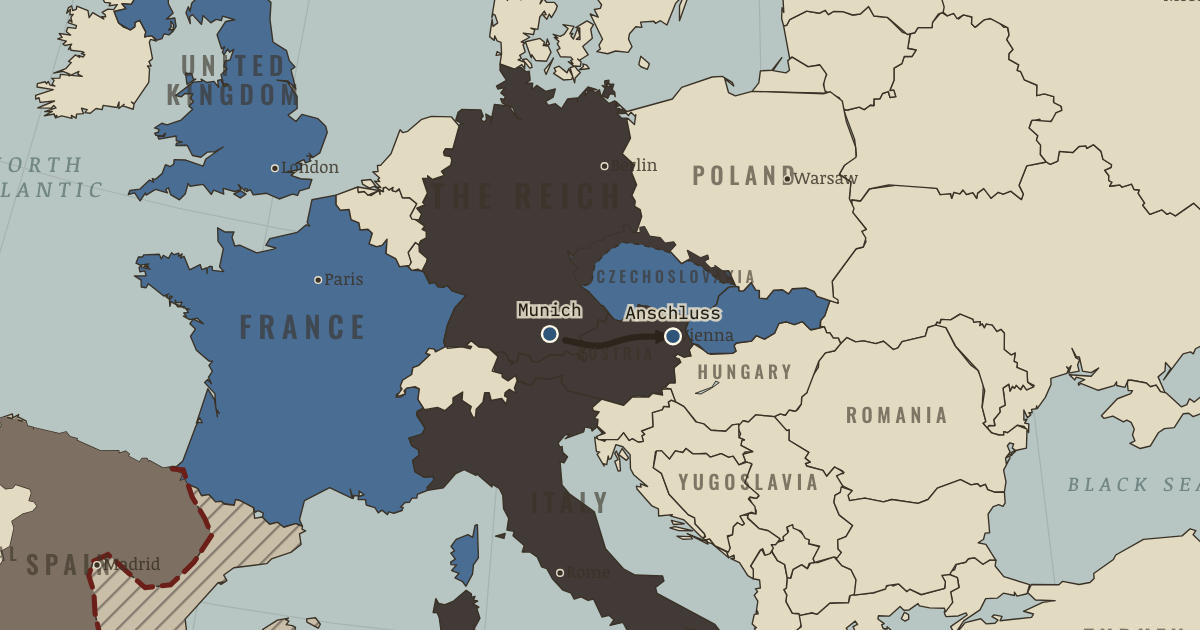
7. Anschluss and Munich: Appeasement at Full Stretch
CHAPTER 7 · 1938
Why it happened: The bomber, the trenches and 1914 · A grievance with real content, exploited in bad faith · The military arithmetic was contested — then and now · France had subcontracted its policy
The turning point: Munich, 29–30 September 1938.
8. Prague, the Pact, Poland
CHAPTER 8 · 1939
Why it happened: Prague converted the doubters · The pact was the cheapest insurance either dictator ever bought · Danzig was pretext; the objective was erasure · Poland would not be a client
The turning point: The Kremlin, 23 August 1939.
9. The Fall of the West
CHAPTER 9 · 1939–1940
Why it happened: Sickle-cut was a gamble that punished exactly the Allies’ preparation · Eight months of phoney war spent the Allies’ advantages · Neutrality was a strategy, and it failed everywhere · Vichy: defeat, then choice
The turning point: Compiègne, 22 June 1940.
10. The Turn South
CHAPTER 10 · 1939–1941
Why it happened: Khalkhin Gol re-priced the northern option · The China war could not pay for itself · Europe’s catastrophe was Asia’s vacancy · Washington believed pressure would deter; Tokyo experienced it as siege
The turning point: The freeze, 26 July – 1 August 1941.
11. Barbarossa: The Gamble That Ends the Gambles
CHAPTER 11 · 1940–1941
Why it happened: The program had always pointed east · Britain’s survival made Russia the exit · The underestimate was manufactured in Moscow · Stalin refused his own intelligence
The turning point: Berlin, 27 September 1940.
12. Pearl Harbor: The Roads Meet
CHAPTER 12 · DECEMBER 1941
Why it happened: The oil clock ran out · Yamamoto’s wager against his own judgment · Washington expected war — somewhere else · Hitler chose the world war
The turning point: Pearl Harbor, 7:48 a.m., 7 December 1941.
Essay questions, argued
Every chapter ends with a discussion question that historians still argue about, with our answer in brief. Use them as essay practice: plan your own answer, then read how we would argue it.
DISCUSSION QUESTION · CHAPTER 1
How far was the road to war laid by economics rather than ideology?
The correlation is uncomfortable: no Depression, no Nazi majority — the party polled 2.6% in prosperous 1928 and 37% in desperate 1932 — and Japan’s military radicals rode the same wave of rural misery. But economics chose neither the destination nor the methods. Weimar Germany and Japan both had liberal, internationalist options on the ballot; what the slump did was discredit them and hand prestige to men who had always wanted conquest and now had an audience. Most historians therefore treat the Depression as the enabling condition — it opened the door — while ideology and institutions (a Japanese army outside civilian control, a German conservative elite willing to deal) decided who walked through it. The transferable lesson: economic catastrophe does not make aggression, but it dissolves the antibodies against it.
The chapter behind it: The World the Slump Made. Every chapter’s question is on the discussion questions page.
DISCUSSION QUESTION · CHAPTER 5
“The dictators intervened and the democracies did not — that is the history of the Spanish war in one sentence.” Fair?
As a summary of state policy, nearly: Germany and Italy committed air forces, armor and (in Italy’s case) an army; Britain and France embargoed both sides, which in practice meant the Republic. But the sentence hides three complications. The USSR did intervene — arms, advisers, and the NKVD, whose imported purges against Trotskyists and anarchists (the Barcelona May Days of 1937) corroded the Republic from within and let Franco’s propaganda cast the war as Christianity versus Bolshevism. Some 35,000 International Brigade volunteers from fifty countries intervened where their governments refused, a moral datum the state-centric sentence erases. And “the democracies” were not monolithic: Blum’s France leaked aid across the Pyrenees in cycles of open and closed borders. The deeper question the war still poses — when does non-intervention become intervention on the stronger side? — has outlived every participant.
The chapter behind it: The Rhineland Bluff and the Spanish Rehearsal. Every chapter’s question is on the discussion questions page.
DISCUSSION QUESTION · CHAPTER 9
Was the fall of France a military defeat or a national collapse — and why does the answer matter?
The “decadence” reading — a Third Republic rotten with division that deserved its fate — was written first by Vichy itself (the defeat as moral judgment) and long echoed abroad. Modern scholarship (Ernest May, Julian Jackson) has largely dismantled it: France in 1940 fielded more tanks than Germany, fought — 50,000–90,000 French soldiers died in six weeks, a rate comparable to Verdun — and fell to a specific, contingent operational failure: a bad doctrine meeting a brilliant gamble at Sedan. The answer matters because each reading carries a policy moral. If France collapsed morally, the lesson is about national character — comfortable and useless. If France lost operationally while fighting hard, the lesson is that doctrine, command tempo and the location of reserves can undo material equality in days — a lesson every general staff since 1940 has studied. And it matters for justice: the “collapse” story was the alibi of the regime that used defeat to bury the Republic.
The chapter behind it: The Fall of the West. Every chapter’s question is on the discussion questions page.
DISCUSSION QUESTION · CHAPTER 12
“A date which will live in infamy” — but was Pearl Harbor a surprise attack or a foreseen war with a surprising address?
Both, and the distinction is the lesson. War with Japan was so far from a surprise that Washington had war-gamed it for two decades (War Plan Orange), read Japan’s diplomatic cipher in real time, and sent explicit war warnings ten days early; conspiracy theories that Roosevelt knew Pearl Harbor specifically have been repeatedly tested against the decrypt record and have failed — the intercepts pointed clearly at Southeast Asia, and no message named Hawaii. What failed was the last mile: the assumption that Japan would not attempt the operationally spectacular, the radar contact explained away, the fleet moored in rows because sabotage, not air attack, headed the local threat list. The congressional inquiry (39 volumes) and every serious study since converge on system failure without a hidden hand. The transferable seminar point, which intelligence services still teach with this case: warning is not the same as expectation, and expectation is not the same as readiness — each conversion has to be made deliberately, and each can fail separately.
The chapter behind it: Pearl Harbor: The Roads Meet. Every chapter’s question is on the discussion questions page.
What it changed
Consequence questions need the end of the story. The final chapter, Pearl Harbor: The Roads Meet, sets out what the period left behind:
The perimeter, then the tide. Japan’s six months ran almost exactly to Yamamoto’s schedule: Malaya, Singapore (the empire’s worst capitulation, February 1942), the Indies and the Philippines all fell. Then Coral Sea checked the advance in May 1942, and at Midway in June the carriers missed at Pearl sank four of the six that had attacked it. The war this atlas ends by starting is told in the WW2 atlas — this map hands its final snapshot to that one’s first.
The arsenal opens both doors. Germany’s declaration let Roosevelt pursue “Europe first” with public consent. Lend-Lease, already flowing to Britain and the USSR, became the bloodstream of a global coalition. By war’s end it had supplied some $50 billion in matériel. That aid ranged from Studebaker trucks on the road to Moscow to the food shipments that kept Britain fed.
Asia’s empires never come back. The tan on this map’s southern half did not survive the demonstration that European empires could be beaten by an Asian power in weeks. The colonial restorations of 1945 were rearguard actions; India was gone by 1947, Indonesia by 1949, Indochina after wars that fill the Cold War atlas. Japan’s war of conquest, defeated, still ended the world it attacked.
Revision tools
The atlas ends with a map quiz that asks you to find places and moments on the map itself (part of membership and of the Exam Sprint). The quick quiz and the discussion questions with our answers are free pages on this site, and the printable study guide gathers every chapter’s notes into one document for revision.
Read next
Maps of History is independent and is not affiliated with or endorsed by the International Baccalaureate Organization. IB course names describe alignment only; paper, theme and section names follow the new course outline and may change when the final guide is published.
THE DISPATCH
A short welcome series, then a letter when a new atlas opens — and the printable study guide for The Road to War is yours now, free.
NO TRACKING · YOUR ADDRESS IS USED FOR THE DISPATCH AND NOTHING ELSE · UNSUBSCRIBE ANYTIME