MAPS OF HISTORY · IB HISTORY · THE CRUSADES
IB HISTORY · 1095 – 1291 · 12 CHAPTERS
IB History: The Crusades — notes, maps and essay questions
Why did half of Europe march east? What they built and burned there, and what two centuries of contact changed on every shore of the Mediterranean.
IB notes for this atlas are in preparation. Meanwhile, this page gathers the study notes every one of its 12 chapters already carries: why each episode happened, the moment it turned on, what it changed, and the question historians still argue about. It also shows where the atlas fits the IB course.
WW2 is free — every chapter. Try chapters 1–2 of any 2 other atlases (3 with a free account). Opening a new atlas uses one of them. Membership opens all 21 — Join.
Where it fits the course
The atlas is filed under Paper 2 (Conflict) and Paper 3 for Higher Level (Africa and the Middle East). Its IB notes, with evidence lists, primary sources and model essay plans, are in preparation. These are the IB History pages for the parts of the course it serves:
Why it began
Causation questions start at the beginning. These are the causes the atlas’s opening chapters argue, each in a few sentences you can test against your own reading.
Chapter 1: Three Civilizations, One Sea
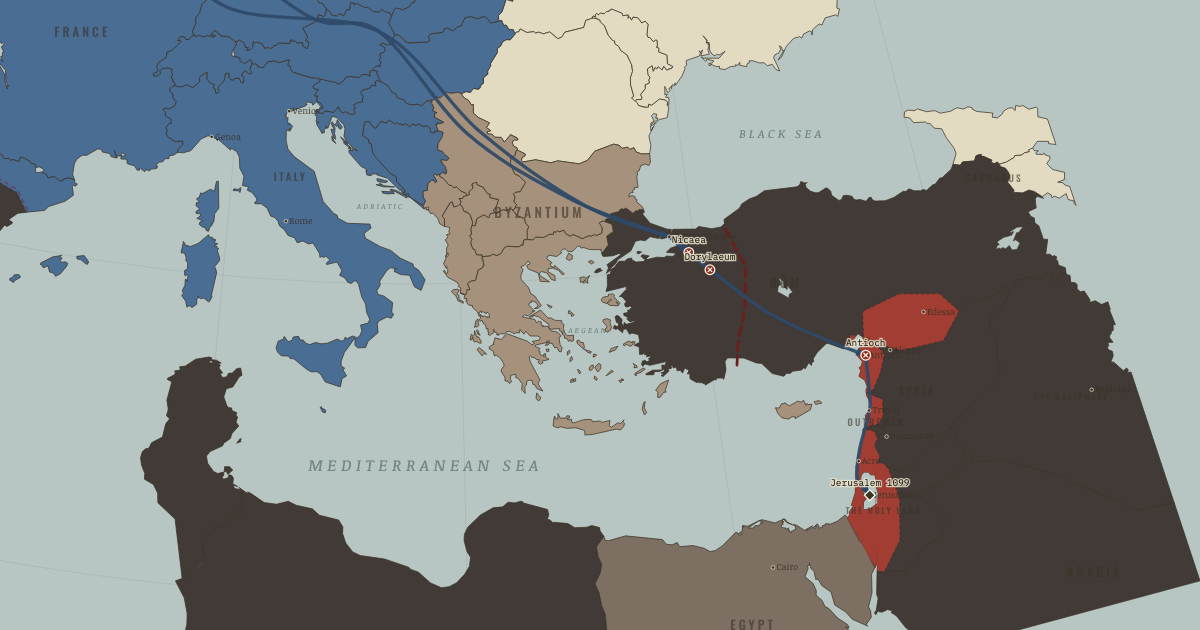
Manzikert and the Byzantine appeal. The catastrophe of 1071 cost Byzantium the Anatolian heartland that fed and manned it. Emperor Alexios I Komnenos wrote west asking for mercenaries to help claw it back. What he got instead was an armed migration of tens of thousands with its own agenda — the difference between a hired sword and a holy war he did not control.
The Seljuk fracture. Malik-Shah’s death in 1092 split the Seljuk realm among feuding heirs and atabegs; Syria dissolved into rival emirates; the Sunni-Shia schism set Baghdad against Cairo. A united Islam could have crushed the First Crusade at the frontier. A divided one let it pass. Disunity, here, is not background — it is the cause.
The reform papacy and the Peace of God. The Gregorian reform had just made the papacy a power that could command kings. The Peace and Truce of God movements tried to curb the private wars of a violent knightly class. Urban’s genius was to fuse the two: redirect that violence outward, sanctify it as penance, and make the pope its author.
Jerusalem and the pull of pilgrimage. Jerusalem was the centre of the medieval Christian map and the goal of a growing pilgrim traffic. Fused with apocalyptic expectation and the promise that dying on the road washed away all sin, the idea of an armed pilgrimage to the Holy City had a motive force no purely political summons could match.
Chapter 2: The First Crusade
Muslim disunity, above all. No coordinated defence met the crusade because there was no “Islam” to mount one. Seljuk heirs fought each other; the Fatimids of Egypt actually retook Jerusalem from the Seljuks in 1098, seeing the Franks as a useful counterweight; individual emirs sold the crusaders supplies. The First Crusade succeeded largely because it arrived in the one narrow window when its enemies were too fractured to unite against it.
Byzantine logistics and Italian fleets. For all the distrust, Alexios ferried the armies across, fed them, and guided them; and Genoese and Pisan ships brought the timber, food and siege engines without which Antioch and Jerusalem could not have been taken. The “miracle” ran on Greek grain and Italian keels.
Zeal and the refusal to turn back. A self-selected army convinced it was doing God’s work endured losses — starvation, disease, desertion — that would have broken a normal force. The Holy Lance episode, whatever one makes of it, shows how morale and belief substituted for the supply and command structure the crusade never had.
Chapter by chapter
The atlas has 12 chapters. For each, the causes it explains and the moment it turns on; the title opens the chapter’s free page with the full explanation, a discussion question and the map.
1. Three Civilizations, One Sea
CHAPTER 1 · THE WORLD OF 1095
Why it happened: Manzikert and the Byzantine appeal · The Seljuk fracture · The reform papacy and the Peace of God · Jerusalem and the pull of pilgrimage
The turning point: Clermont, 27 November 1095.
2. The First Crusade
CHAPTER 2 · 1096–1099
Why it happened: Muslim disunity, above all · Byzantine logistics and Italian fleets · Zeal and the refusal to turn back
The turning point: Antioch, June 1098 — the siege within a siege.
3. A Society on the Edge
CHAPTER 3 · OUTREMER
Why it happened: The tyranny of numbers · The maritime bargain · Coexistence as necessity
The turning point: Ascalon, 1153 — the high-water mark.
4. Europe’s First Standing Institutions
CHAPTER 4 · THE MILITARY ORDERS
Why it happened: The demographic gap demanded permanence · Papal privilege built a supranational body · The need to move money safely
The turning point: Krak des Chevaliers — permanence in stone.
5. Zengi, Nur al-Din, and the Second Crusade
CHAPTER 5 · 1144–1149
Why it happened: Edessa’s fatal exposure · The counter-crusade, constructed · Distrust, Latin and Greek
The turning point: Edessa, 24 December 1144.
6. Saladin
CHAPTER 6 · 1171–1187
Why it happened: The union of Egypt and Syria · Legitimacy, manufactured · The crusaders’ self-destruction
The turning point: The Horns of Hattin, 4 July 1187.
7. The Third Crusade
CHAPTER 7 · 1189–1192
Why it happened: The shock of 1187 · The logistics of holding Jerusalem · Exhaustion, personal and political
The turning point: Arsuf, 7 September 1191.
8. The Fourth Crusade — The Wrong Ending
CHAPTER 8 · 1202–1204
Why it happened: The Venetian debt · A Byzantine succession crisis · A century of Latin contempt for the Greeks
The turning point: The pretender’s bargain, 1203.
9. The Idea Turned Loose
CHAPTER 9 · CRUSADING EVERYWHERE
Why it happened: The indulgence, generalized · Frontier ambition, sanctified · Heresy treated as mortal threat
The turning point: Las Navas de Tolosa, 16 July 1212.
10. The Crusades of Kings
CHAPTER 10 · 1218–1270
Why it happened: The Egypt-first doctrine · Diplomacy could do what war could not · The gap between piety and power
The turning point: Jerusalem regained by treaty, 18 February 1229.
11. Baibars and the End
CHAPTER 11 · 1244–1291
Why it happened: The Mamluk military state · The Mongol shock, survived · European disengagement
The turning point: Ain Jalut, 3 September 1260.
12. What the Crusades Made
EPILOGUE · 1291 AND AFTER
Why it happened: The states were always demographically hollow · Islam unified; Christendom did not · The idea outgrew the place
The turning point: Acre, 18 May 1291 — the end, and the beginning of memory.
Essay questions, argued
Every chapter ends with a discussion question that historians still argue about, with our answer in brief. Use them as essay practice: plan your own answer, then read how we would argue it.
DISCUSSION QUESTION · CHAPTER 1
Was the First Crusade caused by religion or by material self-interest?
The honest answer refuses the “either.” Crusaders faced enormous cost and mortal risk for a journey most would not survive; cynical land-hunger alone does not explain a younger son mortgaging everything for a war he was likely to die in. Yet piety alone does not explain the plunder, the settlement, or the sanctified violence. The mechanism is that Urban offered a way to satisfy several hungers at once — for salvation, for adventure, for land, for an outlet for a warrior culture’s aggression — under one banner that made them all holy. Beware both the cynic who reduces it to greed and the apologist who reduces it to faith; the power of the idea was precisely that it did not make people choose.
The chapter behind it: Three Civilizations, One Sea. Every chapter’s question is on the discussion questions page.
DISCUSSION QUESTION · CHAPTER 5
Why did the Second Crusade — two kings, two great armies — achieve nothing, when the amateur First Crusade took Jerusalem?
Because the strategic situation had inverted. The First Crusade exploited a divided enemy and enjoyed surprise and Byzantine help; the Second faced a Muslim Syria that was learning to combine, a Byzantium now alienated by the memory of Antioch, and its own fatal lack of coordination between the German and French kings. The disaster then compounded itself with the choice to attack friendly Damascus — a blunder that only makes sense as the product of divided counsels and ignorance of local politics, and which pushed the one useful Muslim ally into the enemy camp. The lesson the crusaders drew was the wrong one — that God was punishing their sins — when the real lesson was that holy zeal is no substitute for unity of command and knowledge of the ground.
The chapter behind it: Zengi, Nur al-Din, and the Second Crusade. Every chapter’s question is on the discussion questions page.
DISCUSSION QUESTION · CHAPTER 9
By 1220, with crusades called against Spanish Muslims, Baltic pagans and French heretics, what did “crusade” actually mean?
It had become less a specific expedition to the Holy Land than a legal and spiritual instrument that the papacy could deploy against any enemy it defined as a threat to Christendom. That elasticity was a source of enormous power — it could mobilize men, money and zeal on multiple fronts at once — and of obvious danger, because it let religious authority sanctify wars of conquest (Iberia, the Baltic) and repression (Languedoc) that served very worldly ends. The Iberian and Baltic crusades also reveal why the eastern one failed by contrast: they were contiguous, settler-backed land wars a society could sustain, whereas Outremer was a distant, thinly held coast. The broader lesson is what happens when a moral licence becomes a political tool — the temptation to expand its use until “crusade” means little more than “a war the powerful have declared holy.”
The chapter behind it: The Idea Turned Loose. Every chapter’s question is on the discussion questions page.
DISCUSSION QUESTION · CHAPTER 12
Two centuries, perhaps a million lives, Jerusalem held for less than a lifetime — were the crusades “worth it,” and is that even the right question?
“Worth it” is largely the wrong question because it imposes a modern cost-benefit calculation on a penitential and religious act. Those who went were not investing for a return. They believed they were answering God and saving their souls. Judged as strategy, the crusades failed over two centuries to secure their stated aim. Judged as a human phenomenon, they produced some exchange in trade and knowledge, although other forces were already driving that exchange. They also produced unmistakable harm: assaults on Europe’s Jews, the maiming of Byzantium, and poisoned relations between Christians and Muslims and between Catholics and Orthodox Christians. The historian’s task is not to award a score. It is to explain why people believed strongly enough to die for a distant city, how a fragile settler society lasted so long, and why it eventually fell. Understanding is more useful than either triumphalism or inherited guilt.
The chapter behind it: What the Crusades Made. Every chapter’s question is on the discussion questions page.
What it changed
Consequence questions need the end of the story. The final chapter, What the Crusades Made, sets out what the period left behind:
A catastrophe for Europe’s Jews. The pogroms of 1096 and their successors mark a lasting worsening of Jewish life in Christendom — expulsions, ghettoization, blood libel — that far outlived the crusades themselves. It is the venture’s clearest and most terrible domestic legacy.
A maimed Byzantium, an advancing Islam. The wound of 1204 and the fall of Outremer left the eastern Mediterranean open; a weakened Byzantium fell to the Ottomans in 1453, and the frontier of Islam and Christendom moved into Europe. A crusade against Islam helped, in the end, to open Europe to it.
A word that would not die. “Crusade” survives as metaphor, honoured and abused, down to the present day. Read it always with the history and not the slogan: the medieval reality was stranger, sadder and more human than any modern use of the word admits.
Revision tools
The atlas ends with a map quiz that asks you to find places and moments on the map itself (part of membership and of the Exam Sprint). The quick quiz and the discussion questions with our answers are free pages on this site, and the printable study guide gathers every chapter’s notes into one document for revision.
Read next
- The Mongol Empire, 1206–1294 · THE MONGOL EMPIRE
Maps of History is independent and is not affiliated with or endorsed by the International Baccalaureate Organization. IB course names describe alignment only; paper, theme and section names follow the new course outline and may change when the final guide is published.
THE DISPATCH
A short welcome series, then a letter when a new atlas opens — and the printable study guide for The Crusades is yours now, free.
NO TRACKING · YOUR ADDRESS IS USED FOR THE DISPATCH AND NOTHING ELSE · UNSUBSCRIBE ANYTIME