MAPS OF HISTORY · IB HISTORY · THE MONGOL EMPIRE
IB HISTORY · 1206 – 1294 · 12 CHAPTERS
IB History: The Mongol Empire — notes, maps and essay questions
Assembled in three generations, from Korea to Hungary: how the steppe was united, why the cities fell, and what the Mongol peace carried along its roads — silk, silver, ideas, plague.
IB notes for this atlas are in preparation. Meanwhile, this page gathers the study notes every one of its 12 chapters already carries: why each episode happened, the moment it turned on, what it changed, and the question historians still argue about. It also shows where the atlas fits the IB course.
WW2 is free — every chapter. Try chapters 1–2 of any 2 other atlases (3 with a free account). Opening a new atlas uses one of them. Membership opens all 21 — Join.
Where it fits the course
The atlas is filed under Paper 2 (Conflict) and Paper 3 for Higher Level (Asia and Oceania). Its IB notes, with evidence lists, primary sources and model essay plans, are in preparation. These are the IB History pages for the parts of the course it serves:
Why it began
Causation questions start at the beginning. These are the causes the atlas’s opening chapters argue, each in a few sentences you can test against your own reading.
Chapter 1: The World of the Steppe
An ecology that manufactures cavalry. The steppe cannot feed dense populations, so it selects for mobility: five horses per rider, herds as rations on the hoof (mare’s milk, blood, dried curd), felt tents struck in an hour. A nomad army needs no supply train — its logistics graze. That single fact explains half of what follows: campaigns in winter, across deserts, at distances no settled army could contemplate.
The composite bow and the decimal habit. The recurved composite bow packed a longbow’s power into a weapon usable at full gallop, and steppe hunts — the great ring-drives called nerge — rehearsed thousands of riders in encirclement, signaling and timed movement. What Temüjin will add is organization: units of 10, 100, 1,000 and 10,000 that deliberately mix tribes, so a soldier’s loyalty runs to his unit and his khan, not his clan.
Divide-and-rule from the settled south. Jin policy treated the steppe as a fire to be managed: pay the Tatars to destroy the Mongols’ khan (see the Ambaghai marker), then arm others against the Tatars when they grew strong. It worked for a century — and it taught every steppe leader that the settled world was not a neighbor but a predator. The system’s one failure mode: a unifier it couldn’t divide.
A crisis generation. Twelfth-century chronicles describe worsening feuds and, some historians argue from tree-ring data, a cooling, drying spell squeezing the pastures. Whether or not climate lit the fuse, the social material was explosive: too many armed young men, too little order, and a code — revenge as sacred duty — that kept every wound open.
Chapter 2: Temüjin Becomes Genghis Khan
Merit against lineage. Steppe society ran on aristocratic blood — “white bone” over “black bone.” Temüjin, a nobody twice over, had no stake in that system and built its replacement: his greatest generals, Jebe and Subötai, were an enemy archer who had shot his horse and a blacksmith’s son. Talent flowed to him because he was the only employer paying for it. Jamukha kept the aristocrats — and kept losing captains to his rival.
Loyalty made calculable. His rules were brutally legible: absolute faith rewarded, betrayal punished symmetrically. Enemies who fought loyally for their own lords were recruited; allies who betrayed their lords for him were killed. Once every ambitious man on the steppe could predict the payoff matrix, defection to Temüjin became the rational strategy — a slow landslide you can date follower by follower in the sources.
Institutions that outlive charisma. The keshig bound every commander’s family to the center; decimal units broke clan blocs; the yam relay (Ch. 7) would bind distance itself. Compare every previous steppe confederation, which dissolved at its founder’s death: Genghis’s empire survives his death, doubles, and is inherited twice — because 1206 built structure, not just victory.
The sacred mandate. Victory itself became theology: Eternal Heaven (Tengri) had given the khan the earth, so rebellion was blasphemy and world-conquest mere collection of what was owed. The claim sounds like propaganda and functioned like grand strategy — it is cited in Mongol ultimatums from Korea to Hungary, and it made every peace merely a receipt for submission.
Chapter by chapter
The atlas has 12 chapters. For each, the causes it explains and the moment it turns on; the title opens the chapter’s free page with the full explanation, a discussion question and the map.
1. The World of the Steppe
CHAPTER 1 · THE STEPPE BEFORE 1206
Why it happened: An ecology that manufactures cavalry · The composite bow and the decimal habit · Divide-and-rule from the settled south · A crisis generation
The turning point: A khan nailed to a wooden mule, c. 1156.
2. Temüjin Becomes Genghis Khan
CHAPTER 2 · 1162–1206
Why it happened: Merit against lineage · Loyalty made calculable · Institutions that outlive charisma · The sacred mandate
The turning point: The kurultai at the Onon, spring 1206.
3. The Fall of North China
CHAPTER 3 · 1209–1234
Why it happened: Why the walls failed now · A conquest dynasty’s fatal seams · Geography turned inside out · Tribute misread as peace
The turning point: Zhongdu, May 1215.
4. The Khwarazm Catastrophe
CHAPTER 4 · 1218–1223
Why it happened: The murdered caravan — spark, not cause · An empire with no skeleton · Terror as doctrine · Speed as strategic surprise
The turning point: Bukhara, February 1220.
5. The Great Raid
CHAPTER 5 · 1221–1224
Why it happened: Reconnaissance in force, as institution · The steppe road runs both ways · A coalition of the mutually suspicious
The turning point: The Kalka, 31 May 1223 — and the morning after.
6. The Storm on the West
CHAPTER 6 · 1236–1242
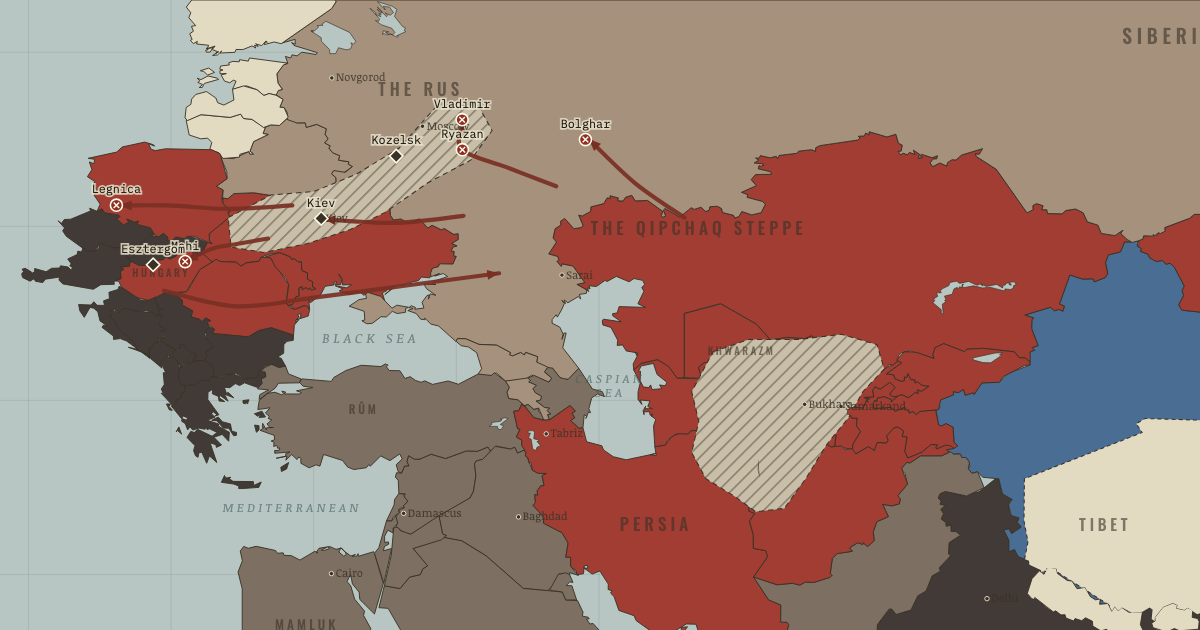
Why it happened: An empire’s full attention, this time · Winter as a chosen weapon · A fractured target set · The refugee trigger
The turning point: Legnica and Mohi, 9–11 April 1241.
7. The Machinery of Empire
CHAPTER 7 · 1229–1259
Why it happened: Steppe institutions, scaled · Pluralism as control theory · Terror’s dividend, spent on administration
The turning point: The silver fountain of Karakorum.
8. The Hammer on Islam
CHAPTER 8 · 1253–1260
Why it happened: Why Baghdad, why now · A hollow caliphate · The Mamluk anomaly · A fatally divided theater
The turning point: Ain Jalut, 3 September 1260.
9. The Family War
CHAPTER 9 · 1259–1266
Why it happened: An inheritance law for herds, not empires · Regionalization by success · Islam enters the family
The turning point: The Terek, January 1263.
10. Khubilai and the Song
CHAPTER 10 · 1234–1279
Why it happened: The longest war on the map, explained by water · A state too rich to knock out, too divided to win · Legitimacy as a weapon system · One empire’s parts, one project
The turning point: Xiangyang, 1268–1273.
11. The Limits of the World
CHAPTER 11 · 1274–1293
Why it happened: An ecological engine at the end of its fuel · Coerced fleets, reluctant crews · Enemies who had read the file · Prestige with a navy attached
The turning point: Hakata Bay, August 1281.
12. The Long Shadow
EPILOGUE · 1294 AND AFTER
Why it happened: Why the peace worked while it worked · Exchange without a customs officer for ideas · The pathogen rides the post-roads
The turning point: Caffa, 1347 — the exchange’s dark rider.
Essay questions, argued
Every chapter ends with a discussion question that historians still argue about, with our answer in brief. Use them as essay practice: plan your own answer, then read how we would argue it.
DISCUSSION QUESTION · CHAPTER 1
Settled empires were richer, more populous and technologically ahead. Why did the steppe repeatedly produce armies they could not match?
Settled states had more people and wealth, but converting those resources into mobile armies took time, taxes and supply lines. Steppe households already possessed horses, riding skill and portable food. That gave a united confederation a high rate of mobilization at relatively low cost. The advantage was conditional, however. It depended on political unity and access to pasture. Temüjin removed the first limit in 1206; forests, wet farmland, deserts without grazing and open sea continued to impose the second.
The chapter behind it: The World of the Steppe. Every chapter’s question is on the discussion questions page.
DISCUSSION QUESTION · CHAPTER 5
Why did Europe and the Rus learn nothing from 1223, when the Mongols learned everything?
The Mongols had experienced commanders whose job included gathering and preserving operational knowledge. Subötai could use what the expedition learned when he returned more than a decade later. Rus rulers lacked a shared institution for frontier planning, and the Mongol withdrawal made the danger seem temporary. Religious interpretation was not simple ignorance, but it did not supply routes, scouts or unified command. One side converted a rare encounter into doctrine; the other returned to immediate local rivalries.
The chapter behind it: The Great Raid. Every chapter’s question is on the discussion questions page.
DISCUSSION QUESTION · CHAPTER 9
Was the empire’s division inevitable — or the contingent result of Möngke dying in front of a minor Song fortress?
Some division was likely because regional branches already controlled distinct armies, revenues and advisers, while no binding succession rule existed. Möngke’s sudden death determined the timing and the particular rivals. Had he lived longer, central reforms might have delayed or reshaped the break. The careful distinction is between structural pressure toward regional rule and the contingent form of the 1260–64 civil wars. The first was strong; the second was not predetermined.
The chapter behind it: The Family War. Every chapter’s question is on the discussion questions page.
DISCUSSION QUESTION · CHAPTER 12
Tens of millions dead; Eurasia connected. Can one honestly speak of the Mongol Empire’s “achievements” — and how should a student weigh creation against destruction?
Use a double-entry method without pretending the columns cancel. State mass killing, displacement and long regional damage with honest ranges and source limits. Then state separately the consequences: political reunification, trade protection, specialist movement and successor institutions. Achievements do not justify atrocities, and condemnation does not make documented exchange disappear. Finally identify perspective: Persian, Rus, Arab, Chinese, Mongolian and modern historians inherit different archives and memories. The goal is not one moral score but a precise account of mechanisms, experiences and consequences.
The chapter behind it: The Long Shadow. Every chapter’s question is on the discussion questions page.
What it changed
Consequence questions need the end of the story. The final chapter, The Long Shadow, sets out what the period left behind:
Successor states inherit the frame. The Yuan fall in 1368 but leave China its size and its capital. Muscovy grows inside the Horde’s tax system until it swallows the steppe itself, a Russian empire ruling Sarai’s ashes. The Mughals carry the dynasty’s name and legitimacy into India. Chinggisid descent remains the steppe’s gold standard of kingship into the 1700s. Empires end, but their filing systems, borders and pretensions get recycled. Most of the map’s modern shapes have Mongol fingerprints somewhere in the provenance.
The world turns to the sea. Plague, khanate wars and rising tolls close the overland century; Europe’s appetite for the East — whetted by exactly the reports the Pax allowed — survives the road’s closure and goes looking for a water route. Columbus sails with Polo’s book aboard, hunting the Great Khan’s Cathay a century and a half after the last Great Khan could have received him. The Mongol road ends, in the long run, at the Atlantic: the era this atlas closes helped cause the one your other maps open.
Revision tools
The atlas ends with a map quiz that asks you to find places and moments on the map itself (part of membership and of the Exam Sprint). The quick quiz and the discussion questions with our answers are free pages on this site, and the printable study guide gathers every chapter’s notes into one document for revision.
Read next
- The Crusades, 1095–1291 · THE CRUSADES
Maps of History is independent and is not affiliated with or endorsed by the International Baccalaureate Organization. IB course names describe alignment only; paper, theme and section names follow the new course outline and may change when the final guide is published.
THE DISPATCH
A short welcome series, then a letter when a new atlas opens — and the printable study guide for The Mongol Empire is yours now, free.
NO TRACKING · YOUR ADDRESS IS USED FOR THE DISPATCH AND NOTHING ELSE · UNSUBSCRIBE ANYTIME