MAPS OF HISTORY · IB HISTORY · WW2
IB HISTORY · 1936 – 1945 · 15 CHAPTERS
IB History: The Second World War — notes, maps and essay questions
Ten years of war on one living map: fifteen guided chapters across two theaters, twenty-two territorial states, sixty-five battles and memory sites, and a map quiz at the end of it.
IB notes for this atlas are in preparation. Meanwhile, this page gathers the study notes every one of its 15 chapters already carries: why each episode happened, the moment it turned on, what it changed, and the question historians still argue about. It also shows where the atlas fits the IB course.
WW2 is free — every chapter. Try chapters 1–2 of any 2 other atlases (3 with a free account). No sign-up.
Where it fits the course
The atlas is filed under Paper 2 (Conflict) and Paper 3 for Higher Level (Europe and Asia and Oceania). Its IB notes, with evidence lists, primary sources and model essay plans, are in preparation. These are the IB History pages for the parts of the course it serves:
Why it began
Causation questions start at the beginning. These are the causes the atlas’s opening chapters argue, each in a few sentences you can test against your own reading.
Chapter 1: The Gathering Storm
Versailles and Nazi revisionism. The 1919 settlement reduced German territory and armed strength. Nazi propaganda converted widespread resentment into support for expansion and falsely presented each breach as a limited correction.
Depression and political weakness. Economic crisis discredited moderate parties and helped the Nazis reach power. It also constrained British and French military spending and made another major war politically difficult.
Memory of 1914–18. Leaders and voters feared another industrial slaughter. They accepted risk now to delay war, partly because they believed additional time would improve rearmament.
Failed collective security. Weak responses to Japan in Manchuria and Italy in Abyssinia showed that League of Nations sanctions lacked enforcement. Germany learned that rapid action could outrun collective decisions.
Chapter 2: The Pact and the Partition of Poland
Soviet distrust after Munich. Stalin doubted that Britain and France would form an effective anti-German alliance. A deal with Germany offered time, territory, and distance from a future front.
Hitler avoids two fronts. The pact neutralized the USSR during the Polish campaign and opened Soviet trade. Hitler expected Britain and France either to retreat again or to fight without decisive effect.
Danzig as pretext. The status of Danzig and the Polish Corridor supplied public demands. Hitler’s wider aim was Lebensraum, or living space, and the destruction of an independent Polish state.
Chapter 3: Blitzkrieg in the West
Organization over equipment totals. France had many capable tanks but distributed much of its armor for infantry support. Germany concentrated combined-arms formations and connected them by radio.
The Ardennes gamble. The revised German plan placed its main weight through terrain the Allies considered unsuitable for a large, rapid armored advance. Surprise came from accepting operational risk.
Norway and iron ore. Control of Norway protected Swedish ore shipments and supplied Atlantic bases. German naval losses there, however, reduced its ability to cover an invasion of Britain.
Chapter by chapter
The atlas has 15 chapters. For each, the causes it explains and the moment it turns on; the title opens the chapter’s free page with the full explanation, a discussion question and the map.
1. The Gathering Storm
CHAPTER 1 · 1936–1938
Why it happened: Versailles and Nazi revisionism · Depression and political weakness · Memory of 1914–18 · Failed collective security
The turning point: Munich, 30 September 1938.
2. The Pact and the Partition of Poland
CHAPTER 2 · AUG–OCT 1939
Why it happened: Soviet distrust after Munich · Hitler avoids two fronts · Danzig as pretext
The turning point: First shots, 1 September, 04:47.
3. Blitzkrieg in the West
CHAPTER 3 · APR–JUN 1940
Why it happened: Organization over equipment totals · The Ardennes gamble · Norway and iron ore
The turning point: Sedan, 13–15 May.
4. The Battle of Britain
CHAPTER 4 · JUL–OCT 1940
Why it happened: Sea Lion’s impossible arithmetic · Hitler expected a deal · The world’s first integrated air defense
The turning point: The system holds, 15 September.
5. Mussolini’s Parallel War
CHAPTER 5 · OCT 1940–JUN 1941
Why it happened: Fascist prestige economics · Britain’s imperial artery · A coup in Belgrade
The turning point: Crete, May 1941 — a pyrrhic first.
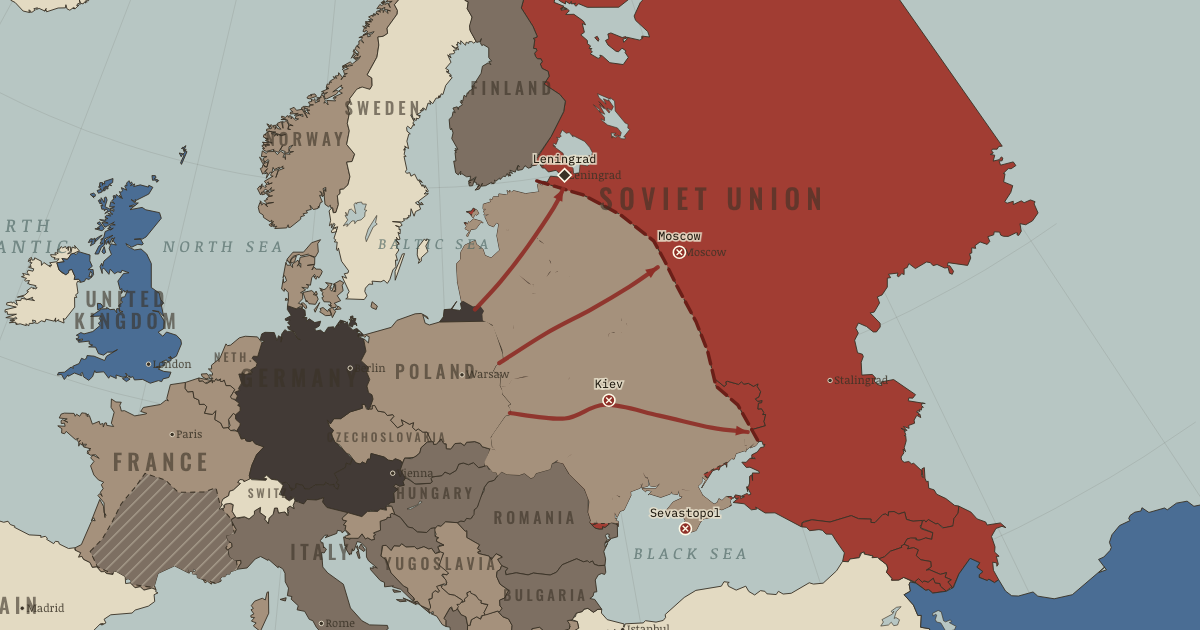
6. Barbarossa: The War of Annihilation
CHAPTER 6 · JUN–DEC 1941
Why it happened: Ideology: Lebensraum and the “Jewish-Bolshevik” enemy · “Kick in the door and the whole rotten structure comes down” · Britain’s last hope
The turning point: The gates of Moscow, 5 December.
7. Rising Sun: From China to Pearl Harbor
CHAPTER 7 · 1937–MAY 1942
Why it happened: An empire built on imported oil · The China quagmire · Khalkhin Gol turns Japan south · The knockout-blow theory
The turning point: Pearl Harbor, 7 December 1941.
8. Midway: Five Minutes That Turned an Ocean
CHAPTER 8 · APR–JUN 1942
Why it happened: The Doolittle sting · Codebreaking: the invisible weapon · Victory disease
The turning point: 10:20–10:25 a.m., 4 June 1942.
9. The Hinge: Stalingrad and El Alamein
CHAPTER 9 · JUL 1942–FEB 1943
Why it happened: Oil, again · A name worth an army? · The Atlantic pipeline
The turning point: Operation Uranus, 19–23 November.
10. Kursk, and the Fall of Fascist Italy
CHAPTER 10 · JUL–DEC 1943
Why it happened: Germany needed a shop-window victory · The best-advertised attack of the war · The Mediterranean compromise
The turning point: Prokhorovka and the halt order, 12–13 July.
11. The Island Road
CHAPTER 11 · AUG 1942–OCT 1944
Why it happened: The tyranny of distance · Two commanders, two roads · Unrestricted submarine warfare
The turning point: Guadalcanal, August 1942–February 1943.
12. Overlord and Bagration: The Vice Closes
CHAPTER 12 · JUN–AUG 1944
Why it happened: Three years of preparation · Fortitude: the war’s greatest lie · A genuinely allied timetable
The turning point: Omaha Beach, morning of 6 June.
13. Closing the Ring
CHAPTER 13 · DEC 1944–MAY 1945
Why it happened: Why fight to annihilation? · The Bulge’s false premise · Yalta: drawing the after
The turning point: Berlin, 16 April–2 May.
14. The Downfall of Imperial Japan
CHAPTER 14 · FEB–SEP 1945
Why it happened: A government of two minds · Unconditional surrender and the Emperor · The bomb’s momentum
The turning point: Hiroshima, 08:15, 6 August.
15. The World the War Made
EPILOGUE · 1945 AND AFTER
Why it happened: Why the peace looked like this: armies are arguments · Security through buffer · The productivity superpower
The turning point: The handshake that became a border.
Essay questions, argued
Every chapter ends with a discussion question that historians still argue about, with our answer in brief. Use them as essay practice: plan your own answer, then read how we would argue it.
DISCUSSION QUESTION · CHAPTER 1
Britain and France could probably have stopped Hitler cheaply in 1936–38. Why didn’t they?
Several constraints combined: fear of another mass war, limited readiness, economic pressure, divided public opinion, and the mistaken belief that Hitler had limited aims. Appeasement also bought useful rearmament time. Its central failure was diagnostic: leaders negotiated as if the dispute concerned specific borders, while Hitler treated each concession as a step toward a larger racial empire.
The chapter behind it: The Gathering Storm. Every chapter’s question is on the discussion questions page.
DISCUSSION QUESTION · CHAPTER 6
Every military expert — including most Allied ones — predicted Soviet collapse within weeks. Why were they all wrong?
They projected early Soviet defeats forward and underestimated regeneration. Strategic depth, factory evacuation, mass mobilization, coercion, patriotism, and a war for survival kept the USSR fighting. German supply systems could not sustain the same tempo over vast distances. Visible battlefield losses concealed the Soviet state’s remaining capacity.
The chapter behind it: Barbarossa: The War of Annihilation. Every chapter’s question is on the discussion questions page.
DISCUSSION QUESTION · CHAPTER 11
Why bypass a 100,000-man fortress like Rabaul instead of capturing it?
Isolation removed Rabaul’s ability to affect the campaign without paying the likely cost of assault. Air and sea control cut supply, movement, and communication. The objective was not possession of every island but destruction of Japan’s operational network. The comparison with Stalingrad is structural: attack the supporting system around a strongpoint.
The chapter behind it: The Island Road. Every chapter’s question is on the discussion questions page.
DISCUSSION QUESTION · CHAPTER 15
Was the Second World War “one war”? Argue both sides using what you’ve seen on this map.
For “separate wars,” China, Poland, Barbarossa, and the Pacific began with different dates, actors, and aims. For “one war,” December 1941 linked alliances, production, shipping, and strategy across theaters. Lend-Lease and synchronized offensives made outcomes interdependent. The strongest judgment is that several conflicts merged into one global system.
The chapter behind it: The World the War Made. Every chapter’s question is on the discussion questions page.
What it changed
Consequence questions need the end of the story. The final chapter, The World the War Made, sets out what the period left behind:
The long peace — under a mushroom cloud. No great-power war since 1945: deterrence, exhaustion, institutions, or luck? Historians argue; all four probably. But the wars didn’t stop — they moved to the decolonizing world, fought by proxy, from Korea to Vietnam to Angola.
Never again — the unfinished project. Human-rights law, refugee conventions, genocide prevention: all direct answers to 1939–45, all tested and often failed since (Cambodia, Rwanda, Bosnia — the last on this very map). The war’s deepest lesson is not that evil was defeated once, but what it took, and how late everyone acted.
Revision tools
The atlas ends with a map quiz that asks you to find places and moments on the map itself (free in WW2). The quick quiz and the discussion questions with our answers are free pages on this site, and the printable study guide gathers every chapter’s notes into one document for revision.
Read next
- The road to war, 1931–1941 · THE ROAD TO WAR
- The Cold War that followed · THE COLD WAR
Maps of History is independent and is not affiliated with or endorsed by the International Baccalaureate Organization. IB course names describe alignment only; paper, theme and section names follow the new course outline and may change when the final guide is published.
THE DISPATCH
A short welcome series, then a letter when a new atlas opens — and the printable study guide for WW2 is yours now, free.
NO TRACKING · YOUR ADDRESS IS USED FOR THE DISPATCH AND NOTHING ELSE · UNSUBSCRIBE ANYTIME