ON THIS DAY ·
Harry Thuku protest shooting
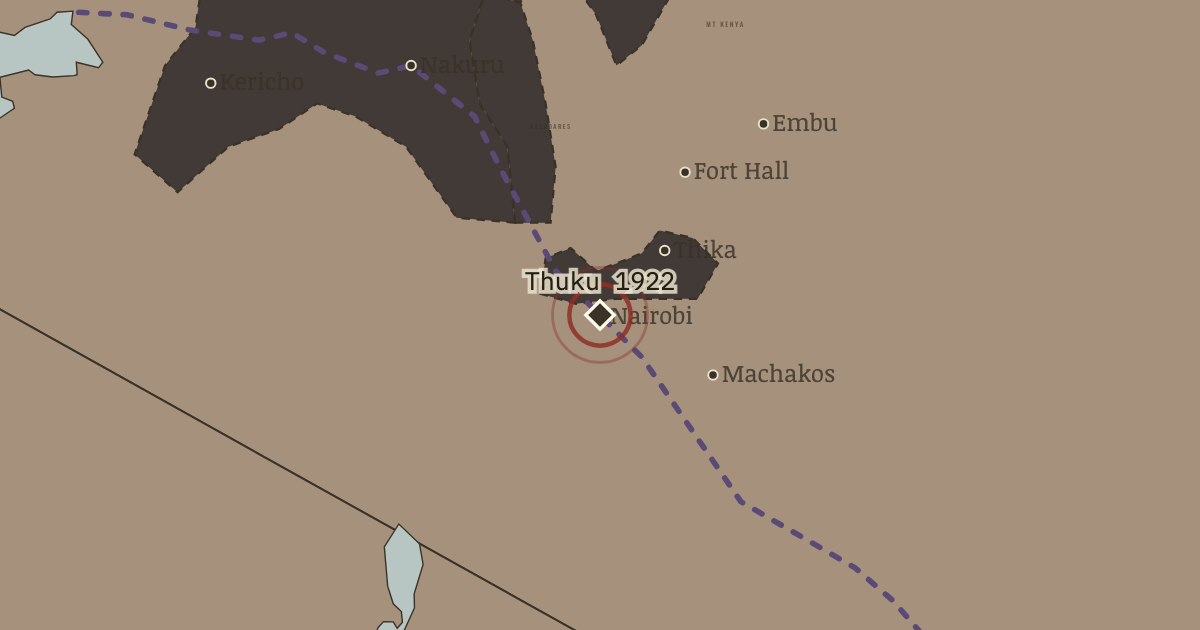
16 Mar 1922 — Police and settlers fire on a crowd demanding the release of Harry Thuku outside Nairobi’s police lines; the official count is 21 dead. Mary Muthoni Nyanjiru, who led the women, was among them.
WW2 is free — every chapter. Try chapters 1–2 of any 2 other atlases (3 with a free account). Opening a new atlas uses one of them. Membership opens all 21 — Join.
Free printable Haiti and Kenya independence study guide, sent by email ↓
The moment in context
Kenya was built backwards, with the railway first and a colony invented afterwards to pay for it, and that sequence explains much of what followed. The first rail was laid at Mombasa on 30 May 1896; the line reached the depot town of Nairobi in May 1899 and touched Lake Victoria at Kisumu on 20 December 1901. Of the 31,983 workers recruited in British India, 2,493 died and 6,724 stayed, the beginning of Kenya’s Asian community, shown by the arrow from the eastern edge. In 1902 Britain moved Uganda’s Eastern Province, the highlands from Naivasha to Kisumu, into the protectorate so that one government ran the whole line, and Commissioner Sir Charles Eliot began granting farms to Europeans. The railway’s debt was paid in African land.
From White Highlands of colonial Kenya, chapter 7 of Two Roads to Independence: Haiti 1789–1838 and Kenya 1895–1978 (1922).
The place: Harry Thuku protest shooting — map and full story →
Teach this in 5 minutes
- Why it happened — A railway that needed freight. The protectorate existed to protect a railway, and the railway needed paying traffic. Built to secure Uganda and the Nile, the line cost about £5.5…
- The turn — The Nairobi police lines, 16 March 1922. The shooting outside the Nairobi police lines is the hinge of this chapter because it turned private grievance into public politics and showed what…
- What it changed — Kikuyu land politics takes the lead. After 1922 the best-organised African politics in Kenya was Kikuyu politics about land. The Kikuyu Central Association gathered evidence of lost…
Then ask the room: Was land or labour the deeper grievance of colonial Kenya? The argued answer is on the chapter page →
The atlas that shows it
THE FREE PRINTABLE STUDY GUIDE
Join the Dispatch — a short welcome series, then a letter when a new atlas opens — and the printable study guide for Two Roads to Independence is yours now, free.
NO TRACKING · YOUR ADDRESS IS USED FOR THE DISPATCH AND NOTHING ELSE · UNSUBSCRIBE ANYTIME