Haiti and Kenya independence · CHAPTER 7 ·
White Highlands of colonial Kenya
Chapter 7 of Two Roads to Independence: Haiti 1789–1838 and Kenya 1895–1978: “The White Highlands”
Britain declared the East Africa Protectorate in 1895 for the sake of the Uganda Railway, built from 1896 to 1901 for about £5.5 million. To make the line pay, officials settled European farmers on the highlands along its route, and laws of 1902 and 1915 made African land Crown property; the Maasai lost at least half their land.
Chapter 7 is part of membership. WW2 is free — every chapter. Try chapters 1–2 of any 2 other atlases (3 with a free account). Opening a new atlas uses one of them. Membership opens all 21 — Join.
Free printable Haiti and Kenya independence study guide, sent by email ↓
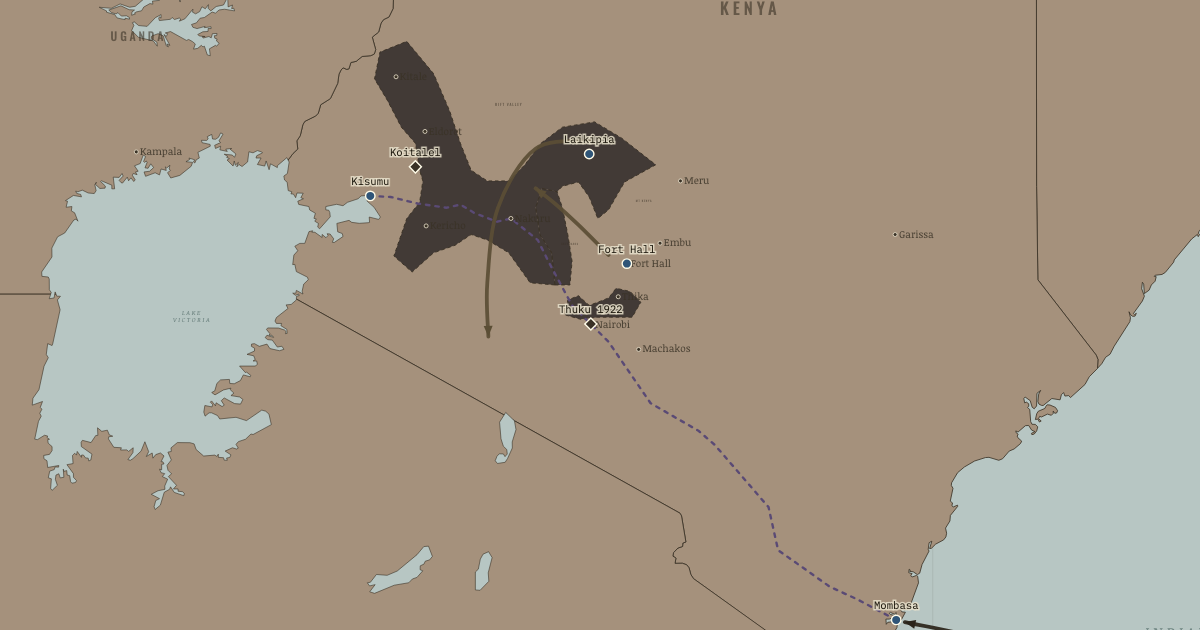
The map above is the world of Kenya, 1920 — Kenya Colony and the White Highlands.
Part of IB History: Haiti and Kenya →
BRIEF EXPLANATION — THE ESSENTIAL ARGUMENT
The second case asks the question the Haitian chapters asked, how people under colonial rule came to see themselves as a nation, but in Kenya the answer begins with a railway and the land it opened. Britain declared the East Africa Protectorate on 1 July 1895. A protectorate was territory ruled by Britain without formal annexation, rather like a property run by an agent for an absent owner. Its real purpose was the Uganda Railway, built between 1896 and 1901 to secure Uganda and the headwaters of the Nile. The line cost about £5.5 million, far above the estimates presented to Parliament, and the officials who ran the protectorate decided that European farmers on the cool highlands along its route would earn the freight to pay for it.
That decision made land the central fact of Kenyan history. Laws of 1902 and 1915 turned African land into Crown property, land owned by the British state, the Maasai, herders of the Rift Valley grasslands, were moved off the Laikipia plateau in 1911–13, and Kikuyu families, farmers of the central highlands, lost fields in Kiambu to coffee estates. On the map, the charcoal block astride the dashed railway is the White Highlands, land reserved for Europeans much as a whites-only zoning law would reserve a district today. Taxes and the kipande, a pass worn round the neck like an internal passport, pushed Africans into work on settler farms. When police and settlers fired on a Nairobi crowd demanding Harry Thuku’s release in March 1922, killing 21 by the official count and many more by other estimates, Kenyans learned that the colonial state would defend the land with guns. Colonial rule had created the grievance long before anyone imagined the nation.
The full story
Kenya was built backwards, with the railway first and a colony invented afterwards to pay for it, and that sequence explains much of what followed. The first rail was laid at Mombasa on 30 May 1896; the line reached the depot town of Nairobi in May 1899 and touched Lake Victoria at Kisumu on 20 December 1901. Of the 31,983 workers recruited in British India, 2,493 died and 6,724 stayed, the beginning of Kenya’s Asian community, shown by the arrow from the eastern edge. In 1902 Britain moved Uganda’s Eastern Province, the highlands from Naivasha to Kisumu, into the protectorate so that one government ran the whole line, and Commissioner Sir Charles Eliot began granting farms to Europeans. The railway’s debt was paid in African land.
Settler wealth rested on three instruments that turned African land and labour into European farms. The first was law. The Crown Lands Ordinance of 1902 let officials lease “waste and unoccupied” land for 99 years, and the ordinance of 1915 extended leases to 999 years and classed land occupied by Africans as Crown land, so that the courts soon called Africans tenants at will of the Crown, people who could be removed whenever the owner chose. The Maasai, promised Laikipia in 1904 for as long as they existed as a people, were moved south in 1911–13 along the brown arrow and lost at least half their land. The second instrument was tax, a hut tax from 1901 and a poll tax from 1910, payable only in cash. The third was the kipande, a pass much like an internal passport, compulsory from 1919–20 for every African man over sixteen, which carried his fingerprints and his employers’ verdicts. Together they made the highlands rich on the work of the people who had lost them.
Kenyan politics began as an answer to these grievances, and the answers already held two ideas of who “the people” were. In 1921 Harry Thuku, a young government telephone operator, founded the East African Association, which welcomed every community and campaigned against the kipande, higher taxes and cuts in wages. His arrest on 14 March 1922 brought thousands to the Nairobi police lines, where police and settlers killed 21 people by the official count, among them Mary Muthoni Nyanjiru, who had led the women forward. The Kikuyu Central Association, founded in 1924–25, narrowed the cause to Kikuyu land and culture, and its secretary from 1928, Jomo Kenyatta, spent 1931 to 1946 lobbying in Britain. One politics spoke for all Africans and the other for a people and its land, and Kenya carried both into independence.
DEEP EXPLANATION — EVIDENCE & INTERPRETATION
A railway that had to be paid for
Historians agree that settlement in Kenya was a policy chosen to rescue a railway budget, and they differ on how much freedom the colonial state had once the choice was made. The line was sold to Parliament at a far lower estimate and finished at about £5.5 million; with Treasury interest the bill reached some £7.9 million by 1925, and London wanted the protectorate to stop needing grants. Eliot answered with settlers, and Lord Delamere, who took 100,000 acres at Njoro on a 99-year lease in 1903, became their leader. Yet the settler population stayed small, 9,651 in 1921 and 16,812 in 1931, which is why Bruce Berman and John Lonsdale, in Unhappy Valley (1992), describe a state trapped between two needs: it had to help settlers make money, and it had to keep order among an African majority whose taxes paid most of its costs. Figures for the land itself vary with what is counted, from about 12,000 square miles of farmland, some 7.5 million acres, to 16,500–16,700 square miles once forest reserves are included. A small community holding a huge estate explains why the land question never cooled.
Law as the instrument of dispossession
Kenya’s settlers held their land by law, and the law was shaped so that African claims could not be heard. When the Maasai, led by Parsaloi Ole Gilisho, went to court in 1912 to keep Laikipia, the High Court at Mombasa dismissed the case in May 1913 and the appeal failed that December, because the judges held that the agreements of 1904 and 1911 were treaties, acts of state beyond any court’s reach. Lotte Hughes, in Moving the Maasai (2006), estimates that they lost at least half and perhaps 70 percent of their land. Kikuyu claimants fared no better: in the early 1920s Chief Justice Barth read the 1915 ordinance with the annexation order of 1920 to hold that Africans were tenants at will of the Crown, the phrase H. W. O. Okoth-Ogendo later used as the title of his study Tenants of the Crown (1991). The Kenya Land Commission of 1932–34 added small areas to the reserves but confirmed the highlands, and an Order in Council of February 1939 fixed their boundaries. Closing the courtroom did not end the claim; it moved the claim into the oath and, in time, the forest.
Making tribes, making Kenyans
The identities that later fought for independence were partly made by colonial rule, and John Lonsdale’s distinction between “moral ethnicity” and “political tribalism” is the clearest way to see how. The administration governed through tribes: it drew a reserve for each, appointed chiefs to run them and printed a tribe on every kipande, so that ethnic labels gained a weight they had not carried before. Inside each community, Lonsdale argues, people then debated what it meant to be a worthy member and how land, work and seniority should be earned, and that internal argument gave politics its passion. Organisations followed the same lines: the Kikuyu Central Association, the Ukamba Members Association, the Taita Hills Association and the Kavirondo Taxpayers’ Welfare Association each spoke for a people, while Thuku’s short-lived association had tried to speak for all. Kenyatta’s Facing Mount Kenya, published in 1938 with an introduction by his teacher Bronisław Malinowski, defended Kikuyu custom by tying it to the land. The nation was later assembled from these communities, which is why it was never simply their sum.
Key places on the map
On this day
Why it happened
A railway that needed freight. The protectorate existed to protect a railway, and the railway needed paying traffic. Built to secure Uganda and the Nile, the line cost about £5.5 million, far above early estimates, and London expected the protectorate to stop relying on Treasury grants. Officials concluded that European farmers growing export crops would supply the freight, so Commissioner Charles Eliot advertised the highlands to settlers in Britain and South Africa from 1903. A transport project became a settlement policy, and the colony’s politics followed from it.
Land declared empty. Colonial law treated African land as vacant whenever nobody could show a European kind of title. The ordinance of 1902 let the Crown lease “waste and unoccupied” land, the ordinance of 1915 made even occupied African land Crown property, and the Maasai were moved off Laikipia in 1911–13. Pasture left to rest in the dry season looked empty to surveyors who did not understand herding. As in Saint-Domingue a century earlier, the colony’s wealth depended on a legal fiction about who owned the land and who could be made to work it.
Taxes and the pass made a labour force. Settlers needed workers even more than they needed land, and the state supplied them. A hut tax from 1901 and a poll tax from 1910 had to be paid in cash, which pushed men into wage work, and the kipande, compulsory from 1919–20, recorded each man’s employers and let police stop him anywhere. A worker who left a harsh employer could be traced through his papers. The pass turned a scattered rural population into a disciplined labour supply, and it became the most hated object in colonial Kenya.
A state that listened to settlers. Settlers sat on the Legislative Council, the colony’s law-making body, from 1907, and Lord Delamere led them until his death in 1931, while Africans had no elected voice at all. When settlers demanded self-government in the early 1920s, London answered with the Devonshire Declaration of 1923, which called Kenya “an African territory” in which African interests must be paramount. The words checked the settlers’ political ambitions, yet the land stayed in their hands. Kenyans learned that promises made in London changed little on the ground.
THE TURNING POINT
The Nairobi police lines, 16 March 1922. The shooting outside the Nairobi police lines is the hinge of this chapter because it turned private grievance into public politics and showed what the colonial state would do to defend its order. Thuku’s association had drawn Kikuyu, Kamba and others into one campaign against the pass, the taxes and the wage cuts, and his arrest brought a crowd of perhaps 7,000 into the capital. When police and settlers fired, killing 21 by the official count and many more by other estimates, the crowd scattered and Thuku was exiled to the far north until 1931. The lesson cut both ways: open protest could be crushed, yet the dead, Mary Muthoni Nyanjiru above all, became the first martyrs of Kenyan nationalism.
What it changed
Kikuyu land politics takes the lead. After 1922 the best-organised African politics in Kenya was Kikuyu politics about land. The Kikuyu Central Association gathered evidence of lost fields for the Kenya Land Commission, backed schools independent of the missions after the quarrel over female circumcision in 1929–31, and sent Kenyatta to London. When the commission confirmed the White Highlands in 1934, a generation concluded that petitions would not bring the land back, the conclusion the next chapter follows into the oath.
Squatters move onto the settler farms. Landless Kikuyu families moved onto settler farms as squatters, resident labourers who worked for the farmer in return for a plot and grazing, much like tenants paying their rent in labour. By the early 1930s there were more than 100,000 of them, a movement traced by the arrow from the reserves into the Rift Valley. Their bargain held while settlers needed labour more than land, and its collapse after 1945 made the Rift Valley a cradle of Mau Mau.
A colony of separate peoples. Colonial rule had drawn a reserve, a chief and a label for each people, and each organised on its own: the Kamba, the Taita, the Luo and Luhya, the Kikuyu. These separate politics shaped the parties of 1960, when KANU spoke for the larger communities and KADU for the smaller ones that feared them. The question Thuku had raised, whether Kenyans could act as one people, stayed open at independence and long after it.
DISCUSSION QUESTION — Was land or labour the deeper grievance of colonial Kenya?
The case for land is strongest among the Kikuyu and the Maasai, who lost fields and grazing to the White Highlands and whose politics, from the Kikuyu Central Association to the oath, spoke the language of stolen land; Kenyatta’s Facing Mount Kenya made land the root of Kikuyu identity. The case for labour is strongest in the towns and on the farms, where the kipande, the hut and poll taxes and falling wages touched every African man, and it was a labour grievance that brought Thuku’s mixed crowd to the police lines in 1922. The best answer treats the two as one mechanism: dispossession created people without enough land, tax and the pass turned them into workers, and the settler economy depended on keeping both arrangements in place. Berman and Lonsdale’s picture of a state caught between helping settlers profit and keeping control describes exactly this bind. The transferable lesson is that the most explosive colonial grievances joined a material loss to a daily humiliation that everyone could see.
An interesting fact
Kenya’s capital began as a railway supply depot, set up in 1899 beside a swampy stream the Maasai called Enkare Nairobi, “the place of cool water”, because it was the last level ground before the line climbed the Rift Valley escarpment. Within six years the depot town had replaced Mombasa as the protectorate’s capital. Its first residents included the railway workers from British India: of the 31,983 recruited, 6,724 stayed in East Africa, and with the traders who followed them they built much of the new town’s commerce. Nairobi is, quite literally, a railway town.
Related
THE FREE PRINTABLE STUDY GUIDE
Join the Dispatch — a short welcome series, then a letter when a new atlas opens — and the printable study guide for Two Roads to Independence is yours now, free.
NO TRACKING · YOUR ADDRESS IS USED FOR THE DISPATCH AND NOTHING ELSE · UNSUBSCRIBE ANYTIME