ON THIS DAY ·
Flateyjarbók
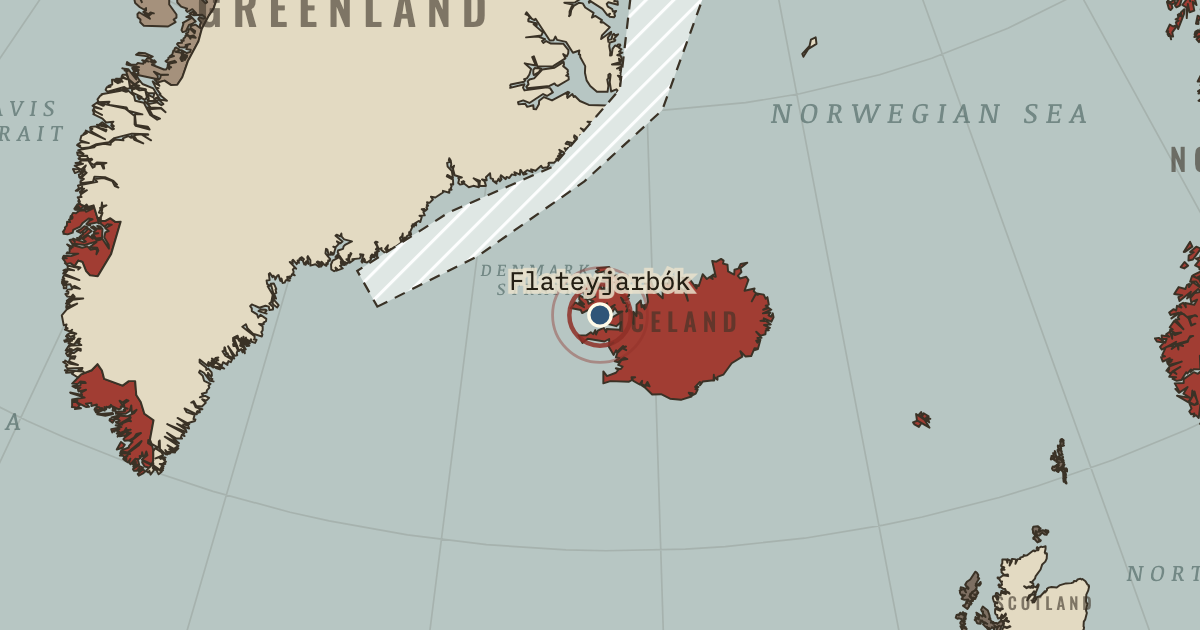
1387–94 — Flateyjarbók, the largest medieval Icelandic manuscript, is named after this island farm in Breiðafjörður, whose owner gave it to the bishop of Skálholt in 1647. It reached the Danish king in 1656 and came home to Reykjavík on 21 April 1971. It preserves the Saga of the Greenlanders, written centuries after the voyages it describes.
WW2 is free — every chapter. Try chapters 1–2 of any 2 other atlases (3 with a free account). Opening a new atlas uses one of them. Membership opens all 21 — Join.
Free printable Norse and Aztecs study guide, sent by email ↓
The moment in context
Medieval climate changed unevenly from place to place, which is why scientists call the warm spell an anomaly, meaning a regional departure from the usual pattern, much as one unusually hot summer stands out from the long-run average in a city’s records. Comparing hundreds of records in 2009, Michael Mann and his colleagues found that the years 950–1250 were warm around the North Atlantic while parts of the tropical Pacific were cool. In south Greenland, midge remains in the mud of Scoop Lake point to summers about 1.5 °C warmer between 900 and 1400 than in the colder centuries on either side. Yet lakes near Kangerlussuaq, further north and inland, record a fall of about 4 °C in some eighty years from around 1100. The cold returned abruptly, and Gifford Miller’s team dates its onset to 1275–1300, after a burst of volcanic eruptions whose sulphur dimmed the sun and whose effect spreading sea ice then prolonged. A coast could therefore be warm for one community while its neighbour cooled, and that unevenness is what turns climate into history.
From Medieval Warm Period and Little Ice Age, chapter 1 of Climate and Innovation: The Norse and the Aztecs, c. 790–1521 (1250).
The place: Flateyjarbók — map and full story →
Teach this in 5 minutes
- Why it happened — Living at the margin magnifies small changes. A society that farms close to the limit of what its crops and animals can tolerate feels a small shift in climate as a large shift in harvests.…
- The turn — Summit, Greenland, 1 July 1993. On this day the GISP2 drill reached bedrock 3,053 metres below the summit of the Greenland ice sheet, completing a record of past climate that can…
- What it changed — The warm centuries open the sea road. The warmth of roughly 950–1250 coincided with the boldest phase of Norse voyaging, when settlers crossed open water to Iceland, Greenland and North…
Then ask the room: Can climate ever be the cause of a society’s success or failure, or only its context? The argued answer is on the chapter page →
The atlas that shows it
THE FREE PRINTABLE STUDY GUIDE
Join the Dispatch — a short welcome series, then a letter when a new atlas opens — and the printable study guide for Climate and Innovation is yours now, free.
NO TRACKING · YOUR ADDRESS IS USED FOR THE DISPATCH AND NOTHING ELSE · UNSUBSCRIBE ANYTIME