Norse and Aztecs · CHAPTER 1 ·
Medieval Warm Period and Little Ice Age
Chapter 1 of Climate and Innovation: The Norse and the Aztecs, c. 790–1521: “Climate as a Force in History”
Between about 950 and 1250 much of the North Atlantic enjoyed a warm spell scientists call the Medieval Climate Anomaly; from about 1275–1300 it slid into the colder Little Ice Age. Proxies such as Greenland ice cores and lake-mud records show the change was uneven, warming one coast while a neighbour cooled.
WW2 is free — every chapter. Try chapters 1–2 of any 2 other atlases (3 with a free account). Opening a new atlas uses one of them. Membership opens all 21 — Join.
Free printable Norse and Aztecs study guide, sent by email ↓
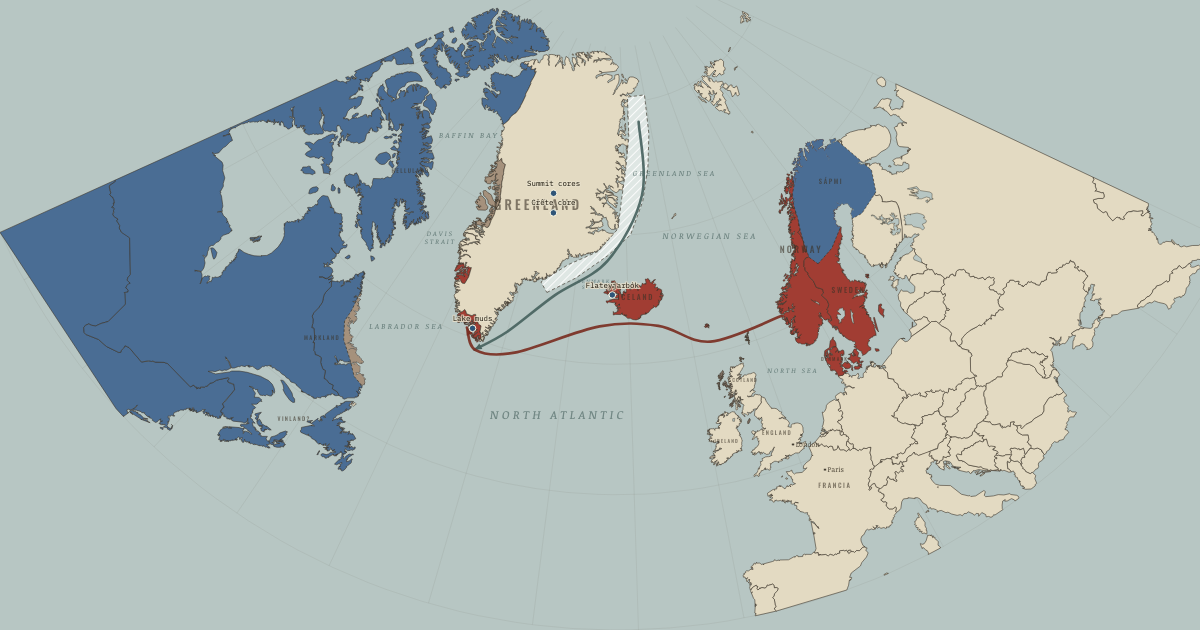
The map above is the world of The Norse North Atlantic, 1250 — Greenland at its height; the Thule Inuit arrive.
Part of IB History: The Norse and the Aztecs →
BRIEF EXPLANATION — THE ESSENTIAL ARGUMENT
The central question of this whole atlas is how two very different societies innovated to live with, and to profit from, a demanding climate, and why some of their innovations lasted while others failed. Climate means the long-run pattern of temperature, rain and ice that people can plan around, as distinct from weather, which is a single season’s luck. Between about 950 and 1250 much of the North Atlantic enjoyed a warm spell that scientists call the Medieval Climate Anomaly, a regional departure from the norm, like one unusually hot decade in a city’s weather records. From about 1275–1300 it slid into the colder centuries known as the Little Ice Age, the reverse of the warming the Arctic sees today. The Norse sailed west during the first and had to survive the second. Far to the south, the Mexica, the people often called the Aztecs, built a city in a lake with no outlet in central Mexico, where frost, drought and flood were constant risks.
Innovation in this atlas means a working system, much as a modern power grid joins power stations, laws and the habits of its users. For the Norse that system joined ships, sheep, seal hunting and assemblies; for the Mexica it joined dikes, raised fields and an empire that collected food as tribute. Historians reconstruct the climate these systems faced from ice cores, columns of ice drilled from the Greenland ice sheet whose yearly layers work like the rings of a tree, and from lake muds and tree rings, read beside sagas, annals and painted books. On the map, the white band off east Greenland marks the summer drift ice of the warm centuries, and red shows the Norse world at its height around 1250. Both cases teach the same lesson, because climate set the margin while each society decided what happened at that margin.
The full story
Medieval climate changed unevenly from place to place, which is why scientists call the warm spell an anomaly, meaning a regional departure from the usual pattern, much as one unusually hot summer stands out from the long-run average in a city’s records. Comparing hundreds of records in 2009, Michael Mann and his colleagues found that the years 950–1250 were warm around the North Atlantic while parts of the tropical Pacific were cool. In south Greenland, midge remains in the mud of Scoop Lake point to summers about 1.5 °C warmer between 900 and 1400 than in the colder centuries on either side. Yet lakes near Kangerlussuaq, further north and inland, record a fall of about 4 °C in some eighty years from around 1100. The cold returned abruptly, and Gifford Miller’s team dates its onset to 1275–1300, after a burst of volcanic eruptions whose sulphur dimmed the sun and whose effect spreading sea ice then prolonged. A coast could therefore be warm for one community while its neighbour cooled, and that unevenness is what turns climate into history.
Most of this knowledge comes from proxies, natural records that stand in for a thermometer in the way that a tree’s rings stand in for a calendar. At Summit, the highest point of the Greenland ice sheet, the American GISP2 team drilled 3,053 metres to bedrock between 1989 and 1993, and the European GRIP core reached 3,028 metres in 1992. Every year’s snow survives as a layer, and the share of a slightly heavier form of oxygen in it rises when the air is warmer, so the ice works like a thermometer that wrote down its own readings. Lake muds add rainfall, and tree rings add exact years, as when a burst of cosmic radiation recorded in the ring for 993 later dated Norse timber in Newfoundland. Written sources complete the picture, because Icelandic annals record ice and hard winters, and Mexica chronicles describe the frosts and droughts of the 1450s that Mexican tree rings now confirm. The strongest arguments come when ice, wood and words agree.
The two cases meet the same question from opposite directions, and the map is built to let a reader compare them. The Norse, the Scandinavian peoples of the Viking Age, were a mobile people who used the warm centuries to sail west, settling Iceland in the 870s and Greenland in the 980s and reaching North America around 1000, so their story tests whether farming at the climatic edge could survive the cold that followed. The Mexica, often called the Aztecs, stayed in one basin and engineered it, so their story tests how far dikes, aqueducts and raised fields could tame a lake prone to salt, flood and frost. Set side by side, they show that the size of a society, the variety of its food and the reach of its trade decided as much as any single invention.
DEEP EXPLANATION — EVIDENCE & INTERPRETATION
What the proxies can and cannot say
Each climate proxy answers a narrower question than it first appears to, and the disagreements between them are themselves evidence. The Summit ice cores record the air above an ice sheet more than 3,000 metres high, which is a poor guide to the sheltered fjords where Norse farmers cut hay; Antoon Kuijpers and others warned in 2014 that summit records may miss the maritime climate of the coast entirely. The Kangerlussuaq lakes studied by William D’Andrea in 2011 lie inland and north of any Norse farm, so their sharp cooling from about 1100 describes a neighbouring region. Closest to the farms, Lake 578 beside a Norse homestead in the Eastern Settlement shows, according to Boyang Zhao and colleagues in 2022, no substantial temperature change during the settlement at all, but a persistent drying trend that would have cut the hay crop. Temperature, rainfall and sea ice moved separately, and a historian who quotes one proxy as “the climate” has already chosen an answer.
Sagas, annals and codices as climate data
Written sources carry the experience of climate, but every one of them was shaped by the purposes of its writers. The Icelandic sagas were written down in the thirteenth and fourteenth centuries, two hundred years or more after the voyages they describe, so their mild Vinland and their fertile Greenland may reflect the authors’ world as much as Erik’s. Icelandic annals are closer in time and record sea ice, famine and storms year by year, yet one famous sentence, in which ice forces Greenland’s sailors off their old route, is judged by Astrid Ogilvie and colleagues in 2009 to be a later insertion into Ívar Bárðarson’s fourteenth-century description. In Mexico the chronicles of Diego Durán and others, compiled after the Spanish conquest, describe the famine of the 1450s with moral purpose. Here the trees have vindicated the words, because the Mexican Drought Atlas published by David Stahle’s team in 2016 shows a great drought across central Mexico in 1452–54. The best practice is to read each document as a witness with a viewpoint, and to test it against a proxy that had none.
Climate determinism and its critics
The most important debate in this field concerns how much climate decides, and it has swung back and forth for fifty years. In 1975 Willi Dansgaard’s team read the Crête ice core beside Norse history and concluded that the record suggested a strong climatic impact on the Greenland colony. Jared Diamond’s Collapse of 2005 shifted attention to choices, arguing that the Norse damaged their soils, clung to cattle and churches and refused to learn from the Inuit. Most specialists now reject both pure climate and pure folly. Andrew Dugmore, Thomas McGovern and colleagues argued in 2012 that the colony was flexible and successful, and that it failed through a conjuncture, a coming-together of cooling, falling trade and isolation acting on weaknesses that its own earlier success had created. The same move from blame to vulnerability shapes the study of the Mexica, whose hydraulic triumphs made the lake city larger and therefore more exposed when the lake turned against it. The question has moved from who was to blame to who was exposed, and why.
Key places on the map
On this day
Why it happened
Living at the margin magnifies small changes. A society that farms close to the limit of what its crops and animals can tolerate feels a small shift in climate as a large shift in harvests. Greenland’s Norse depended on enough summer warmth and moisture to grow the hay that fed their cattle through eight winter months, while the Mexica grew maize at about 2,240 metres, where an early autumn frost can kill a crop before it ripens. In both places a change of a degree or two decided whether a year was ordinary or desperate.
Ocean currents and sea ice shape the routes. The North Atlantic’s climate is carried by the sea as much as by the air, which matters enormously to a people who travel by ship. The cold East Greenland Current, drawn as the grey arrow, carries Arctic ice south along Greenland’s east coast and around Cape Farewell. When the climate cooled, that drift ice spread further and lasted longer each summer, blocking harbours, lengthening voyages and making the link between Greenland and Norway slower and riskier.
Volcanoes can tip a climate into a new state. Large eruptions inject sulphur high into the atmosphere, where it reflects sunlight and cools the world for several years. Gifford Miller’s team argued in 2012 that a cluster of four large eruptions in about fifty years, including the great eruption of 1257–58 later traced to Samalas in Indonesia, began the Little Ice Age between 1275 and 1300. Spreading sea ice then reflected more sunlight and kept summers cold long after the volcanic haze had cleared.
Societies build their own vulnerabilities. The same weather harms societies differently, depending on how many people they must feed, how varied their food is and how far their trade reaches. A colony of perhaps 2,000–2,500 people on the edge of the Arctic had little margin for a run of bad years, while a city of perhaps 200,000 drew on an empire but concentrated its people on one lake. Climate exposed these differences more than it created them, and that is why the same cold or drought could be survived in one place and fatal in another.
THE TURNING POINT
Summit, Greenland, 1 July 1993. On this day the GISP2 drill reached bedrock 3,053 metres below the summit of the Greenland ice sheet, completing a record of past climate that can be read almost year by year. This is the hinge of the chapter because it changed what historians could ask. Before the great cores, the climate of the Norse age was inferred largely from the sagas and annals whose story it was meant to explain, so the argument risked going in a circle. After them, climate became independent evidence that could be tested against the documents, and the documents tested against it.
What it changed
The warm centuries open the sea road. The warmth of roughly 950–1250 coincided with the boldest phase of Norse voyaging, when settlers crossed open water to Iceland, Greenland and North America. The next chapter asks what made those crossings possible in the first place, and it finds the answer in a ship and in the farming society that paid for it, with climate as the setting that made the gamble of open-ocean sailing pay off more often than it failed.
The cold tests the farms. The shift into the Little Ice Age after about 1275–1300 fell hardest on the communities furthest out, above all the Greenland settlements that lived on hay, cattle and walrus ivory. Chapter 5 follows that test in detail and weighs climate against markets, isolation and choice as explanations of why the Norse left while the Inuit, newly arrived, stayed and prospered.
A second laboratory in Mexico. The same questions about margins, buffers and invention apply to the Basin of Mexico, where frost and drought struck in the 1450s and floods in 1449 and 1499. Chapter 8 shows how the Mexica answered with dikes, aqueducts and granaries, and how each answer, by letting more people live on the lake, created a new and larger kind of risk.
DISCUSSION QUESTION — Can climate ever be the cause of a society’s success or failure, or only its context?
The evidence in this atlas supports climate as a powerful context that becomes decisive only through a society’s structure. The warm centuries plainly widened the window for Norse farming in Greenland, and the cooling after 1275–1300 narrowed it, so a purely human account ignores real physical change. Yet the same cooling did not end Iceland, and the Thule Inuit expanded into Greenland during exactly the centuries when the Norse withdrew, which shows that the cold was survivable with the right tools and food. The proxies also disagree, since Lake 578 shows drying where the summit cores show cold. A careful answer treats climate as a pressure whose effect depends on population, trade, technology and choice, and historians call this the study of vulnerability. The transferable insight is that the same shock can be an inconvenience for one society and a catastrophe for another, so explanation must always ask who was exposed and why.
An interesting fact
The principle behind ice-core thermometers began with beer bottles. On a rainy Saturday at the end of June 1952 the Danish physicist Willi Dansgaard set out an empty beer bottle with a funnel in his garden in Herlev, near Copenhagen, to catch the rain from successive showers, and found that the share of heavy oxygen in the water changed with the temperature of the cloud it fell from. If falling snow kept the same signature, he reasoned, the Greenland ice sheet would be an archive of past temperatures. Two decades later he read that archive beside the history of the Greenland Norse.
Related
THE FREE PRINTABLE STUDY GUIDE
Join the Dispatch — a short welcome series, then a letter when a new atlas opens — and the printable study guide for Climate and Innovation is yours now, free.
NO TRACKING · YOUR ADDRESS IS USED FOR THE DISPATCH AND NOTHING ELSE · UNSUBSCRIBE ANYTIME