Refugee crises · EPILOGUE ·
Europe and Indochina refugee crises
Chapter 12 of Uprooted: Refugees in Europe 1945–1960 and Indochina 1975–1990: “Two Crises Compared”
After 1945 the victors moved borders and peoples in Europe, uprooting 12 to 14 million Germans and millions of Poles, Ukrainians, Finns and Italians. After 1975 Indochina’s new communist regimes targeted old enemies, social classes and the Hoa, and over three million fled. In both, the end of a war began the displacement.
Chapter 12 is part of membership. WW2 is free — every chapter. Try chapters 1–2 of any 2 other atlases (3 with a free account). Opening a new atlas uses one of them. Membership opens all 21 — Join.
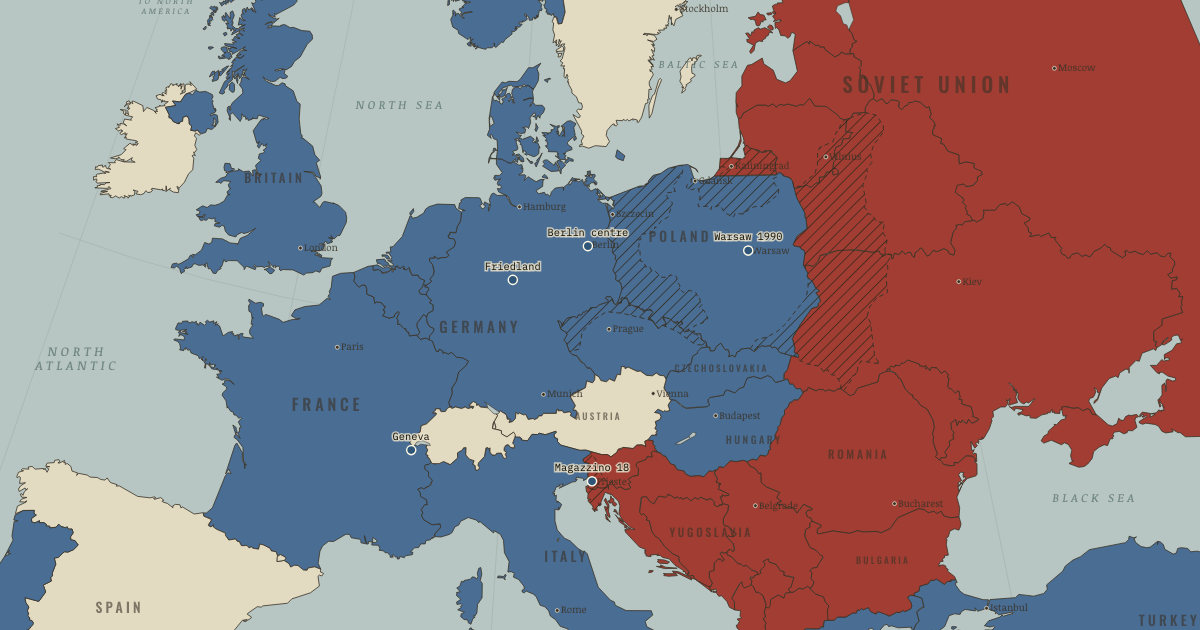
The map above is the world of Refugees in Europe, November 1990 — Germany united; border fixed.
Part of IB History: Refugees in Europe and Indochina →
BRIEF EXPLANATION — THE ESSENTIAL ARGUMENT
The two crises in this atlas answer the inquiry question in different ways, and the difference lies mainly in what drove people out and in who was able to take them in. In Europe after 1945 the victors moved borders and decided that peoples should follow them, so that 12 to 14 million Germans and millions of Poles, Ukrainians, Finns and Italians were moved in the name of a lasting peace. About a million displaced persons, civilians stranded abroad by the war, also refused to return to countries now under communist rule. In Indochina, the former French colonies of Vietnam, Cambodia and Laos, after 1975 new communist regimes treated former enemies, whole social classes and the Hoa, Vietnam’s ethnic Chinese, as obstacles to revolution, and more than three million people left over land and by sea. In both cases the end of a war began the displacement, and the victors’ plans set its scale.
The responses differ because Europe built the international refugee regime while Southeast Asia lived outside it. Most of Europe’s uprooted were absorbed as citizens by their own nation-states, and the rest were resettled by the International Refugee Organization, a UN agency of 1947–52, and protected by the 1951 Convention, the treaty that defines a refugee. In Indochina the states of first asylum, the first safe countries refugees reached, had not signed that Convention, so protection depended on bargains: resettlement in exchange for first asylum at Geneva in 1979, then screening, the individual testing of each claim, and return under the plan of action of 1989. On this final map of November 1990 Germany is united, central Europe has turned blue, and the Oder–Neisse border has just been confirmed as permanent, forty-five years after the Allied conference at Potsdam. Each crisis was closed by fixing a line, a border in Europe and a definition of the refugee in Asia.
The full story
The causes of displacement were alike in mechanism and different in kind. In both regions victorious powers acted on plans for the societies they now controlled, and those plans decided who had to leave. In Europe the plan was territorial and national: Poland was moved west, Germany was cut back, and states removed minorities to make borders and nations match, a project Nazi Germany had begun with its own expulsions and the Allies endorsed at Potsdam, their conference of 1945. In Indochina, Vietnam, Cambodia and Laos, the plan was social and revolutionary: re-education camps, collectivised trade and the emptying of cities targeted classes and political enemies, and the break with China turned the Hoa, Vietnam’s ethnic Chinese, into a suspect minority. Ethnicity ran through both, as the expulsion of Germans and the departures of the Hoa show, and so did the Cold War, the rivalry of the American-led West and the Soviet bloc, which turned people fleeing communism into evidence for the West. The European case moved far more people, and in both the dead of the journey can be counted only as contested ranges.
The responses diverged because of citizenship, law and geography. Germany could absorb its expellees, the Germans driven from the east, because they were Germans arriving in German states, and Finland, Poland and Italy did the same for their own people, so most of Europe’s displacement was solved inside nations. The international system was built for the remainder, the stateless displaced persons, and it grew from relief through UNRRA, the wartime relief agency, to resettlement through its successor the IRO and to rights through UNHCR, the permanent UN refugee agency, and the 1951 Convention, whose definition and ban on forced return still govern refugee law. Indochina’s refugees had no state to absorb them except China, which took more than 250,000 Hoa. They depended on neighbours that had not signed the Convention and on distant countries of resettlement, which took about 2.5 million people by 1995, more than a million to the United States. Europe’s regime therefore became Asia’s instrument, applied through bargains, quotas and finally individual screening, and forced return, dropped in Europe after 1947, came back in Hong Kong in 1989.
Memory has proved as contested as the borders once were. In Germany the expellees’ associations kept their losses in public view, and the effort to commemorate them without diminishing German guilt shaped relations with Poland and the Czech Republic, from the Czech–German Declaration of 1997 to the opening in Berlin in June 2021 of the Documentation Centre for Displacement, Expulsion, Reconciliation. Since 2005 Italy has marked the Istrian exodus on 10 February, and since 2015 Germany has remembered the victims of flight and expulsion on 20 June, World Refugee Day. Vietnamese communities abroad mark 30 April as “Black April”, Canada made it Journey to Freedom Day in 2015, and memorials on Galang and Bidong have been removed and rebuilt in disputes with Hanoi. Each act of memory asks the same question the two crises posed, which is how to honour people driven from their homes without forgetting why the ground under them had shifted.
DEEP EXPLANATION — EVIDENCE & INTERPRETATION
Comparing the causes
Comparative historians place both crises within a twentieth-century pattern in which states tried to make their populations fit a political design. Philipp Ther’s The Dark Side of Nation-States (2014) and Norman Naimark’s Fires of Hatred (2001) treat the expulsions of 1944–48 as the culmination of European ethnic cleansing, in which a modern state with trains, card files and armies could remove whole peoples, and Nazi Germany had shown what was possible before the Allies applied it to Germans. Peter Gatrell’s The Making of the Modern Refugee (2013) sets Indochina beside Europe as a case of revolutionary states expelling people defined by class and ethnicity. The comparison has limits that students should name. Europe’s transfers were agreed by great powers in advance and largely completed within three years, while Indochina’s outflow was never openly declared a policy, and Hanoi insisted that it was only letting people leave. In both cases, though, the people who moved acted as well as suffered: Jewish survivors organised the Bricha, Polish easterners chose Wrocław over Soviet Lviv, Hmong veterans led their villages to the Mekong and Hoa families bought boats. Agency within constraint is the common thread.
Comparing the responses
Gil Loescher’s The UNHCR and World Politics (2001) and W. Courtland Robinson’s Terms of Refuge (1998) together show how an institution built for Europe was reshaped by Asia. In 1951 the Convention looked backward to European events and offered states the option of a European limit, and UNHCR was expected to close within three years. Hungary in 1956 established the method of first asylum backed by rapid resettlement and group recognition, and that method was carried to Southeast Asia in 1979 on a far larger scale. The differences then mattered more than the model. Austria was a small, neutral, European state receiving Europeans whom the West wanted; Malaysia, Thailand and Indonesia were developing states, not party to the Convention, facing arrivals they feared would stay. The United States, absent from the Convention in 1951, became the dominant resettlement country and wrote the Convention’s definition into its own law in 1980. The end point, individual screening and monitored return under the plan of action of 1989, became the template for asylum systems in the 1990s, so that the European crisis supplied the rules and the Indochinese crisis supplied the procedures.
Memory of two exoduses
Remembering displacement has been political in both cases. In Germany the Federation of Expellees long linked commemoration to claims on the lost territories, and its president Erika Steinbach’s proposal around 2000 for a Centre against Expulsions in Berlin provoked fierce criticism in Poland that it would recast Germans as victims. The compromise, a federal foundation established in 2008 whose documentation centre opened in 2021, places the expulsion of Germans within a European and global history of forced migration and sets it in the context of the Nazi war that preceded it. The Czech–German Declaration of 1997 paired German acknowledgement of Nazi crimes with Czech regret for the injustice of the expulsions. Among Vietnamese abroad, memory of the boat journey became a foundation of diaspora identity, while Hanoi long described the boat people as economic migrants or traitors and objected to memorials that called them refugees; plaques on Galang and a memorial on Bidong were removed in 2005 after Vietnamese protests, and a replica was later built on Bidong. Such disputes show that refugees become citizens of other nations, carrying a memory that their country of origin and their new home may read in opposite ways.
Key places on the map
On this day
Why it happened
Victors with plans. In both regions the end of a war handed power to victors with programmes for remaking the land and its people: the Allies’ new map of central Europe in 1945, and the communist parties’ revolutions in Indochina in 1975. Those programmes, more than the destruction of war, decided who had to leave and when. The lesson for Paper 1 is to look at the political aims of victors when explaining displacement after conflict.
Ethnicity as a target. Both crises turned on ethnic categories applied to whole groups. Germans in Poland and Czechoslovakia were expelled as Germans, whatever they had done, and the Hoa of Vietnam were suspected as Chinese after the break with Beijing. Ethnic targeting multiplied the numbers in both places, because it swept up people who had no personal connection to the war or the old regime.
The Cold War frame. The Cold War made people fleeing communism welcome in the West. From 1947 in Europe and throughout the Indochinese crisis, Western states treated them as proof of their own system. That motive helps explain both the Convention’s definition, built around persecution by a state, and the generous resettlement quotas of 1956 and 1979. It also explains why generosity faded once the political value of the refugees declined in the late 1980s.
Who signed the rules. European states wrote the 1951 Convention and bound themselves to it, while the first-asylum states of Southeast Asia, except the Philippines from 1981, never joined. Where states had accepted legal duties, protection could be argued in law; where they had not, it had to be bought with resettlement places and money. The difference explains much of the contrast between Austria in 1956 and Malaysia in 1979.
THE TURNING POINT
Warsaw, 14 November 1990. The German–Polish Border Treaty is the hinge of the epilogue because it formally closed the European story at the moment the Indochinese one was reaching its own settlement. United Germany accepted the Oder–Neisse line as final, ending forty-five years in which expellee politics had kept the border open in law, and the people moved in 1945 became, beyond doubt, citizens of the places where they had settled. In the same years the plan of action was screening the last boat people in Hong Kong and Malaysia. Both crises ended when states agreed where people belonged, and in both the agreement came long after the people had moved.
What it changed
A global refugee regime. The institutions born in Europe’s crisis, UNHCR and the 1951 Convention with its 1967 Protocol, now operate worldwide, and the Indochinese experience gave them their modern tools of large-scale resettlement, orderly departure and individual screening. Both crises are therefore present in every refugee operation since, from the Balkans in the 1990s to Syria and Ukraine in the 2010s and 2020s.
Resettlement and return as competing solutions. Europe after 1947 rejected forced return and relied on integration and resettlement; Indochina after 1989 combined resettlement with monitored return. UNHCR’s three “durable solutions”, return home, integration where refugees first arrive and resettlement in a third country, took shape through both experiences, and choosing among them remains the central decision in every refugee crisis.
Memory and reconciliation. Commemoration of the expulsions has shaped German relations with Poland and the Czech Republic since 1990, and memory of the boat exodus has shaped Vietnamese communities abroad and their relations with Hanoi. In both cases reconciliation has meant naming one’s own losses alongside the wrongs done by one’s own side, a balance that remains difficult.
Echoes at sea. The dilemmas of 1979 returned in the twenty-first century. In May 2015 thousands of Rohingya and Bangladeshi migrants were stranded on boats in the Andaman Sea as Thailand, Malaysia and Indonesia turned them away, until Malaysia and Indonesia agreed to give temporary shelter. The episode repeated the dilemmas of June 1979, first asylum without shared responsibility, and showed that the lessons of the Indochinese crisis had to be learned again.
DISCUSSION QUESTION — Compare and contrast the responses of states and international organisations to displacement in Europe between 1945 and 1960 and in Indochina between 1975 and 1990.
The similarities are real: in both cases first asylum came from a neighbouring or occupying state, resettlement in distant countries removed the pressure, UNHCR coordinated burden-sharing, and Cold War politics shaped who was welcomed. The contrasts, however, run deeper than these shared tools. Europe’s largest displaced group, the German expellees, was absorbed by its own nation-state, so integration did most of the work, while Indochina’s refugees depended on foreign states. Europe built the legal regime and recognised Hungarians as a group in 1956, while Southeast Asia stayed outside the Convention and ended with individual screening and return. Forced return was abandoned in Europe after 1947 and revived in Hong Kong in 1989. A strong conclusion is that the international system grew more legal but less generous between the two cases, because the definition of the refugee became more precise just as states began to use it to say who did not qualify. The broader insight is that protection depends chiefly on whether the receiving states see the refugees as people they want to keep.
An interesting fact
The same UN agency was honoured for both crises in this atlas. UNHCR received the Nobel Peace Prize for 1954, chiefly for its work with Europe’s post-war refugees, and again in 1981, when the Indochinese exodus dominated its work. Only the International Committee of the Red Cross has won the prize more often, three times. Fridtjof Nansen, the League of Nations’ first High Commissioner for Refugees, had won it in 1922, so the prize has followed refugee protection from the aftermath of the First World War to the end of the Cold War.
Related
THE FREE PRINTABLE STUDY GUIDE
Join the Dispatch — a short welcome series, then a letter when a new atlas opens — and the printable study guide for Uprooted is yours now, free.
NO TRACKING · YOUR ADDRESS IS USED FOR THE DISPATCH AND NOTHING ELSE · UNSUBSCRIBE ANYTIME