MAPS OF HISTORY · IB HISTORY · UPROOTED
IB HISTORY · 1945 – 1990 · 12 CHAPTERS
IB History: Refugees in Europe and Indochina — notes, maps and essay plans
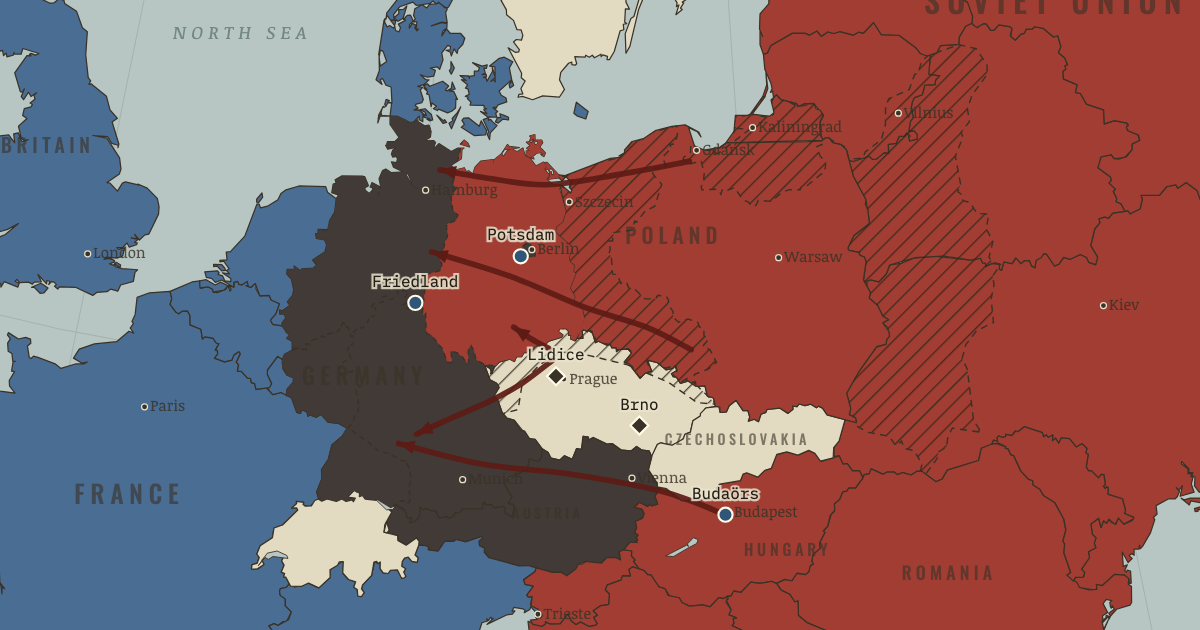
After 1945 Europe’s borders moved and millions were made to follow them; after 1975 three million people fled Vietnam, Cambodia and Laos. Two maps, one question: what drove people out, and who took them in?
This page gathers the atlas’s IB notes: where each of its 12 chapters fits the syllabus, the concepts and evidence it supports, practice questions with model essay plans, primary sources, and starting points for the Internal Assessment.
WW2 is free — every chapter. Try chapters 1–2 of any 2 other atlases (3 with a free account). Opening a new atlas uses one of them. Membership opens all 21 — Join.
Where it fits the course
Every chapter’s IB notes name the parts of the course it serves. Across the atlas they add up to this: It is the paired atlas for the Paper 1 Focused Study Conflict and Displacement, whose page holds a free source-question set.
- Paper 1 · Conflict and Displacement · 12 CHAPTERS
- Paper 2 · Conflict · 12 CHAPTERS
- Paper 3 · Asia and Oceania, section 12.11 · 4 CHAPTERS
- Old course · World history topic 11: Causes and effects of 20th-century wars · 2 CHAPTERS
- Old course · World history topic 12: The Cold War: superpower tensions and rivalries (20th century) · 3 CHAPTERS
Chapter by chapter
The atlas holds 72 points of evidence and 40 primary sources across 12 chapters. Chapters 1 and 2 are free, so their evidence is shown here in full; for the others you get one point and the practice question, and the rest waits in the atlas. Each chapter title opens the chapter’s free page, with the full explanation.
1. Europe Uprooted
CHAPTER 1 · MAY 1945 · CONCEPTS: CAUSATION, CONSEQUENCE
EVIDENCE TO USE · ALL 6 POINTS (A FREE CHAPTER)
- By August 1944 about 7.6 million foreign civilians and prisoners of war worked in the Reich, more than a quarter of its labour force, so Germany’s defeat was bound to strand millions of people far from home at once.
- Nazi Germany expelled about 920,000 Poles from the western Polish lands it annexed in 1939 and settled more than 300,000 ethnic Germans there by 1941, which shows that moving peoples to fit borders began as Nazi policy.
- At Yalta in February 1945 Roosevelt, Churchill and Stalin agreed to move Poland’s eastern border to roughly the Curzon Line and to return each other’s liberated citizens, decisions that turned the end of the war into a second, planned displacement.
- Nearly six million displaced persons were repatriated from the western zones of Germany by the end of September 1945, yet more than a million refused or were unable to go home and became the “last million” of the camps.
- The Allied category of “displaced person” covered citizens of Allied states and excluded Germans, so the millions of German civilians who fled west in early 1945 received no international aid and became the defeated state’s own problem.
- Estimates of Europe’s uprooted in May 1945 range from about seven to eight million DPs on German soil to more than 40 million displaced Europeans, a spread that reflects who did the counting and which categories they used.
2. The Expulsions of Germans
CHAPTER 2 · 1945–1950 · CONCEPTS: CAUSATION, PERSPECTIVES, SIGNIFICANCE
EVIDENCE TO USE · ALL 6 POINTS (A FREE CHAPTER)
- Section XIII of the Potsdam agreement of 2 August 1945 stated that the transfer of Germans from Poland, Czechoslovakia and Hungary “will have to be undertaken”, asking only that it be “orderly and humane”, which gave the expulsions great-power consent.
- On 20 November 1945 the Allied Control Council fixed a plan to move 6.65 million Germans, including 3.5 million from Poland and 2.5 million from Czechoslovakia, turning expulsion into an administrative programme of trains and quotas.
- The “wild expulsions” of May to August 1945 drove some 700,000 to 800,000 Germans out of Czechoslovakia before Potsdam, including about 20,000 residents of Brno marched toward Austria, showing that national authorities acted before the Allies decided.
- Winston Churchill told the House of Commons on 15 December 1944 that expulsion was the most “satisfactory and lasting” method and that “a clean sweep will be made”, evidence that Britain accepted mass transfer long before the war ended.
- The West German census of 1950 counted 7.9 million expellees, 16.5 percent of the population, while East Germany held about 4.3 million, so the expulsions reshaped both German states.
- Estimates of German deaths range from about 500,000 documented cases (Overmans, Haar) to 2.2 million in the 1958 West German calculation, and the Czech–German historians’ commission put deaths in Czechoslovakia at 15,000 to 30,000.
3. Borders Move, People Follow
CHAPTER 3 · 1944–1950 · CONCEPTS: CAUSATION, CONSEQUENCE, CONTINUITY
EVIDENCE TO USE · 1 OF 6
- Under the Lublin agreements of 9 and 22 September 1944 about 1.2 to 1.5 million Poles and Polish Jews moved from the Soviet republics to Poland, and about 482,000 Ukrainians moved the other way, an exchange voluntary on paper and coerced in practice.
Practice question: Compare and contrast the population transfers carried out in Poland and in Finland between 1944 and 1950.
5 more points of evidence, 3 primary sources and the model plan for this question are in the IB notes of chapter 3 in the atlas.
4. The DP Camps
CHAPTER 4 · 1945–1947 · CONCEPTS: CHANGE, PERSPECTIVES, SIGNIFICANCE
EVIDENCE TO USE · 1 OF 6
- The Soviet Union recovered about 5.35 million citizens by early 1946, some by force under the Yalta accords, and at Dachau on 19 January 1946 eleven of 399 former Soviet soldiers killed themselves rather than board a train east.
Practice question: Evaluate the reasons why repatriation failed to resolve the problem of displaced persons in Europe between 1945 and 1947.
5 more points of evidence, 3 primary sources and the model plan for this question are in the IB notes of chapter 4 in the atlas.
5. From Relief to Rights
CHAPTER 5 · 1947–1952 · CONCEPTS: CHANGE, SIGNIFICANCE, PERSPECTIVES
EVIDENCE TO USE · 1 OF 6
- Between July 1947 and December 1951 the International Refugee Organization resettled 1,038,750 people, including 328,851 in the United States, 182,159 in Australia, 132,109 in Israel and 123,479 in Canada, turning relief into resettlement.
Practice question: To what extent was the 1951 Refugee Convention shaped by the Cold War?
5 more points of evidence, 4 primary sources and the model plan for this question are in the IB notes of chapter 5 in the atlas.
6. Integration and the Cold War
CHAPTER 6 · 1950–1961 · CONCEPTS: CHANGE, CONSEQUENCE, CONTINUITY
EVIDENCE TO USE · 1 OF 6
- The Equalisation of Burdens law of 14 August 1952 made West Germans whose property survived the war pay half its 1948 value over thirty years into a fund for expellees, paying out more than 130 billion marks by 1986.
Practice question: Discuss the reasons why the international response to Hungarian refugees in 1956 was so rapid.
5 more points of evidence, 4 primary sources and the model plan for this question are in the IB notes of chapter 6 in the atlas.
7. Communist Victory
CHAPTER 7 · 1975 · CONCEPTS: CAUSATION, CONSEQUENCE
EVIDENCE TO USE · 1 OF 6
- After the Geneva agreements of July 1954 divided Vietnam, more than a million people moved south, about 800,000 of them Catholics, and the US Navy carried nearly 310,000, a precedent for flight after a communist victory.
Practice question: Compare and contrast the causes of displacement in Vietnam, Cambodia and Laos in 1975.
5 more points of evidence, 3 primary sources and the model plan for this question are in the IB notes of chapter 7 in the atlas.
8. Re-education and Flight
CHAPTER 8 · 1975–1978 · CONCEPTS: CAUSATION, PERSPECTIVES
EVIDENCE TO USE · 1 OF 6
- UNHCR wrote that more than a million people passed through Vietnam’s re-education camps, while Gareth Porter and James Roberts argued in 1988 that long-term detainees numbered 200,000 to 300,000, an uncertainty that reflects Hanoi’s secrecy.
Practice question: To what extent was the flight of the Hoa from Vietnam in 1978–1979 the result of government policy?
5 more points of evidence, 2 primary sources and the model plan for this question are in the IB notes of chapter 8 in the atlas.
9. The Boat People
CHAPTER 9 · 1978–1979 · CONCEPTS: CAUSATION, PERSPECTIVES, CONSEQUENCE
EVIDENCE TO USE · 1 OF 6
- Boat arrivals in neighbouring countries rose from about 88,000 in 1978 to about 207,000 in 1979, with between 54,000 and 59,000 landing in single months at the peak of May and June 1979.
Practice question: Evaluate the reasons why first-asylum states in Southeast Asia restricted asylum in 1979.
5 more points of evidence, 3 primary sources and the model plan for this question are in the IB notes of chapter 9 in the atlas.
10. Geneva and the US Response
CHAPTER 10 · 1979–1982 · CONCEPTS: CHANGE, CONSEQUENCE, SIGNIFICANCE
EVIDENCE TO USE · 1 OF 6
- At the Geneva meeting of 20–21 July 1979, 65 governments raised resettlement pledges from about 125,000 to 260,000 places and promised about $160 million, while Indonesia and the Philippines offered sites for processing centres.
Practice question: To what extent did the Geneva meeting of July 1979 resolve the Indochinese refugee crisis?
5 more points of evidence, 4 primary sources and the model plan for this question are in the IB notes of chapter 10 in the atlas.
11. Camps, Screening and the CPA
CHAPTER 11 · 1980–1990 · CONCEPTS: CHANGE, CONTINUITY, PERSPECTIVES
EVIDENCE TO USE · 1 OF 6
- Thailand began “humane deterrence” in January 1981, holding new boat arrivals in austere camps such as Na Pho without access to resettlement, and Hong Kong detained every arrival after 2 July 1982 in closed camps.
Practice question: Examine the reasons for the shift from resettlement to screening and return in Southeast Asia in the 1980s.
5 more points of evidence, 3 primary sources and the model plan for this question are in the IB notes of chapter 11 in the atlas.
12. Two Crises Compared
EPILOGUE · 1945–1990 · CONCEPTS: CHANGE, CONTINUITY, SIGNIFICANCE
EVIDENCE TO USE · 1 OF 6
- Between 12 and 14 million Germans fled or were expelled after 1945 and were absorbed as citizens by the two German states, while more than three million people left Indochina between 1975 and 1995 and about 2.5 million were resettled abroad.
Practice question: Compare and contrast the responses of states and international organisations to displacement in Europe (1945–1960) and Indochina (1975–1990).
5 more points of evidence, 4 primary sources and the model plan for this question are in the IB notes of chapter 12 in the atlas.
Practice questions and essay plans
Every chapter ends with a practice question and a model plan: a thesis, three points with evidence and a link back to the question, a counter-argument and a judgement. The plan for chapter 1 is shown in full; for the others, here is the outline, and the rest is in the atlas.
PAPER 2 · UPROOTED · CHAPTER 1
Examine the reasons why the end of the Second World War in Europe led to mass displacement.
The end of the war produced mass displacement because three forces met in May 1945: the Nazi labour and population policies that had already moved millions, the collapse of the Eastern Front that set Germans fleeing, and Allied decisions at Yalta that made borders and populations movable. The last of these turned a temporary emergency into a lasting policy of moving people.
Nazi policy had already uprooted the largest group of people before the war ended.
EVIDENCEAbout 7.6 million foreign workers and prisoners worked in the Reich in August 1944, and around 920,000 Poles had been expelled from annexed lands.
LINKDefeat freed these people at once, so the DP problem was a direct legacy of Nazi rule. Herbert’s research shows the system was built into the war economy, not improvised at the end.
The military collapse of 1945 created a second, German exodus that the Allies did not count as refugees.
EVIDENCEMillions fled East Prussia and Silesia from January 1945, often too late because officials such as Erich Koch had banned evacuation.
LINKFlight emptied districts before any border decision and set up the expulsions that followed. The distinction between flight and expulsion matters for any count of German losses.
Allied wartime agreements ensured that peace would move even more people.
EVIDENCEThe Yalta accords of February 1945 moved Poland’s border to the Curzon Line and bound Britain and the United States to repatriate Soviet citizens.
LINKDisplacement after May 1945 therefore became deliberate policy, which explains its scale. Repatriation and border change were political choices made before the guns fell silent.
One could argue that the war alone caused the crisis, since every category of displaced person in May 1945, from forced labourers to fleeing Germans, had been created by the fighting and by Nazi occupation before any peace terms were applied. Germans who fled in January 1945 had no decision of the Allies behind them at all.
The war created the emergency, but the peace decided its scale and duration. Nearly six million DPs went home within months, while border changes and transfers agreed by the victors uprooted far larger numbers for years, so Allied decisions were the decisive reason why displacement outlasted the fighting.
Read the chapter behind this plan: Europe Uprooted.
PAPER 2 · UPROOTED · CHAPTER 3
Compare and contrast the population transfers carried out in Poland and in Finland between 1944 and 1950.
Both transfers followed the same cause, the Soviet Union’s annexation of eastern borderlands in 1944–45, and both aimed at ethnically uniform states. They differed sharply in method and outcome: Finland resettled its own citizens by democratic choice and law, while Poland’s communist state combined exchanges, expulsions and internal deportation by force.
The causes were similar: Soviet territorial gains forced both states to absorb people from lost lands.
The methods differed: Finland relied on choice and compensation, Poland on coercion.
The outcomes differed in who paid the cost.
The evidence for each point, the counter-argument and the judgement are in the IB notes of chapter 3 in the atlas. Read the chapter first: Borders Move, People Follow.
PAPER 3 · UPROOTED · CHAPTER 10
To what extent did the Geneva meeting of July 1979 resolve the Indochinese refugee crisis?
The Geneva meeting resolved the immediate crisis of closed shores by restoring the bargain of first asylum for resettlement, but it did not resolve the underlying causes of flight or the Cambodian emergency, and its success depended on Vietnam restricting departures and on Western generosity that later faded.
Geneva reopened the shores by expanding resettlement.
Much of the fall in arrivals came from controls inside Vietnam.
Geneva left the Cambodian emergency and long-term questions unresolved.
The evidence for each point, the counter-argument and the judgement are in the IB notes of chapter 10 in the atlas. Read the chapter first: Geneva and the US Response.
PAPER 2 · UPROOTED · CHAPTER 4
Evaluate the reasons why repatriation failed to resolve the problem of displaced persons in Europe between 1945 and 1947.
Repatriation succeeded for most DPs but failed for the people who mattered most to the post-war order, because border changes put their homes under Soviet rule, because the Holocaust and post-war antisemitism left Jews nowhere to return, and because forced return proved morally and politically unsustainable in the West.
Soviet annexations made return unacceptable for many eastern Europeans.
Jewish survivors had no home to return to.
Forced repatriation discredited itself.
The evidence for each point, the counter-argument and the judgement are in the IB notes of chapter 4 in the atlas. Read the chapter first: The DP Camps.
Primary sources
Each chapter’s IB notes carry primary sources with their origin and the context you need before reading them. The sources of chapter 1 are shown in full here.
TEXT · CHAPTER 1
Agreement relating to prisoners of war and civilians liberated by forces operating under Soviet command and forces operating under United States command
- CREATOR
- Maj. Gen. John R. Deane (United States) and Lt. Gen. A. A. Gryzlov (Soviet Union)
- DATE
- 11 February 1945
- ORIGIN
- Bilateral agreement signed at the Crimea (Yalta) Conference; text from C. Bevans, Treaties and Other International Agreements of the United States of America 1776–1949, vol. 3 (US Government Printing Office, 1969)
Context. This agreement, with a parallel British–Soviet one signed the same day, governed how liberated Soviet citizens in western Europe were handed back to Soviet authorities after the war.
US government publication; via the Avalon Project, Yale Law School · original ↗
TEXT · CHAPTER 1
Report of Earl G. Harrison on displaced persons in Germany and Austria (extract on camp conditions)
- CREATOR
- Earl G. Harrison, US representative on the Intergovernmental Committee on Refugees
- DATE
- August 1945
- ORIGIN
- Typescript report to President Truman, Official File 127, Truman papers; US National Archives (NAID 169048805), p. 12
Context. President Truman sent Harrison, dean of the University of Pennsylvania law school, to inspect displaced persons’ camps in Germany and Austria in July 1945, with particular attention to Jewish survivors.
US National Archives; Harry S. Truman Library · original ↗
PICTURE · CHAPTER 1
Displaced persons at the camp at Wittlich, Germany
- CREATOR
- US Army photographer
- DATE
- 18 April 1945
- ORIGIN
- Photograph published in History of the Fifteenth United States Army (1946), p. 118
Context. The original caption states that 48 people shared this room. Wittlich, in the Rhineland, was one of hundreds of assembly centres the Allied armies opened for liberated forced labourers in the spring of 1945.
Picture: Displaced persons crowded into a barracks room full of iron beds at the Wittlich camp in Germany, April 1945.
US Army photograph, public domain, via Wikimedia Commons · original ↗
Every other source in the atlas (37)
- Chapter 2: The Expulsions of Germans
- Speech in the House of Commons on Poland (extract on expulsion) Winston Churchill, Prime Minister of the United Kingdom · 15 December 1944
- Protocol of the Proceedings of the Berlin (Potsdam) Conference, Section XIII: Orderly Transfer of German Populations Governments of the United States, the United Kingdom and the Soviet Union (Truman, Attlee, Stalin) · 1 August 1945
- Allied Control Council plan for the transfer of the German population Allied Control Council for Germany; transmitted by Robert Murphy, US Political Adviser for Germany · 20 November 1945 (telegram of 30 November 1945)
- “Umsiedler” (expellees) at the Berlin-Pankow freight station Otto Donath · 1946
- Chapter 3: Borders Move, People Follow
- Protocol of Proceedings of the Crimea Conference, Section VII: Poland (extract) Franklin D. Roosevelt, Winston Churchill and Joseph Stalin · 11 February 1945
- Speech in the House of Commons on Poland (extract on the transfer of populations) Winston Churchill, Prime Minister of the United Kingdom · 15 December 1944
- Report on the Tripartite Conference of Berlin (Potsdam communiqué): Western frontier of Poland Governments of the United States, the United Kingdom and the Soviet Union · 2 August 1945
- Chapter 4: The DP Camps
- Report of Earl G. Harrison (extract: recommendation on separate camps) Earl G. Harrison, US representative on the Intergovernmental Committee on Refugees · August 1945
- Report of Earl G. Harrison (extract: conclusion on Palestine) Earl G. Harrison · August 1945
- Letter to General Eisenhower concerning conditions facing displaced persons in Germany Harry S. Truman, President of the United States · 31 August 1945 (released 29 September 1945)
- Chapter 5: From Relief to Rights
- Statement by the President upon signing the Displaced Persons Act Harry S. Truman, President of the United States · 25 June 1948
- Statute of the Office of the United Nations High Commissioner for Refugees, paragraphs 1–2 United Nations General Assembly · 14 December 1950
- Convention relating to the Status of Refugees, Article 1A(2) United Nations Conference of Plenipotentiaries on the Status of Refugees and Stateless Persons · 28 July 1951
- Convention relating to the Status of Refugees, Article 33: Prohibition of expulsion or return (“refoulement”) United Nations Conference of Plenipotentiaries · 28 July 1951
- Chapter 6: Integration and the Cold War
- Statement by the President concerning the admission of refugees from Hungary Dwight D. Eisenhower, President of the United States · 8 November 1956
- White House statement concerning the admission of additional Hungarian refugees The White House · 1 December 1956
- General Assembly resolution 1285 (XIII): World Refugee Year United Nations General Assembly · 5 December 1958
- Arrival of the third group of Hungarian refugees Wim van Rossem / Anefo · 25 November 1956
- Chapter 7: Communist Victory
- Memorandum for the record: Vietnam evacuation (President Ford and Secretary Kissinger with the bipartisan congressional leadership) White House / National Security Council record · 29 April 1975
- Remarks upon establishing the President’s Advisory Committee on Refugees (extract on the evacuees) Gerald R. Ford, President of the United States · 19 May 1975
- Boatloads of Vietnamese refugees approach the US fleet PH3 Harold Brown, US Navy · 30 April 1975
- Chapter 8: Re-education and Flight
- Memorandum on Indochina refugees (extract on the causes of the outflow) Dick Clark, US Coordinator for Refugee Affairs, to Vice President Walter Mondale · 18 June 1979
- Statement by Press Secretary Fitzwater on the Vietnam–United States Special Resettlement Program Marlin Fitzwater, White House Press Secretary · 13 January 1990
- Chapter 9: The Boat People
- Memorandum on Indochina refugees (extract on the first-asylum countries) Dick Clark, US Coordinator for Refugee Affairs, to Vice President Walter Mondale · 18 June 1979
- Tokyo Economic Summit: remarks to reporters at the conclusion of the conference (extract) Jimmy Carter, President of the United States · 29 June 1979
- 35 Vietnamese boat people awaiting rescue Lt. Carl R. Begy, US Navy · 15 May 1984
- Chapter 10: Geneva and the US Response
- Meeting on Refugees and Displaced Persons in South-East Asia: report of the Secretary-General (extract) Kurt Waldheim, Secretary-General of the United Nations · 7 November 1979
- The Indochina Refugee Situation: An Update (extract) Central Intelligence Agency, National Foreign Assessment Center · November 1979
- Refugee Act of 1980, section 201(a): definition of “refugee” 96th Congress of the United States · 17 March 1980
- Khao-I-Dang Holding Center gate Cameron Macauley · May 1984
- Chapter 11: Camps, Screening and the CPA
- Declaration and Comprehensive Plan of Action (extract on refugee status and return) International Conference on Indo-Chinese Refugees · Approved in draft 8 March 1989; adopted at Geneva 14 June 1989
- Amerasian Homecoming Act (section 584 of the Foreign Operations Appropriations Act, 1988), extract 100th Congress of the United States · 22 December 1987
- Philippine Refugee Processing Center, Morong, Bataan Project Ngoc (UC Irvine Libraries, Special Collections) · 1990
- Chapter 12: Two Crises Compared
- Convention relating to the Status of Refugees, Article 1B(1): the geographical option United Nations Conference of Plenipotentiaries · 28 July 1951
- Refugee Act of 1980: statement on signing S. 643 into law Jimmy Carter, President of the United States · 18 March 1980 (the Act was approved on 17 March)
- Remarks upon establishing the President’s Advisory Committee on Refugees (extract on immigration) Gerald R. Ford, President of the United States · 19 May 1975
- Aerial view of the Orote Point refugee camp, Guam US Navy · c. 1975
Internal Assessment starting points
Each starting point is an idea for an investigation: a question, the concept it tests, the kinds of sources you could use and where they are held, and one caution. The investigation must be your own work, and your teacher approves the question.
How far did the Harrison Report of August 1945 change the treatment of Jewish displaced persons in the American zone of Germany by the end of 1946?
CONCEPTChange
SOURCESThe Harrison Report and Truman’s letter to Eisenhower; US Army directives on Jewish camps; camp newspapers; survivor testimony; UNRRA reports.
WHERE TO FIND THEMUS National Archives (Record Group 59 and 260, many items online); Truman Library; United States Holocaust Memorial Museum collections; Arolsen Archives online collections.
CAUTIONArmy and UNRRA reports often describe conditions to justify their own decisions, so compare them with what residents wrote in their own camp newspapers.
To what extent did West German school history textbooks between 1950 and 1990 present the expulsion of Germans without reference to Nazi occupation policy?
CONCEPTPerspectives
SOURCESHistory textbooks of different decades and states; curriculum guidelines; expellee association publications; newspaper debates about textbooks.
WHERE TO FIND THEMLeibniz Institute for Educational Media / Georg Eckert Institute, Braunschweig (textbook library and online catalogue); Federal Archives (Bundesarchiv).
CAUTIONTextbooks were approved separately by each West German state, so choose a defined sample and say why it is representative.
How successfully were Hungarian refugees of 1956 received in one city or region of a resettlement country (for example a British, Canadian or Australian city) in 1956–1958?
CONCEPTConsequence
SOURCESLocal newspapers; government files on reception camps; church and charity records; oral history interviews with refugees or their families.
WHERE TO FIND THEMThe National Archives (UK) Home Office files; Library and Archives Canada; National Archives of Australia; local record offices; UNHCR Archives, Geneva (by request).
CAUTIONReception stories in newspapers often celebrate generosity; look for evidence of difficulties, such as unemployment or return to Hungary, as well.
To what extent did press and television coverage of the boat people shape the outcome of the Geneva meeting of July 1979?
CONCEPTCausation
SOURCESNewspaper reports from June–July 1979 in at least two countries; government statements; Foreign Relations of the United States documents on the meeting.
WHERE TO FIND THEMOnline newspaper archives (for example The Times, The New York Times, Le Monde through library access); Office of the Historian (FRUS 1977–1980, vol. XXII); American Presidency Project.
CAUTIONCorrelation is not causation: coverage and policy rose together, so look for evidence that decision-makers responded to the media.
What can the oral testimony of Vietnamese refugees reveal about the reasons for leaving Vietnam in 1978–1979 that official sources do not?
CONCEPTPerspectives
SOURCESRecorded oral histories of former boat people; memoirs; official statements by Vietnam and receiving states for comparison.
WHERE TO FIND THEMVietnamese American Oral History Project, University of California, Irvine (Southeast Asian Archive); The Vietnam Center and Archive, Texas Tech University; national oral history collections in Australia and Canada.
CAUTIONIf you interview anyone yourself, follow your school’s ethics guidance on consent; memories decades later are shaped by what happened afterwards.
Why did Canada’s private sponsorship of Indochinese refugees in 1979–1980 exceed the government’s expectations?
CONCEPTCausation
SOURCESGovernment announcements and statistics; records of sponsoring churches and community groups; newspaper coverage; later reports such as those marking the programme’s anniversaries.
WHERE TO FIND THEMLibrary and Archives Canada; Canadian Council for Refugees (published histories); church and diocesan archives; local newspaper archives.
CAUTIONAnniversary publications tend to celebrate the programme; balance them with contemporary evidence of disagreements and difficulties.
How fair was the screening of Vietnamese asylum seekers in Hong Kong under the Comprehensive Plan of Action, 1989–1996?
CONCEPTSignificance
SOURCESReports by human rights organisations; UNHCR statements and statistics; Hong Kong government records and Legislative Council debates; court cases on detention.
WHERE TO FIND THEMHong Kong Public Records Office; Legislative Council records (online); Human Rights Watch and Amnesty International report archives; UNHCR publications.
CAUTIONAdvocacy reports and government records argue opposite cases, so compare their evidence on the same procedures before judging fairness.
Revision tools
The atlas ends with a map quiz that asks you to find places and moments on the map itself (part of membership and of the Exam Sprint). The quick quiz and the discussion questions with our answers are free pages on this site, and the printable study guide gathers every chapter’s notes into one document for revision.
Read next
- The Second World War, 1936–1945 · WW2
- The Cold War, 1945–1991 · THE COLD WAR
Maps of History is independent and is not affiliated with or endorsed by the International Baccalaureate Organization. IB course names describe alignment only; paper, theme and section names follow the new course outline and may change when the final guide is published.
THE DISPATCH
A short welcome series, then a letter when a new atlas opens — and the printable study guide for Uprooted is yours now, free.
NO TRACKING · YOUR ADDRESS IS USED FOR THE DISPATCH AND NOTHING ELSE · UNSUBSCRIBE ANYTIME